The Independent Uganda: You get the Truth we Pay the Price



Uganda’s Shs84.4tn budget, the largest in the country’s history, allocates substantial funding to security, transport infrastructure, healthcare, education and agro-industrialisation
Kampala, Uganda | JULIUS BUSINGE | Uganda’s economic prospects will depend less on policy announcements and more on execution, economists and business leaders have warned, as the country embarks on implementing its record Shs84.4tn budget and prepares for the start of commercial oil production.
Speaking at the Foreign Chambers Policy Summit in Kampala on June 18, stakeholders said Uganda had entered a pivotal phase marked by large-scale infrastructure investment, preparations for the 2027 Africa Cup of Nations, expanding regional trade opportunities and the anticipated launch of oil production.
While growth prospects remain strong, participants cautioned that implementation gaps, governance weaknesses and accountability challenges could prevent the country from fully capturing the benefits of these opportunities.
“The focus must now shift from planning to implementation. Timely execution of government programmes and private sector investments will determine whether expected economic benefits are realised,” said Andrew Kintu, manager transaction advisory services at Grant Thornton Uganda.
Uganda’s Shs84.4tn budget, the largest in the country’s history, allocates substantial funding to security, transport infrastructure, healthcare, education and agro-industrialisation, sectors viewed as critical to sustaining economic growth and improving competitiveness.
The economy is forecast to expand by between 7 and 8 per cent over the medium term, supported by public investment, private sector activity and expected revenues from the petroleum sector.
Tough economic environment
Kintu said businesses should prepare for a tougher operating environment characterised by stricter tax enforcement and increased pressure on efficiency. He urged companies to strengthen investment readiness and manage costs carefully to remain competitive.
Much of the summit’s discussion centred on the opportunities and risks associated with Uganda’s emerging oil industry, which is expected to begin commercial production in 2026 following progress on the Tilenga, Kingfisher and East African Crude Oil Pipeline projects.
Uganda’s petroleum reserves are estimated at 6.5bn barrels, of which around 1.4bn barrels are commercially recoverable. At peak production, output is expected to reach about 230,000 barrels per day, with Tilenga contributing roughly 190,000 barrels and Kingfisher about 40,000 barrels.
Government projections suggest the sector could generate more than Shs2tn annually in its early years, providing additional fiscal resources for infrastructure development and public services.
Isaac Shinyekwa, head of trade and regional integration at the Economic Policy Research Centre, said Uganda must strengthen local participation in the sector to maximise its economic impact.
He called for greater investment in skills development, stronger local content policies and reforms aimed at improving governance and transparency.
According to Shinyekwa, the benefits of oil production will depend on effective public investment, stronger tax compliance and measures to curb corruption and improve accountability.
The summit, supported by dfcu Bank and other partners, also highlighted the role of financial institutions in supporting Uganda’s economic transformation.
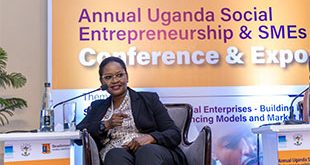
Kate K. Kiiza, executive director and chief corporate and institutional banking officer at dfcu Bank, said translating policy ambitions into measurable outcomes would require sustained collaboration between government, investors, financiers and development partners.
“Uganda’s aspirations will only be achieved when discussions move beyond policy formulation into deliberate implementation. Economic transformation requires collective effort, accountability and sustained commitment from all stakeholders,” Kiiza said.
She noted that dfcu, founded in 1964 as the Development Finance Company of Uganda, has long supported enterprise growth through financing, investment support and business development services.
The bank continues to provide funding across sectors including agriculture, manufacturing, trade, infrastructure and energy, helping businesses expand and create jobs.
Agriculture remains backbone
Despite growing attention on oil and gas, Kiiza stressed that agriculture remains the backbone of Uganda’s economy, accounting for about a quarter of gross domestic product, employing nearly two-thirds of the workforce and generating significant export earnings.
She said dfcu Foundation was helping smallholder farmers transition from informal savings arrangements into structured financial groups, improving access to finance and supporting the commercialisation of agriculture.
Expanding financial inclusion, particularly for women-led enterprises, remains essential to achieving broad-based and sustainable growth, she added.
Participants also identified widening the tax base, formalising informal businesses, promoting tourism, strengthening industrial value addition and expanding public-private partnerships as priorities for sustaining economic momentum.
The discussions underscored a broad consensus that Uganda’s opportunities are significant, but that delivery will ultimately determine whether growth translates into lasting economic transformation.
“Transformation is not the responsibility of one institution or sector. It requires all stakeholders working together with a shared commitment to delivery, accountability and results,” Kiiza said.