The Independent Uganda: You get the Truth we Pay the Price


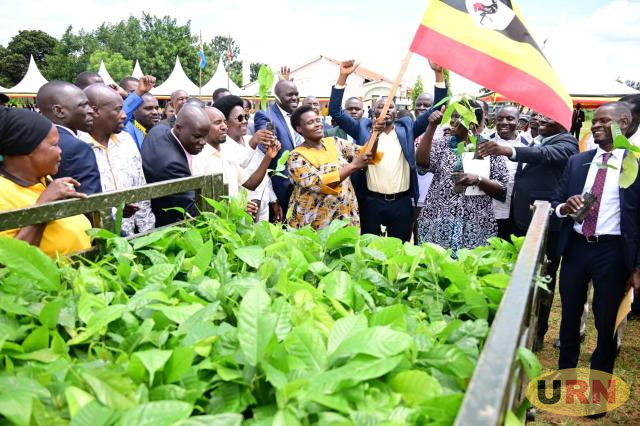
Tororo, Uganda | URN | The government has launched a major campaign to increase coffee and cocoa production in the Bukedi sub-region as part of efforts to fight poverty and expand household incomes. The initiative, code-named the National Kibaalo Concepts Awareness Campaign, was launched at the weekend by Vice President Jessica Alupo together with leaders from the Bukedi sub-region.
The campaign seeks to raise and distribute more than 80 million coffee and cocoa seedlings to farmers across the region through multiplication and distribution centres. Speaking during the launch, Alupo praised the initiative and called on the Ministry of Agriculture to strengthen extension and support services for farmers from planting to harvesting.
She said the introduction of high-value cash crops into the region would help transform livelihoods, stimulate industrial growth, create jobs, and increase household incomes. The campaign follows scientific findings by the Ministry of Agriculture indicating that soils in the Bukedi region are highly suitable for coffee growing.
Alupo noted that African societies were historically productive long before colonialism, citing early European explorers’ accounts of the wealth and abundance they found in the Great Lakes region. She said communities had thriving systems based on bananas, livestock, fishing, and other agricultural activities, although much of the economy was still operating under barter trade, locally known as Okuchurika.
“By 1962, when the British withdrew, they had built a small island of money economy surrounded by a sea of underdevelopment (okukolera ekidda kyoonka – laboring just for the stomach),” Alupo said. “In universities in the 1960s, those colonial and neocolonial economies were described as ‘enclave economies’ — little islands of money economy surrounded by a sea of pre-money traditional economic activities,” she explained.
The Vice President further noted that Uganda’s economy at the time was built around the “three Cs and three Ts.” The three Cs were coffee, cotton, and copper, while the three Ts were tea, tobacco, and tourism. She said by 1969, only about four per cent of homesteads were participating in the money economy before much of the progress was disrupted following the 1971 military takeover by Idi Amin.
According to Alupo, the National Resistance Movement government, since 1986, has implemented several phases of economic transformation, including economic recovery, expansion of traditional export sectors, diversification into new agricultural products, and development of a knowledge-based economy driven by science and innovation. She said these efforts were supported by investments in infrastructure such as roads, electricity, and information and communication technology.
As a result, she said Uganda’s economy has grown from about 1.5 billion US dollars in 1986 to approximately 61 billion dollars today, although much of it still depends on raw material exports. “This is why you hear me insisting that this economy will jump to USD 500 billion by simply adding value to most of our raw materials – agricultural, minerals, forest products, our freshwater products,” Alupo said.To support the campaign, leaders in the Bukedi region have also launched the annual Bukedi Coffee Run aimed at raising funds for the multiplication and distribution of seedlings to farmers.
Tororo County North MP-elect Nicholas Owino described the initiative as a major economic turning point for the Bukedi region.
Bukedi Leaders Forum Coordinator Jona Oboth said the annual coffee run will continue for the next ten years to ensure sustained support for farmers and seedling production. “The run will be organized annually for the next ten years as we target raising all these seedlings and even more for our farmers,” Oboth said.Coffee currently contributes about 20 percent of Uganda’s export earnings, and leaders in Bukedi believe the region has the potential to become a major agricultural production hub with increased farmer participation and government support.