 The Independent Uganda: You get the Truth we Pay the Price


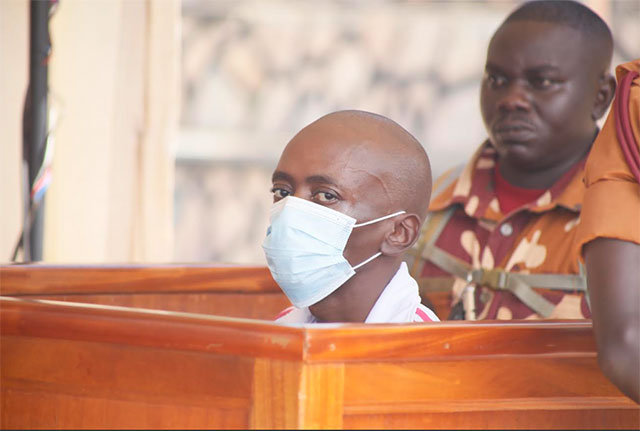
Inside a landmark case that tested Uganda’s mobile courts, judicial independence, and the legal threshold for the ultimate sentence
COVER STORY | RONALD MUSOKE | On the morning of April 2, 2026, what began as an ordinary school day at a modest childcare centre on the southeastern outskirts of Kampala ended in a manner that would leave a permanent scar on the nation’s conscience. By midday, four toddlers lay dead, their lives cut short inside a place their parents had trusted to keep them safe.
The children; Eteku Gideon, aged two and a half; Keisha Agenrwoth Otim, two; Sseruyange Ignatius, two and a half; and Odeke Ryan, one and a half, had been left at Ggaba Early Childhood Development Centre like on any other day. Within hours, their families would be summoned back not to collect them, but to confront a reality no parent expected.
Police who responded to a distress call at around 11:00 a.m. found chaos at the scene. The suspect, later identified as Christopher Okello Onyum, a 39-year-old Ugandan-American, had gained access to the centre by posing as a parent seeking to enrol a child. He was arrested on site while attempting to flee, intercepted by a private security guard and local residents before police took him into custody.
Holy Thursday murder
The brutality of the killings, and the vulnerability of the victims, sent shockwaves across Uganda over the Easter weekend. Yet even as the country struggled to comprehend what had happened, another process began to unfold, one that would draw equal scrutiny: how justice would be administered in a case that had already gripped the public imagination.
On April 6, President Yoweri Museveni publicly directed that the trial be fast-tracked and conducted within the very community where the crime had occurred. The instruction, relayed by Principal Judge, Jane Frances Abodo, signalled an unusual level of executive interest in the handling of a criminal case.
“His Excellency says this case must be handled,” Justice Abodo told mourners at the funeral service of retired Supreme Court Justice, Augustine Nshimye, in Kampala. “Take the court to where the incident happened and handle the case there. And handle it fast.”
On the same day, Museveni extended financial support of Shs 10 million to each of the four bereaved families. The contribution, delivered through State Minister for Youth and Children’s Affairs, Balaam Barugahara, during a sombre Easter Monday service in Ggaba, was received as both a gesture of solidarity and a reflection of the national weight the tragedy had assumed.
The directive on the trial came at a time when the Judiciary had only recently introduced The Constitution (Operation of Mobile Courts) (Practice) Directions, 2026, a framework issued under Article 133(1)(b) of the Constitution by newly appointed Chief Justice, Flavian Zeija. The system was designed to expand access to justice by allowing court proceedings to be conducted outside traditional courtrooms.
Mobile Court in Ggaba draws criticism
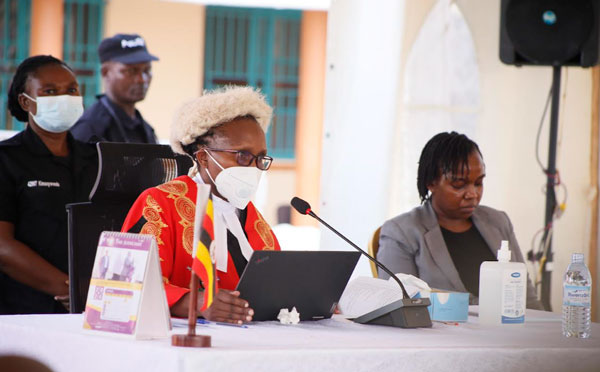
In Ggaba, however, the mobile court would be deployed not because of remoteness, but because of urgency, symbolism, and public demand. By April 7, proceedings had begun at Ggaba Community Church grounds, within sight of the community still grappling with the aftermath of the killings. The case, Uganda v Christopher Okello Onyum, was first presented before Chief Magistrate Aida Nanjala of Makindye Magistrates Court, who formally read out the four counts of murder before committing the accused to the High Court for trial.
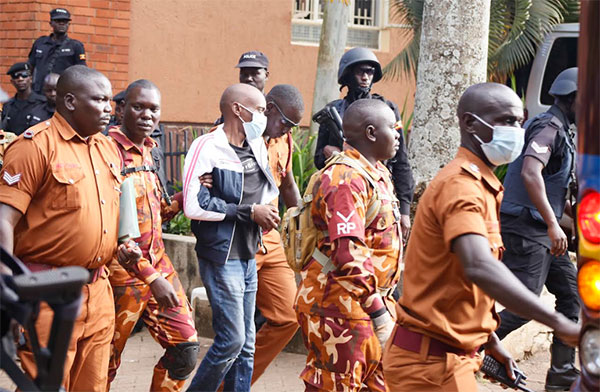
From there, the matter proceeded before Justice Alice Komuhangi Khaukha, who would preside over one of the most closely followed trials in recent years. But the decision to hold the proceedings in a community setting immediately drew controversy. The Uganda Law Society almost immediately filed a legal challenge seeking to halt the trial and relocate it to the High Court’s Criminal Division in Kampala. In its application, the Law Society warned that the setting itself risked undermining the integrity of the process.
“The deliberate relocation of the trial to the churchyard where the four toddlers were mourned renders the trial court structurally incapable of independence or impartiality,” the lawyers argued. The law society pointed to what they described as a troubling sequence of events.
“The unbroken chronological chain of presidential and ministerial directives followed by immediate judicial compliance constitute prohibited interference with judicial power,” the application stated.
Despite these objections, the trial proceeded, drawing large crowds and sustained public attention. Inside the makeshift courtroom, the prosecution, led by Chief State Attorneys Jonathan Muwaganya and Anna Kiiza, laid out a case built on premeditation. Evidence presented to court showed that Okello had rented a vehicle (Rav4) on March 31, conducted reconnaissance of the daycare centre on April 1, and returned the following day, gaining entry after paying Shs 195,000 via Mobile Money for his imaginative child. Moments later, the attack began.
Police testified that upon arrest, Okello attempted to dispose of a bloodstained knife, while two additional knives fell from his pockets. Medical evidence confirmed that the children died of hypovolemic shock (loss of so much blood) resulting from severe neck injuries.
The prosecution also relied on statements attributed to Okello, including a confession in which he reportedly explained that he believed in acquiring wealth through human sacrifice. The Director of Public Prosecutions summarized the findings, stating that his “thought process was found to be normal,” though he held beliefs tied to ritual enrichment.
It was this conclusion; that the accused was mentally sound, that would sit uneasily alongside his conduct both inside and outside the courtroom. On the final day of the trial, the defence, led by Sarah Awero, urged the court to consider mitigating factors, describing Okello as a first-time offender from a “broken, dysfunctional family” who suffered from Sickle Cell disease and could still be rehabilitated.
Is Okello mentally sick?
But medical evidence appeared, at least on the surface, to support the prosecution’s position. A psychiatric report dated December 30, 2025, had found him mentally fit. A police examination conducted on April 7, 2026, described him as calm, cooperative, and in possession of intact memory and sound judgment.
Dr. Emmanuel Nuwamanya, a Police Surgeon with about 25 years of medical practice, who conducted the examination, testified that Okello’s speech was coherent and his thought processes normal, even as he acknowledged the accused’s account of past episodes involving hallucinations. Yet, for those who followed the trial closely, a more complicated picture emerged. Throughout the proceedings, Okello’s demeanour in court often drew attention. At moments that demanded gravity, he was at times seen smiling or displaying expressions that observers found inappropriate given the seriousness of the charges against him. These reactions, occurring in full view of a watching public, provoked murmurs, discomfort, and at times open disapproval.
In several instances, members of the audience responded audibly, booing or expressing frustration at what they perceived as a lack of appropriate emotional response. In a trial already defined by intense public engagement, such moments reinforced the perception gap between clinical assessments of mental fitness and lay expectations of human behaviour.
The law, however, is not guided by perception alone. The question before the court was not whether the accused behaved in ways that appeared unusual, but whether he met the legal threshold for criminal responsibility. When given the opportunity to respond to the charges, Okello denied intentionality. “I am not guilty of the four counts because I was not intentional,” he told the court on April 24. “I did not intentionally cause the death of the four children.”
He challenged the validity of his confession, alleging coercion, and argued that the prosecution had failed to establish deliberate intent. Yet when invited to speak at sentencing, he declined. “I have nothing to say,” he told the court.
Okello receives death sentence
In delivering her judgment on April 30, 2026, Justice Alice Komuhangi Khaukha grounded her reasoning firmly within Uganda’s sentencing framework. She noted that while the starting point for murder is 35 years’ imprisonment, the law permits escalation to the death penalty in exceptional cases.
“The court may only pass a sentence of death in exceptional circumstances in the ‘rarest of the rare’ cases where the alternative… is demonstrably inadequate,” she said. She then turned to the facts before her. “I have considered the fact that the convict meticulously, with a lot of sophistication, planned and premeditated this offence,” she said.
“I have considered the fact that the convict attacked defenceless innocent children who depend on adults for their protection and survival.” “He targeted them in their defenceless state and went ahead to slaughter them as animals.” She noted the brazenness of the act. “He attacked during broad daylight and he had no fear, no shame and no consideration for human life.”
On the question of remorse, she was unequivocal. “The convict has not shown any remorse at all because I would have at least expected an apology,” she said. She reflected on the impact of the crime on the victims’ families. “They dropped their babies to school only to find dead bodies. That pain only God will help them to heal,” she added.
Addressing the defence’s arguments, she stated: “I do not believe that (a dysfunctional background) should be reason to find other people’s children and then slaughter them mercilessly.” She further expressed the view that the killings were linked to ritual motives. “I am inclined to believe that this was for ritual purposes… blood sacrifice for young children,” she said.
Having weighed these considerations, she concluded that the case met the threshold for the most severe penalty. “I agree with the prosecution that this case… falls in the rarest of the rare,” she said.
“In light of the above, I have found no reason why I should not sentence Mr Okello with the maximum sentence.” She then pronounced the sentence: “I hereby sentence him to suffer death… in a manner authorized by law.”
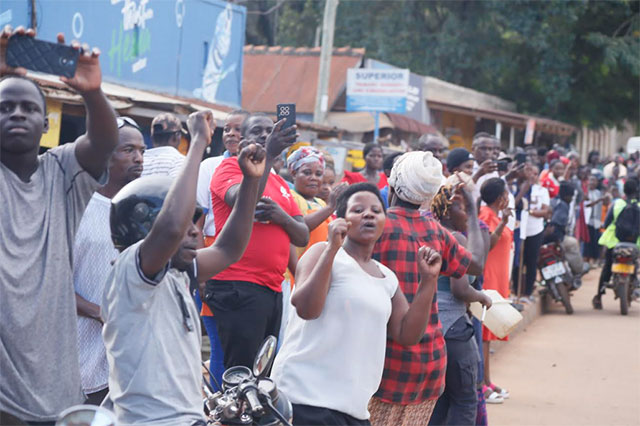
As her words settled over the gathering, the reaction was immediate. Ululations and cheers rose from the crowd, reflecting a release of emotion built over weeks of public attention and grief.
The judge concluded by informing the accused of his right to appeal within 14 days. The Ggaba trial leaves behind more than a record of conviction and sentence. It raises enduring questions about the administration of justice under intense public scrutiny, the boundaries between executive influence and judicial independence, and the complex relationship between legal standards and public perception.
It also leaves a quieter, more difficult question, one that lingers beyond the courtroom: whether the frameworks used to assess responsibility can fully account for the contradictions observed in human behaviour. In the end, the law reached its conclusion. But the questions it encountered along the way remain part of the story. And it is in those questions, as much as in the verdict itself, that the legacy of this case will endure.

I THINK onyum is exceptional to have been sent by someone to do such to young toddlars