 The Independent Uganda: You get the Truth we Pay the Price


How youth in a small town in Uganda answered Gen Muhoozi’s call and its implications for our country
THE LAST WORD | ANDREW M. MWENDA | On April 26th, I met a team of PLU activists from Hima, an industrial town in Kasese District. They rented a minibus at their own cost and came to Kampala to participate in the MK Run in Kololo. I was inspired by this act of selflessness and held a meeting with them after the event. They told me that they had taken the call by Gen Muhoozi Kainerugaba to do community work. So, every last Saturday of every month, they engage in community work.
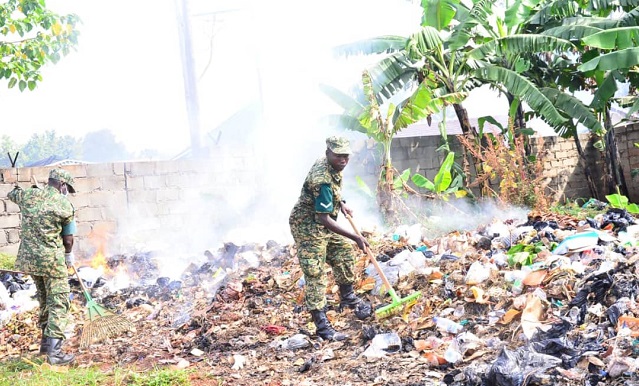
For instance, an old man in their neighbourhood had rains and winds sweep away his house. They mobilised themselves and rebuilt the house for him. Two other elderly ladies had suffered a similar fate, and the PLU youth did the same. In total, three elderly people had their houses rebuilt from this community spirit. The houses were not fancy but rather made of mud and wattle. It is therefore not the quality of these houses but the spirit behind the effort that inspired me. They also use community work to clean their neighbourhoods, removing plastic bottles and bags.
I decided to visit them in Hima, which is 350km from Kampala. On Saturday May 2nd, I joined them for community work, clearing the neighbourhoods of plastics. I also visited and talked to the elderly people they had helped. I found they had mobilized a large community of more than 100 people for that day’s community work. This activity is not new in our culture. Among the Batooro, it is called omuhiigo (mobilisation). Emihiigo (plural) was aimed at doing burungi bwensi (for the beauty or good of the community). People in an area would come together to do public works, building or repairing roads and ensuring public hygiene.
I write about this because these youth in Hima are reviving the kind of community spirit that is dead in today’s Uganda. Everywhere I go, I find roads broken, without any effort of community leaders to organise citizens to do basic maintenance work that used to be routine decades ago. A culture has grown that every small thing in the community, even removing plastics, should wait for government or a politician to come pay for it. Across Uganda, the country has become one continuous garbage dump. The government of Uganda, even without its corruption and incompetence, doesn’t have the money to deliver a large basket of public goods and services that we desire and demand. Community work is therefore critical.
This is where I fault the NRM. When the young Yoweri Museveni went to the bush to fight the government of Milton Obote, he did not have money to pay salaries to his fighters, no housing to accommodate them, little food to feed them, and a very remote possibility that they would capture power. All he offered them was the risk of injury or death by a bullet or starvation. Yet Ugandans answered Museveni’s call in their multitudes. Some abandoned their education, others their families, many their jobs and a big number their businesses. Why? Because Museveni was selling a great idea that made many people make huge sacrifices. The idea was to liberate our country from political tyranny by domestic forces and economic enslavement by multinational institutions and their corporations.
The UPC government of Milton Obote had an army of over 30,000 soldiers. They were backed by more than 30,000 Tanzanian troops whom President Julius Nyerere sent into Luwero to fight them. The government of Obote enjoyed unflinching support from the big powers, the United States and the United Kingdom. It was also a big recipient of generous financial assistance from multinational bodies like the IMF and World Bank, not to mention other bilateral institutions from Western governments. It even had North Korean soldiers to train the army, who also actively participated in joint military operations with the UNLA.
Now, the NRM did not have a generous foreign benefactor to bankroll its struggle, the way UNITA in Angola and RENAMO in Mozambique were backed by the CIA and South Africa. Nor did it have access to a rich mineral like rebel groups in the DRC. Instead, it depended almost entirely on the commitment of Ugandans to liberate themselves. In Luwero Triangle, where the struggle was based most of the time, ordinary people provided their children as soldiers, emptied their granaries to feed the rebels, gave intelligence on the movement of government troops and offered rebels sanctuary in their homes. NRM demonstrated that ordinary people, when well led and inspired, can do extraordinary things.
Yet when it came into power, the NRM abandoned this strategy of self-reliance. Instead, when we look at the internal organisation of the state over which Museveni has presided for the last 40 years, we see the betrayal of this original faith in the ability of Ugandans to shape their destiny. Instead of collecting taxes from citizens to fund the state, the NRM has sought to reconstruct the economy by relying on foreign aid to fund public investments. It seeks foreign direct investment to build a private sector. National/domestic/local capital has not just been ignored. It has been actively sidelined and, in some cases, deliberately destroyed. FDI is seen as the elixir for prosperity. In ministries, foreign experts took over the policy-making and implementation as Ugandans were shoved to the sidelines.
The government was thereby transformed from one that depended on its citizens to liberate itself to one that depended on foreigners to do nearly everything that mattered, except national defence. In this new approach, Ugandans are not active participants in their own economic emancipation but passive recipients of international charity. A culture of dependence on the foreign-funded state and NGOs for nearly everything has grown and consolidated. Today, even in the remotest parts of the country, people wait for government through donor projects or NGOs using foreign money to give them handouts. Candidates win elections by positioning themselves as the ones who brought a donor or NGO-funded project to the community.
It was therefore inspiring for me to find young people in Hima swimming against this tide. There are many things Ugandans cannot do by themselves [because we are poor] and therefore need foreign assistance. However, there are many things we can do by and for ourselves without the aid of foreigners or even the state. And we can do these through community effort. The spirit of PLU Hima youth needs to be promoted across Uganda.
***

amwenda@ugindependent.co.ug


The Arabs say: “Difficult times make strong men,
easy times make weak men”. The NRA/FRONASA spirit died after the bush struggles yet the Revolution needed at least 77years to solidify and allow the nationalist winning spirit seep into the general population.
PLU has a task to present as FRONASA/NRA incarnate.
Also, UPDF needs to take its community sanitation drives beyond Tarehe Sita season to once a month while enforcing the same among the general population. Whoever calls that dictatorship will have to tell us what they are doing about littering/disorderliness in their own environs.
If foreigners are running government programs like M9 says, then the Government of Museveni has been and still is indeed a foreign agent itself against the people of Uganda. No Surprise that they are pushing some useless bill to protect themselves.
True, there is over reliance on others practically for everything. I addressed this issue in a recent presentation to MAAIF on Agro-industrialisation and in past other fora.
I advocate rural micro-agro-industrialisation which our elite Ugandans (like you M9) can easily afford to seed. I have set up an example in rural Kyegegwa district without grid supply, without normal running water, nor village road infrastructure or village technical skills. There are ways around all these constraints if (especially) we, the so called elite – and better exposed – Ugandans/Africans change our outlook to industrialisation.
The problem is…. it is perfectly ok for the likes of Mwenda to hold a charity run as long as they’re in the good books of the establishment…. But it’s otherwise branded “tribalistic” if it’s organised by a group that shows dissent to the establishment. The politicization and weaponisation of dissent has narrowed everything in Uganda as “for us” or, “against us.” And this is how we have arrived to this rather draconian piece of legislation called “The protection of sovereignty Bill!!!!”