 The Independent Uganda: You get the Truth we Pay the Price


Why there is unlikely to be an agreement between America and Iran soon over that country’s nuclear program
THE LAST WORD | ANDREW M. MWENDA | Now that we have the actual Memorandum of Understanding (MOU) between the USA and Iran over which both Washington and Tehran agree is genuine, we can discuss its strategic implications. In its substance, this MOU is about the opening of the Strait of Hormuz. It is also an agreement to negotiate over Iran’s nuclear program over the next two months. In the MOU, Iran does not make any commitments over its nuclear program, which was the basis on which America and Israel launched a war against it. This means it will maintain the status quo as the negotiations are going on. Therefore, the USA and Israel have not achieved any of the aims that took them to war in the first place. They have suffered a strategic defeat. The situation is worse for Israel because it has been left out of the negotiations and is now at loggerheads with the USA.
According to the MOU, all the other nuclear issues will be negotiated within the next 60 days: levels of enrichment of Iran’s uranium, the types of inspections on its nuclear facilities, possible disposition of its uranium stockpiles, etc. Remember that it took the Obama regime two and a half years to negotiate these issues. I don’t think it’s possible for the Trump regime to do this in 60 days. It is even not clear that any deal can be struck between Washington and Tehran. But even if that happened, it is highly unlikely that America will get the results it is seeking. Why?
Negotiations can only succeed if the principal parties are serious about arriving at an agreement. Secondly, there needs to be a shared sense of urgency by both sides to reach such an agreement. Such urgency is only possible when there is a lot of pain each party is feeling, and there is a good prospect of a viable gain by both sides. Of course parties have different thresholds for the pain they can endure, and I will return to this later. Third, there needs to be effective mediation between the parties. Finally, there needs to be an agreement that will allow each side in the talks to walk away feeling that it has gained something quite significant.
The problem America faces can be drawn from a statement attributed to the Taliban: “You have the clock, but we have the time.” Trump needs an agreement urgently in order to stave off a global economic crisis. Such a crisis will hit America hard, causing political discontent at home. With midterm elections coming in November, Trump knows that hard economic times can facilitate Democrats capturing both houses of Congress. This exposes him to potential impeachment and even jail. This reality places the Iranians in a strong position because time is on their side. It is clear that their pain threshold is much higher. Why? For the Iranians, this struggle is existential. It is in their home. They have nowhere to go. Yet for the Americans, the stakes are low, and they can always go back to their home, which is thousands of miles away. Therefore, the balance of resolve is heavily tilted in favour of the Iranians.
One needs to look at the MOU and see what it has already delivered for Iran relative to America. First, the naval blockade has been eased or eliminated on Iranian ports. Second, the USA has removed sanctions on significant amounts of Iranian oil and hydrocarbons. And third, the military strikes by the USA and Israel against Iran and by Iran against US bases, Israel and the Gulf States have all stopped. All those three favour Iran. And for getting all those three, Iran has made no concession on the issues that brought about this war: its uranium enrichment, its missile stockpiles and its support for proxies – Hezbollah, Hamas and the Houthis. Also note that Iran has not yet opened the Strait of Hormuz fully. On June 20th only 25 oil tankers went through, and on June 21st only 12 did. This is a far cry from the 300 vessels that used to go through before the war. So the key variable is time, and it seems Iran has the time.
What leverage does the USA have now? Can the USA go back to war? If it does, what will it change? After two months of constant bombing with precision, Iran did not yield. Besides, after destroying 15,000 key targets, all other extra bombing is a loss of valuable munitions against worthless targets. The only leverage America has is money: the need for Iran to have sanctions relief and money from unfrozen assets. But America has already removed many of the sanctions against Iran in order to stop the global economic crisis. And it has already agreed to unfreeze many Iranian assets. Americans argue that the goal of the MOU is to make Iran part of the international economy. But Iran does not want to gain this under economic pressure. It runs an economy that is dominated by the Revolutionary Guard. They would not put their revolution in jeopardy in order to be admitted into the “international community”. The conflict has an economic component, but it’s not primary. It has something deeply ideological, not to say spiritual, about this conflict.
Just to open the Strait of Hormuz, the USA has agreed in phase one of the agreement to unfreeze $24 billion in Iranian assets, and the terms of the deal say Iran can use this money for whatever purpose it wants. Now this can include enriching its uranium, rebuilding its missile stockpiles and its military and funding its proxies. Then the MOU adds that the USA will immediately waive sanctions on all sales by Iran of oil and petrochemicals, mounting to over $60 billion over the next year. The Obama agreement did unfreeze Iranian assets after Tehran had agreed to the nuclear deal, not before. The Trump agreement gives all these concessions for Iran to open the straits, which were open before it began this war.
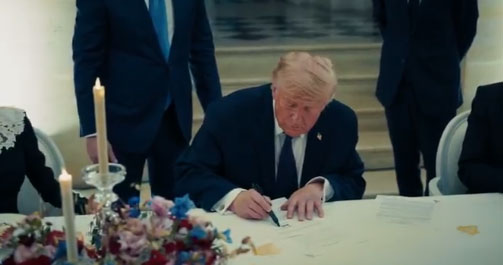
In phase two of this deal, the USA promises to raise $300 billion in reconstruction costs (call them reparations), using its regional partners that Iran had even attacked. Here the USA will lift all the sanctions, including the primary embargo that has been in place for decades and which stayed in place after the Obama deal. The MOU says after the 60 days Iran will work out a scheme with Oman on how to charge fees in the Strait of Hormuz. This is an entirely new development because Iran had never planned to collect toll fees on the straits. The symbolism of signing the agreement in Versailles, the way Germany did after the end of WW1, is not lost to anyone with historical memory – America was capitulating. America has ended in a worse place today than before the war. Iran would have conceded everything it has agreed to now without the war.
Continues next week
****

amwenda@ugindependent.co.ug


Anything for peace, in the circumstances, needs a try. War is never smart.
I hope, Andrew, that you sometimes file your articles /views in the international press. We want those people to know clearly that we despise their belligerence. Doesn’t matter if they don’t listen because we know the forces dragging them hooked by the jaw.
Andrew, there is still uncertainty on whether the MOU will be sustained, and how the negotiations on the major issues over the 60 days will span out. For now, we can draw some important lessons. The MOU shows that both USA and Iran reached a consensus on shared interests. Iran gets relief from economic sanctions, while the US is relieved from global and domestic pressure with the benefit of economic normalization. This is a win for Iran and the global economy. Secondly, the incentive structure in favor of Iran is quite significant. It is unprecedented that America offers such concessions without corresponding concessions by Iran. This signifies a tilt in the balance of power. Thirdly, we see a tilt in the global diplomacy and regional mediation. The deal was brokered by Pakistan and Qatar, supported by Turkey, Egypt and Saudi Arabia, which shows that regional peace is no longer guaranteed by global superpowers. Instead, a new mediation model based on positionality and shared interests is being set in global diplomacy. It is instructive to see how this political evolving reality will span out in the long run.
And in all this mess, Uganda proved a very unreliable partner when the bombs began falling on Iran with which it has maintained very close relationship spanning more than three decades. This ties in with Julia Subutindes dessenting vote at I CJ a balant betrayal of the Palestinians whose late leader Yasser Arafat was a celebrated guest here .And as for the brave Cuban people, am certain nobody wants to associate with them today. Castro Fidel was worshiped here and the Cuban ambassador was easily the most important diplomat in the 1990s. Consulted ideological rhetoric when a country sides with oppressors .
What did you want Uganda to do, to deploy for Iran and Hamas and Hezbollah and Houthis? Did you read the President’s statement on Uganda’s position at the start of the war? Do you see what the Mullah’s axis is doing in Nigeria, Somalia, DRC, etc?