The Independent Uganda: You get the Truth we Pay the Price


The survey suggests that young Africans are becoming increasingly practical in how they view global partnerships
Kampala, Uganda | THE INDEPENDENT | Africa’s young people are becoming more optimistic about the future of their countries and economies, but they are also sending a clear message to governments and leaders: hope alone is no longer enough.
A new survey of young Africans shows a generation that believes in the continent’s potential but wants faster action on jobs, corruption, security and political inclusion.
The 2026 African Youth Survey, released by the Ichikowitz Family Foundation and conducted by PSB Insights on July 29, found that confidence in Africa’s direction has recovered to its highest level since the Covid-19 pandemic.
The survey interviewed 4,901 young Africans aged between 18 and 24 across 16 countries in March 2026, making it the largest edition of the research since it began in 2020.
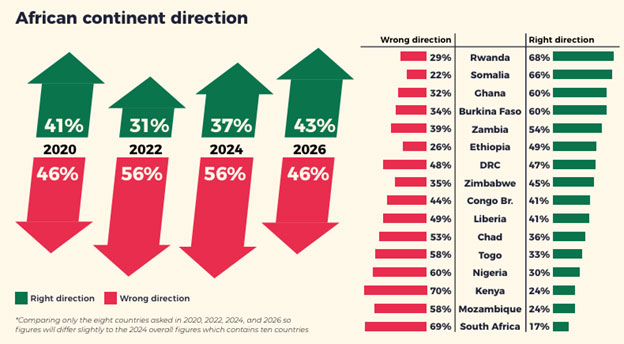
Across the eight countries tracked in every edition of the survey, 47% of young people said their country was moving in the right direction, compared with 30% in 2024.
Confidence in national economies also improved, with 45% saying their economy was heading in the right direction, up from 26% two years earlier.
At the continental level, 43% believe Africa is moving in the right direction, compared with 37% in 2024.
But behind the optimism is a strong demand for change. For many young Africans, the biggest challenge remains economic pressure. The rising cost of living was identified as the most significant development affecting the continent over the past five years, cited by 27% of respondents.
When asked what Africa needs most to move forward, young people placed creating well-paying jobs at the top of the list, followed by reducing government corruption.
Making it easier to start businesses was also becoming more important, rising from 10% in 2020 to 16% in the latest survey.
Ivor Ichikowitz, Commissioner of the African Youth Survey and Chairman of the Ichikowitz Family Foundation, said the optimism should not be interpreted as satisfaction with the current situation.
“Do not mistake this optimism for satisfaction. It is not a vote of confidence in the status quo. It is a warning,” he said.
“Young Africans still believe in this continent, but they are no longer prepared to confuse hope with patience while they struggle with the cost of living, unemployment, corruption and governments that too often talk about the future while excluding the very generation that will have to live in it.”
A generation focused on delivery
The survey suggests that young Africans are becoming increasingly practical in how they view global partnerships.
With 70% saying the world is becoming more divided and dangerous, many favour international relationships based on economic benefits rather than ideology.
More than half of respondents — 55% — said their countries should prioritise partnerships with nations that can deliver trade, investment and economic benefits, regardless of their political systems.
Infrastructure investment and economic support ranked as the most important factor when choosing international partners, followed by respect for natural resources, democratic values and technology transfer.
The United States and China remain the two most influential global powers in Africa’s eyes.
US influence was recognised by 81% of respondents, while China’s influence was seen by 79%.
However, China received a more positive perception among those who recognised its influence, with 95% describing it positively compared with 85% for the United States.
Young Africans want democracy — but on their own terms
The survey shows strong support for democracy, but also growing frustration with how it works in practice.
About 73% of young Africans said democracy remains preferable to any other form of government.
Free and fair elections, equal treatment under the law and freedom of speech remain among the most valued democratic principles.
However, 56% said Western-style democracy does not fully fit African realities and that a new African model of democracy is needed.
For young Africans, such a model should prioritise national unity and stability, regular elections, leaders who deliver jobs and services, and greater community participation.
Ichikowitz said this should not be interpreted as a rejection of democracy.
“The call for African-style democracy should not be misunderstood as a rejection of democracy but rather as a rejection of a Western model that too often fails to meet African realities,” he said.
“Perhaps the most important lesson is that African youth do not see a contradiction between democracy and delivery. They want both.”
A louder political voice
Although many young Africans believe they can influence politics, they remain sceptical about whether leaders truly understand them.
The survey found that 70% believe their voice matters to national leaders, while 84% are confident young people can influence political decisions in the next five years.
Yet 76% said leaders are out of touch with young people’s needs and aspirations.
The findings suggest a generation seeking meaningful participation rather than symbolic representation.
Many support reforms that would increase youth involvement in government, including creating dedicated youth leadership positions and introducing age limits for senior political offices.
For Africa’s youth, employment is not just an economic issue — it is increasingly viewed as a security concern.
While 70% said they feel safe in their countries, unemployment and poverty remain the biggest perceived threats to community safety, identified by 54% of respondents.
When asked what governments should prioritise to improve security, job creation ranked highest at 56%, ahead of military investment and anti-corruption efforts.
“Prosperity is one of the most powerful forms of security,” Ichikowitz said.
“For young Africans, unemployment and poverty are not simply economic challenges. They are security challenges, governance challenges and stability challenges.”
Different countries, different realities
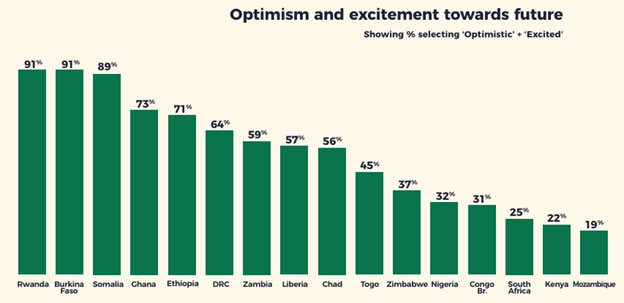
The survey reveals significant differences across the continent. Rwanda recorded the highest confidence in national direction, with 91% of young people saying the country is moving in the right direction, while 99% said they feel safe.
Somalia emerged as one of the strongest positive surprises, with 82% saying the country is moving in the right direction and 89% expressing optimism about the future.
Ghana, Ethiopia and Zambia recorded major improvements in confidence compared with 2024.
However, youth in countries including Kenya, South Africa, Mozambique, Chad and Nigeria expressed greater pessimism about economic prospects, security and Africa’s overall direction.
As Africa’s population becomes increasingly young, the survey highlights a central challenge for governments: a generation that remains hopeful about the continent but is demanding evidence that promises can translate into opportunities.