The Independent Uganda: You get the Truth we Pay the Price


Kampala, Uganda | URN | The disaster response official from the Prime Minister’s Office told a High-level conference in Addis Ababa, Ethiopia, that Uganda is preparing for El Niño rains predicted to intensify from October through December 2026.
Uganda reported that it has early warning systems, a decentralised disaster management structure, regular coordination meetings and mechanisms for taking weather information to communities.
While officials told a regional forum that its disaster management systems and coordination mechanisms are in place, other countries are already describing concrete measures such as pre-positioning emergency supplies, clearing drainage systems and preparing evacuation capacity.
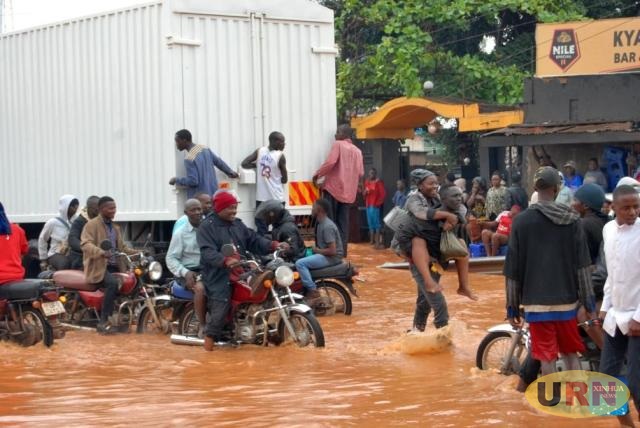
But as heavy rain swept through Kampala on Thursday, flooding roads, businesses and drainage channels, a more difficult question emerged: how much of that preparedness has actually been translated into action?
At Shell Capital along Kampala Road, a flooded pothole disrupted traffic and made it difficult for passengers to access taxis.
At Bata Bata in Namasuba, floodwater submerged roadside businesses, stalled traffic and left traders salvaging merchandise from knee- to waist-deep water.
In other parts of the city, including Banda, Kyambogo and Kinawataka-Katogo, police said some roads had become impassable. The flooding is not proof that Uganda was unprepared for the rain.
Kampala is prone to flooding, and heavy rainfall can overwhelm even functioning drainage systems. But the scenes provide an immediate test of a question Uganda itself raised at the regional forum in Addis Ababa: what happens after the forecast is issued?
The Commissioner for Relief, Disaster Preparedness and Management, Davis Mwenyi, told the meeting that the country has intensified coordination because of the rainfall warning.
He said the national disaster management system brings together government agencies, local governments and communities, while Uganda Red Cross volunteers help monitor risks and encourage people to move early.
But Mwenyi also acknowledged the challenge of turning preparedness discussions into action.
“How do you translate the things that you talked about in these conferences into action? And this is where the rubber meets the mud, the tarmac. This is what we all should do, taking the information to the people so that the people can decide for themselves,” he said.
That question becomes particularly important because another OPM official, Assistant Commissioner for Disaster Management Rose Nakabugo, acknowledged that the country’s costed preparedness and response plan has not yet been funded.
Nakabugo told the IGAD-funded event in Ethiopia that Uganda’s plan identifies the risks expected from the September to December rains and sets out interventions across agriculture, food security, health, water and sanitation, education and disaster coordination.
But she said the plan still has to go to Cabinet for approval and funding.
“As I mentioned, a costed contingency and response plan has been developed, but in order for it to be funded, we need to present it to Cabinet to approve the required resources to support us in response,” Nakabugo said.
That leaves an important distinction between having a plan and having the capacity to implement it.
“We have a problem of insufficient resources for timely procurement and prepositioning of relief items, including emergency equipment,” she said.
In the mountainous Elgon and Rwenzori areas, for example, authorities know landslides are a potential hazard and know that excavation equipment may be required.
“We have those mountainous areas like the Elgon and Rwenzori. We are likely to experience landslides there, but we need equipment to support us in excavation, just in case. But these need to be prepositioned,” Nakabugo said.
URN has previously reported that while structures for disaster response exist, they are non-operational because of a lack of financing. Many districts have previously indicated that they have no budgets for disaster risk management.
That is the point at which Uganda’s preparedness story becomes more complicated. The country knows what is coming. It has identified vulnerable areas. It has a coordination structure. It says warnings are shared with local governments and communities.
But some of the resources required to act on that information are still awaiting approval and funding.
Across the region, governments and humanitarian agencies at the IGAD forum repeatedly described the difficulty of moving from forecasts and contingency plans to anticipatory action.
Some countries also described specific measures already being taken before the rains. These countries exposed clear gaps that could be exposed as soon as the rains come in Uganda.
Djibouti, for example, said it had spent the previous month preparing key areas, strengthening monitoring and early warning, identifying vulnerable locations and preparing for rapid intervention.
Officials said drainage systems were being maintained and cleared ahead of the rains, particularly in the capital, while critical infrastructure such as roads, water systems, electricity facilities, health centres and schools had been identified for protection.
Ethiopia described a more extensive risk-based approach. Its National Emergency Coordination Center operates daily, while authorities at different levels use seasonal forecasts and assessments of exposure and vulnerability to determine where action is most urgent.
Officials said essential food and non-food items were being prepositioned in areas where risks warranted it.
In flood-prone parts of southern and south-eastern Ethiopia, preparations include strengthening river and hydrological monitoring, disseminating early warnings, prepositioning shelter and water-treatment supplies and protecting critical infrastructure.
Aydrus Hassen, Deputy Commissioner for the Strategic Logistics Sector at Ethiopia’s National Disaster Risk Management Commission (NDRMC), noted that “Ethiopia is not waiting for the risk to become uniform or for the situation to become an emergency. We are sustaining action where it already exists, preparing ahead where new risks are emerging and adapting our response to the evolving evidence.”
Officials from Kenya said the widespread floods and landslides of 2023 and 2024 exposed weaknesses in a largely reactive system.
Kenya subsequently developed an anticipatory-action roadmap, with greater emphasis on translating warnings into action, communicating directly with communities, and prepositioning resources before roads become inaccessible.
For Somalia, Mahamoud Moallim Abdulle, Commissioner for Disaster Management, made a similar argument from his country’s experience with floods following drought.
“Having a forecast is not enough. We also needed the systems, resources, and coordination to act early before the hazard becomes a disaster,” he said.
Somalia says it has since strengthened early warning and anticipatory action, including evacuation planning, river protection and the deployment of emergency boats in vulnerable areas. Even with those on the ground, Abdulle still noted that Somalia was not fully prepared.
“Being better prepared does not mean we are fully prepared,” he said.
From the deliberations at the conference hall, different countries are at different stages of preparedness: warning, planning, financing and actual pre-positioning of capacity before the hazard arrives.
South Sudan, another country facing major flood risks, said it had activated a National Flood Task Force and established committees down to local levels.
Officials described drainage clearance, food prepositioning and preparations to protect livestock. A South Sudanese official at the forum warned that anticipatory action will not work without the government taking the lead in finances.
WFP’s Maureen Ambani made a similar point from the humanitarian side, saying there is a critical challenge in translating plans into actual action without pre-arranged financing.
“A key plan for us is to pre-arrange finance right now before the rainfall and flooding starts,” she said.
The events in Kampala on Thursday bring that regional discussion closer to home. At Shell Capital, road users said a pothole that had remained unattended for nearly two weeks became a muddy pool after the rain.
Boda-boda riders said they were collecting money themselves to buy equipment to unblock drainage channels.
At Bata Bata, traders said a drainage channel leading towards Kalidubi swamp was silted and too narrow to cope with the volume of water. They said a 14-kilometre drainage project, launched about six months ago, had yet to begin.
Ismah Lubega, the area Defence Secretary, said the contractor had not started work despite the launch of the project.
“Since the launch of the channel, nothing has been done. China Ten was contracted to do work on the channels, including Kalidubi and these other small tributaries, but they have not done anything, despite reports that the money was given to contractors,” Lubega said.
The incidents raise questions beyond individual potholes and drainage channels. If authorities know which areas are vulnerable to flooding, what preventive work has been completed before the rain season?
If early warnings are being shared, what specific actions are local authorities expected to take after receiving them? And where preparedness requires money for drainage works, excavation equipment, relief supplies, or other emergency capacity, has that money been released before the rains arrive?
Those questions are particularly relevant because the OPM officials say early action is cheaper and more effective than waiting for a disaster to occur.
Nakabugo on Tuesday also acknowledged that some high-risk local governments and urban areas have limited preparedness and response capacity, while critical infrastructure remains vulnerable.
The challenge, therefore, is not necessarily that Uganda lacks knowledge about the risks. It is that there remains a distance between knowing where the risks are and having the resources to act before they materialise.
The country’s disaster management system is not starting from zero. The country has a national disaster management policy, decentralised structures, early-warning mechanisms, community networks and coordination between government agencies and humanitarian partners.
Mwenyi told the regional forum that the interagency coordination mechanism, which normally meets monthly, is now meeting at least every two weeks because of the warning.
Mwenyi boasted of the so-called government hour airtime on nationwide FM radio to disseminate public information, including weather and disaster warnings, in local languages.
He also told the forum that the national cleaning days launched over a month ago were part of the preparedness for El Niño rains.
But preparedness ultimately has to be measured beyond meetings, warnings and policy documents.
It has to be visible in the actions that take place before the floodwater arrives: drains cleared, vulnerable infrastructure protected, rescue equipment positioned, supplies prepositioned, evacuation areas identified and communities reached with information they can act on.
That is where the experience of other countries at the IGAD forum becomes relevant. The regional message was not simply to produce better forecasts. It was to close the gap between forecasts and action. Uganda has the forecast; it has identified the risks and has developed a costed preparedness and response plan.
What remains unresolved is whether the resources required to activate that plan will arrive before the hazards do. Thursday’s flooding in Kampala cannot by itself answer that question.
In Addis Ababa, experts combined scientific information, technical analysis, and country experiences.
They examined the regional risk outlook, reflected on lessons from previous El Niño events, discussed anticipatory actions, and endorsed the call to action. But that is not the end of the work.
For Uganda, the need is to secure financing, strengthen the national disaster risk management system, and implement the multi-hazard early warning system.