The Independent Uganda: You get the Truth we Pay the Price


SPECIAL REPORT | Uganda’s roads are claiming more lives than ever before. But for those who survive, the greatest struggle often begins after the wreckage is cleared. As debate grows over whether the country should establish a road accident fund, victims, lawyers and road safety experts are asking whether Uganda’s compulsory Motor Third Party Insurance has become a promise that delivers too little, too late, reports Ronald Musoke.
There are moments in life that divide time into two parts; the life before and the life after. For Charles Yokoloam Okemeri, that dividing line came on a February evening in 2022, somewhere along the highway between Bugiri and Tororo towards Uganda’s common border with Kenya.
He remembers almost everything. He remembers leaving Nakawa Taxi Park, on the eastern outskirts of Kampala, that morning with his two brothers after learning that their aunt had died in the village. He remembers boarding a taxi driven by someone they knew, a villagemate making the familiar journey east.
He remembers Bugiri town. Passengers got off. The 14-seater Toyota Hiace became lighter. The road ahead stretched smooth and inviting. Then the driver pressed harder on the accelerator. “He was driving very fast,” Okemeri recalls quietly, more than four years later. “Around one hundred kilometres per hour.”
Then came a sound he has never forgotten. A tyre exploded. Not gradually, not with warning but with one violent bang. The taxi lurched wildly across the road. It zigzagged from one lane to another. Inside, panic erupted. Okemeri instinctively reached for the door. He wanted to jump, but the vehicle was moving too fast.
The next memory arrives like fragments of broken glass. A roadside ditch. Silence. Dust. His torn clothes. For a few moments he did not know whether he was alive or dead. Then he tried to stand. His body obeyed. He looked around. His cousin lay nearby. Motionless. He had died instantly.
Not far away was another victim; a woman who, moments earlier, had simply been walking along the roadside when fate placed her in the path of a speeding vehicle. She, too, would never return home. Then another thought entered his mind. His jacket. Inside it was Shs8 million. Years of savings. Money, he had planned to use to begin building his first house. He searched frantically. Against all odds, he found it. Every shilling was still there. “I was happy the money was there,” he says. “But then I started feeling something strange.”
An intense heat spread through his body. “It felt as if my blood had become hot.” He lay down beside the road. He prayed. Around him, strangers had begun gathering. Some were rescuers. Others were motorists stopping to help. They wanted to rush him to hospital immediately. Instead, he pointed towards one of his brothers. “My brother first,” he insisted. “He was worse than me.” The rescuers listened. His brother was taken first.
Okemeri was later transported to a nearby clinic before being referred to Mbale Regional Referral Hospital, about 120km away. Doctors discovered his right arm had been shattered. Two ribs were broken. The following day came another blow. His brother died. In total, at least five lives were lost in that single crash.
The burial they had set out to attend had become two burials. Then three. For weeks afterwards, hospital wards replaced family gatherings. Instead of buying bricks, cement and roofing sheets, Okemeri paid surgeons. His operation alone cost Shs 3 million. He spent two weeks in hospital and six months recovering. By the time he returned to work, nearly every coin he had saved for his future had disappeared into treatment, medicine and survival. His dream house remained exactly that: a dream.
Motor third-party insurance shock
But perhaps the greatest shock came after the wounds had healed. Like many Ugandans, Okemeri believed compulsory motor insurance existed precisely for moments like these. After recovering, he travelled back to Bugiri to seek compensation. He expected paperwork. Questions. Perhaps delays. He did not expect to be told there was effectively nothing for him.
“The police told me the insurance only covered the people sitting in front,” he says. “I kept following up.” Nothing. “I thought about getting lawyers.” But lawyers needed money. Money he no longer had. Eventually, exhaustion replaced determination. “I decided to leave it,” he says. “Maybe God would bless me again.”
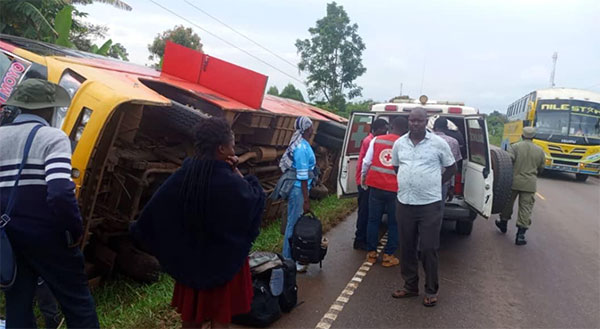
For Okemeri, the crash did not end beside a highway in Bugiri. It followed him home. It consumed his savings, delayed his future, and changed his family forever. And then, quietly, the system that was supposed to protect victims disappeared from the story altogether.
If Okemeri’s experience sounds exceptional, Uganda’s road safety data suggests otherwise. Across the country, thousands of families are discovering that surviving a road crash often marks the beginning of another ordeal: months of treatment, mounting medical bills, lost incomes, permanent disability and, for many, an insurance scheme whose statutory compensation bears little resemblance to the real cost of rebuilding a shattered life.
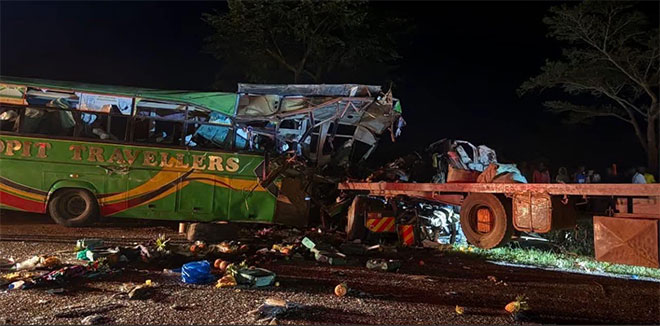
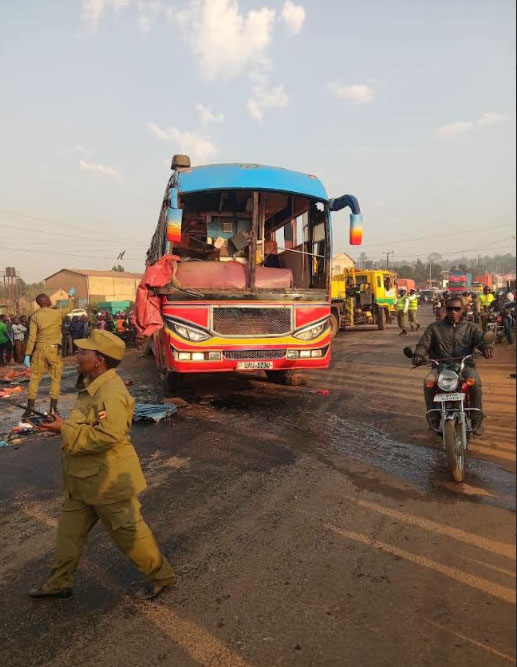
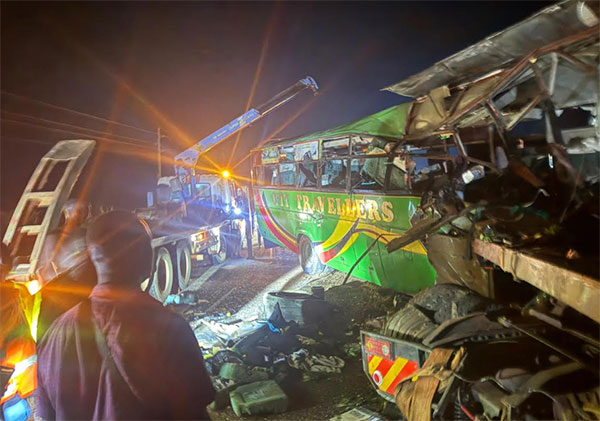
The debate burst into public view again on the night of July 7. At about 9.30 p.m., along the Kampala-Gulu Highway at Bobi Trading Centre in Omoro District, an Opit Travellers bus travelling north collided head-on with an oncoming Mercedes-Benz Actros trailer after the bus driver reportedly attempted to avoid a pedestrian while speeding. Fourteen people died while 28 others survived with injuries of varying severity, the Uganda Police Force noted in a short report shared on July 8 via its social media platforms.
Within minutes, ambulances, police officers and residents descended on the wreckage. Families elsewhere waited for phone calls they prayed would never come. Some would receive them before dawn. The Bobi crash was not remarkable because it was rare. It was remarkable because it was familiar. The twisted wreckage. Lifeless bodies lying near the wreckage. Survivors carried into ambulances. Relatives making frantic telephone calls through the night. By sunrise, another corner of Uganda had joined a growing map of communities mourning loved ones lost on the country’s roads.
Police said preliminary investigations suggested that the bus driver, allegedly travelling at high speed, attempted to avoid a pedestrian crossing the highway before losing control and crashing into an oncoming trailer. Investigators would later begin piecing together exactly what happened in the final seconds before impact. But while investigators searched for the immediate cause of the collision, another question was already confronting dozens of families.
How would they pay for what came next? The funerals. The surgeries. The weeks, perhaps months, away from work. The rehabilitation. The children suddenly left without breadwinners. The permanent disabilities that no police report would ever capture. It was a question that reached beyond Omoro District.
Almost immediately after news of the crash spread, Ker Kwaro Acholi, the cultural institution representing the Acholi people, issued a statement that went beyond condolences. Through its Minister of Information, Okello Okuna, the institution appealed to the government to assist bereaved families with burial expenses and to support survivors receiving treatment in different health facilities. It also urged Ugandans to donate blood, recognising that many of the injured would need urgent transfusions if their lives were to be saved.
It was an unusual appeal. Traditional leaders often call for prayers after national tragedies. This time, they also appealed for financial support. Perhaps it reflected an uncomfortable reality that many Ugandans already understand; a devastating road crash rarely ends when the injured leave hospital. For many families, it marks the beginning of a financial crisis from which they may never fully recover.
Presidential support for victims
Four days later, the Presidency responded. President Yoweri Museveni contributed Shs5 million to each of the families of the fourteen people who died and Shs1 million to each injured survivor. The assistance was delivered by the Minister of State for Disaster Preparedness, Lillian Aber, to the Gulu City Mayor, Julius Acire Labeja, offering immediate relief to families confronting funeral costs and mounting medical bills.
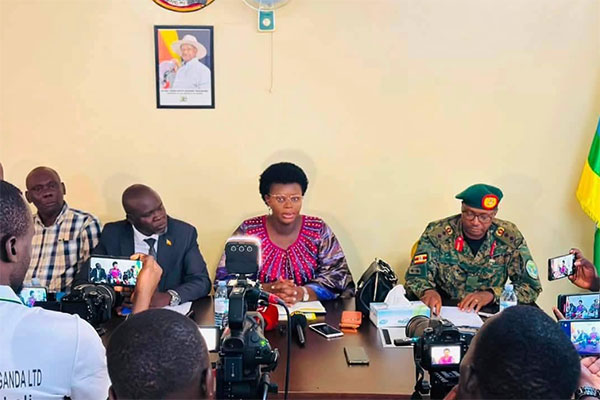
Few questioned the compassion behind the gesture. Yet the donations also exposed a deeper policy dilemma. Should families devastated by road crashes depend on extraordinary acts of presidential generosity? Or should support be guaranteed through a permanent national system that operates regardless of who occupies State House?
The question quickly drew in lawyers. In one of the strongest public interventions following the Bobi tragedy, Isaac Ssemakadde, the president of the Uganda Law Society, argued that Uganda had for too long relied on emergency generosity instead of building institutions capable of supporting victims automatically.
As the country mourned those killed at Bobi, the Law Society mourned too. But its statement was also an indictment of what it described as decades of neglect. “No family should bury its dead alone, or pay for it alone,” the society declared, announcing that its legal aid clinics in Gulu and Masindi would provide free assistance to victims and bereaved families while unveiling plans for a national pro bono programme dedicated to road crash victims.
Ssemakadde’s statement inevitably ventured into politics, criticising government priorities and arguing that Uganda had failed to establish the kind of road accident compensation framework already operating elsewhere on the continent. Not everyone would agree with every aspect of that critique. But beneath the politics lay a question that transcended partisan debate.
Why does a country that requires every motor vehicle owner to purchase compulsory Motor Third Party Insurance still leave so many victims struggling to obtain meaningful compensation? It is a question that becomes even more pressing when viewed against the scale of Uganda’s road safety crisis.
Road crash deaths remain high
Police statistics cited after the Bobi crash show that 5,383 people died on Uganda’s roads in 2025; an average of 15 deaths every single day. The trend has moved steadily upward over recent years, from 4,534 fatalities in 2022 to 4,806 in 2023 and 5,144 in 2024. Behind each number lies a family whose future changed in an instant.
Yet even those figures may tell only part of the story. Researchers at the Makerere University School of Public Health have argued that police records alone fail to capture the true burden of road traffic injuries because of incomplete reporting, missing data and weak connections between police and health facility records. In a nationwide study published in 2016, they concluded that Uganda’s road injury crisis had long been underestimated, suggesting the human toll extends far beyond official statistics.
Numbers, however, can sometimes conceal as much as they reveal. What they cannot adequately measure is the life interrupted. The mason who can no longer lift bricks after spinal injuries. The shopkeeper forced to sell her business to pay hospital bills. The child withdrawn from school because the family’s breadwinner died on a highway.
The statistics also struggle to capture the burden carried by Uganda’s hospitals, where the aftermath of every major crash unfolds far from television cameras. At Mulago National Referral Hospital in Kampala, doctors receive between 45 and 70 road crash victims on an average day. Many spend about two weeks under intensive care before requiring months of follow-up treatment. Researchers estimate that treating a single seriously injured crash victim costs, on average, more than Shs13 million, with government absorbing roughly 90% of that expense.
Regional hospitals such as Kawolo General Hospital along the Kampala-Jinja highway face similar pressures, stabilizing victims before transferring the most severely injured to Kampala. Road crashes, in other words, are not merely traffic incidents. They are a public health emergency, an economic burden, a development challenge, and, increasingly, a test of whether Uganda’s institutions are equipped not only to prevent tragedy but also to help citizens rebuild their lives once tragedy strikes.
The next question is unavoidable. If Uganda has required compulsory Motor Third Party Insurance for nearly four decades, why do so many survivors like Okemeri still walk away believing they have been left to fend for themselves? For nearly four decades, Uganda has required every private and commercial vehicle on its roads to carry Motor Third Party Insurance. In theory, it is one of the country’s most important social protection mechanisms.
The principle is straightforward. If someone is killed or injured because of a motor vehicle, there should be a system capable of cushioning the financial consequences of that tragedy. That is why every vehicle owner pays for the insurance. At least, that is what most Ugandans believe. The reality, however, is considerably more complicated.
Few passengers boarding a taxi in Nakawa, a bus in Gulu or a boda boda in Mbarara have ever read the Motor Vehicle Insurance (Third Party Risks) Act of 1989. Fewer still know how to begin a claim after an accident. For many, compulsory insurance is little more than another sticker on a windscreen, a legal requirement for vehicle owners rather than a lifeline for victims.
That misunderstanding has consequences. When tragedy strikes, survivors often discover that the protection they assumed existed is either difficult to access, insufficient to meet their needs or, in many cases, never pursued at all. Even the government acknowledges the problem.
Appearing before Parliament’s Committee on Health in February 2024, then Minister of State for Transport, Fred Byamukama, painted a sobering picture of Uganda’s road safety landscape. There were, he noted, more than 1.7 million registered motor vehicles in the country, nearly two-thirds of them motorcycles or Boda boda. Road crashes were claiming thousands of lives every year while leaving many more with life-changing injuries. Uganda was losing an estimated 5% of its Gross Domestic Product, more than Shs7 trillion annually, to road traffic crashes.
Yet preventing crashes was only one side of the challenge. Helping victims recover was another. Byamukama’s presentation was unusually candid. He acknowledged that many Ugandans purchase Motor Third Party Insurance simply because the law requires it, not because they understand what it covers or how to use it.
Claims, he admitted, are often lengthy and cumbersome. Victims frequently incur transport costs travelling back to the jurisdiction where the crash occurred simply to obtain police documentation. Insurance companies process claims centrally rather than through regional branches, creating another obstacle for victims living hundreds of kilometres away.
Fraud has further undermined confidence, while government vehicles themselves fall outside the compulsory insurance framework, forcing victims seeking compensation to sue the Attorney General instead. Most striking of all was his acknowledgement that the compensation available under the current law is often grossly inadequate.
A single bus crash can leave dozens dead or seriously injured. Yet the statutory limits remain capped at Shs1 million per injured person and Shs10 million for the entire accident. Those figures may once have appeared reasonable. Today, they barely scratch the surface of modern medical costs. Consider Okemeri’s experience. His surgery alone cost Shs3 million. That did not include transport, medication, months without income, or the emotional cost of losing family members.
Need for reforms
Sam Bambanza, the Executive Director of Safe Transport and Survivors Support Uganda (STASSU), believes the current system has drifted far from its original purpose. He welcomes the Uganda Law Society’s decision to provide pro bono legal representation to crash victims, arguing that many survivors abandon compensation claims simply because they cannot afford lawyers.
But, he says, legal assistance alone cannot fix a broken compensation system. “The current Motor Third Party Risks Act of 1989 has largely failed to deliver meaningful benefits to victims,” Bambanza told The Independent. Many survivors, he argues, do not even know they have a right to claim. Others, he said, become discouraged by delays and bureaucratic hurdles. Some encounter insurance companies that, in his words, create unnecessary barriers to compensation.
Increasingly, Bambanza told The Independent, the scheme is viewed by many road safety advocates as “a cash cow” benefiting insurers more than the people it was intended to protect. His solution is not merely to increase compensation. He wants Uganda to rethink the entire model. Instead of relying solely on conventional third-party insurance, he argues for establishing a comprehensive Motor Accident Fund—similar to systems operating elsewhere in Africa—that would compensate victims while simultaneously investing in crash prevention, safer roads and improved investigations.
“Preventing crashes ultimately reduces compensation costs and saves lives,” he argues. “It is a sustainable approach.” Not everyone frames the problem in quite the same way. Road safety advocate Andrew Mwase agrees that the state bears primary responsibility for creating safer roads but cautions against overlooking individual responsibility.
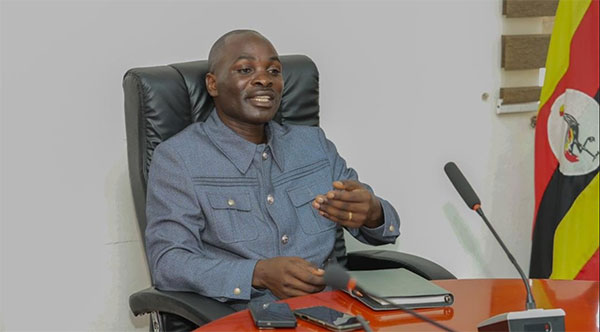
Without going into details of the Bobi collision, he told The Independent, it would be premature to attribute every tragedy solely to institutional failures. Drivers, too, make choices, he says. They decide whether to slow down, whether visibility is adequate for overtaking, or whether road conditions justify speed. “A reasonable driver should take into consideration visibility, the size of the road and the quality of the road surface,” he told The Independent.
Uganda’s compensation system, he says, no longer inspires confidence. “Motor Third Party insurance is a rip-off,” he argues. “Citizens don’t even know how it works. What is needed is something that actually works.”
Even within the insurance industry, there is recognition that public understanding remains painfully limited. An insurance expert who spoke to The Independent on condition of anonymity explains that the claims process begins immediately after an accident. Vehicle owners or drivers are expected to notify their insurers. The crash must be reported to police. Medical reports and receipts should be retained. Most importantly, he says, injured people should never delay seeking treatment while waiting for insurance compensation. “Every minute counts,” she says. “Take the injured person to hospital first, then begin the claims process.” Her advice reflects the system as it is designed to operate.
But it also exposes a disconnect. If the process is straightforward in principle, why do so many victims—from Okemeri to countless others across the country—walk away convinced that the system either failed them or was simply beyond their reach? Perhaps the answer lies not only in compensation, but in the way Uganda understands road crashes themselves. For decades, public debate has often reduced collisions to careless drivers, reckless overtaking or speeding. Those factors undoubtedly matter. But an emerging school of road safety thinking argues that they tell only part of the story. And if that thinking is right, then Uganda may not simply need better drivers. It may need an entirely different way of thinking about road safety.
If compensation asks what happens after a crash, road safety asks an even more uncomfortable question. Why do the crashes keep happening? Every major road accident in Uganda follows a familiar script. Within hours, investigators search for the immediate cause. The driver was speeding. A tyre burst. Another vehicle was overtaking. Someone crossed the road. Brake failure. Driver fatigue. Those explanations are rarely wrong. But are they enough?
Safe systems approach
For Ronald Amanyire, the Principal Road Safety Officer at the Ministry of Works and Transport writing in his personal capacity on his X handle, focusing only on the final mistake risks missing the bigger picture. Writing shortly after the Bobi tragedy, Amanyire urged Ugandans to think differently about road crashes. The problem, he argued, is not simply that drivers make mistakes. Human beings, by their very nature, will always make mistakes.
The real question is whether the transport system is designed to forgive those mistakes—or to turn them into death sentences. His argument reflects what road safety specialists around the world call the Safe Systems Approach, a philosophy that begins with a simple but profound assumption: perfect human behaviour is impossible.
Drivers become tired. Pedestrians misjudge traffic. Motorcyclists take risks. Children dash across roads. Tyres burst. Brakes fail. None of those realities can ever be eliminated completely. What can be changed, proponents argue, is the system surrounding them. Roads can be engineered to reduce the consequences of mistakes. Vehicles can be designed to better protect occupants. Speed limits can reflect the environment.
Emergency medical services can reach victims quickly enough to prevent survivable injuries from becoming fatalities. The responsibility, therefore, shifts from asking whether individual road users are perfect to asking whether governments have built transport systems capable of accommodating inevitable human error. Seen through that lens, Uganda’s recurring bus crashes begin to look less like isolated tragedies and more like predictable outcomes. Amanyire points to highways that remain narrow and largely undivided, leaving opposing traffic separated only by painted lines.
There are few median barriers to prevent head-on collisions. Limited recovery shoulders mean drivers who drift off the carriageway have little opportunity to regain control safely. Many highways lack overtaking lanes or physical measures that calm traffic approaching busy trading centres where pedestrians frequently cross.
When buses travel at highway speeds through such environments, a single lapse in judgement can quickly become a mass-casualty event. Infrastructure, however, is only one layer of the system. Vehicle safety is another. Across much of the developed world, modern passenger vehicles increasingly incorporate technologies such as electronic stability control, sophisticated occupant restraint systems and crashworthy designs intended to absorb impact forces.
Many public service vehicles operating on Uganda’s roads, by contrast, lack comparable levels of protection. For passengers, survival often depends as much on the violence of the collision as on the structural integrity of the vehicle itself. Then there are the commercial pressures shaping driver behaviour. Long-distance buses compete fiercely for passengers. Schedules reward speed. Night travel maximizes fleet utilization. Owners expect vehicles to complete journeys quickly before beginning the next trip. Within such an environment, speeding and risky overtaking are not merely individual choices. They become commercial incentives. Safe Systems thinking does not excuse dangerous driving. Rather, it asks why transport systems continue rewarding behaviour known to increase the likelihood of catastrophic crashes.
The final layer is one most Ugandans encounter only when disaster strikes. Emergency response. Every minute after a severe crash can determine whether a victim lives or dies. Yet survivors are frequently transported to hospital in passing vehicles, police pickups or private cars because ambulances either arrive late or are unavailable. Hospitals themselves must stabilize dozens of casualties arriving simultaneously, often stretching already limited trauma resources. It is here that prevention and compensation intersect.
A country that cannot always prevent crashes inevitably requires strong systems to care for those who survive them. That is precisely why many countries have moved beyond viewing road crashes purely as criminal investigations or insurance claims. Increasingly, they are treated as matters of social protection. Road crashes may begin with a traffic collision. But they often end as public health emergencies, economic shocks and long-term social welfare challenges.
That broader understanding helps explain why Uganda’s current compensation debate extends well beyond insurance companies. It is increasingly about the role of the State itself. Indeed, even before the Bobi tragedy thrust the issue into the national spotlight, the government had already begun acknowledging that important gaps remained.
Uganda needs Accident Road Fund
Addressing Parliament in 2024, then Minister of State for Transport, Byamukama, noted that while Uganda had strengthened legislation governing road safety and emergency medical care, one crucial question remained unresolved. Who pays when the person responsible cannot? Or when the driver disappears? Or when the crash involves a hit-and-run vehicle? Or when the statutory limits of compulsory insurance fall far short of the cost of saving a life?
His answer was cautious but significant. Uganda, he suggested, needed to begin discussing a Road Accident Fund, financed through a levy on fuel, that could compensate victims while simplifying access to support after crashes. It was not a radical proposal. It was, in many respects, recognition that the existing framework was struggling to meet the realities of modern road transport.
The idea is neither uniquely Ugandan nor entirely new. Across southern Africa, countries confronted similar questions years ago. How should society support innocent victims? Should compensation depend on private insurance alone? What happens when the person responsible cannot pay? Should every motorist contribute collectively to protecting every road user? South Africa answered those questions one way. Namibia answered them another way. Both countries arrived at the same conclusion on one fundamental point. The consequences of a road crash are too great to leave victims carrying the burden alone.
South Africa reached that conclusion nearly three decades ago. Rather than leaving compensation almost entirely to private insurance, it established the Road Accident Fund (RAF) under an Act of Parliament in 1996. Financed through a levy on fuel, the Fund provides compensation to people injured in road crashes and to families who lose loved ones on South African roads.
Its philosophy is simple. Road transport benefits the entire economy. The risks associated with road transport should therefore be shared across society rather than falling solely on individual victims. The Fund pays for medical treatment, rehabilitation, loss of income, loss of family support, funeral expenses and, in qualifying cases, compensation for pain, suffering and permanent disability. It also shields motorists from financial ruin arising from liabilities they would otherwise struggle to meet. The Fund is not limited to South African citizens. Every lawful road user within the country’s borders—including foreign visitors—is eligible for protection under the law, subject to the conditions set out in the legislation.
Neighbouring Namibia adopted a model built on similar principles. Its Motor Vehicle Accident Fund, created under the MVA Fund Act of 2007, also draws its income primarily from a fuel levy. Unlike traditional fault-based compensation systems, Namibia’s scheme adopts what officials describe as a hybrid approach, enabling people injured in road crashes—and the dependants of those killed—to access medical care, rehabilitation, funeral grants, injury benefits and, where applicable, compensation for loss of income or financial support. The Fund also invests heavily in road safety education and crash prevention, recognising that every collision avoided is both a life saved and a future compensation claim prevented.
Its vision extends beyond paying claims. It seeks to restore injured people to productive lives and help families regain economic independence after tragedy. Neither model is perfect. South Africa’s Road Accident Fund has faced financial pressures, legal disputes and administrative backlogs over the years. Namibia’s scheme also operates within funding constraints and statutory limits.
For Sam Bambanza, reform must place victims at the centre while strengthening crash investigations and prevention. For Andrew Mwase, better compensation must be matched by greater accountability for reckless drivers and transport operators. For Ronald Amanyire, lasting progress depends on redesigning the transport system itself so that inevitable human mistakes no longer become fatal.
Even government, through Fred Byamukama’s presentation to Parliament, has acknowledged the need to discuss a road accident fund and explore more sustainable ways of financing post-crash care. What remains unresolved is not whether Uganda has a road safety problem. The statistics settled that debate long ago. Nor is it whether road crashes impose crushing financial burdens on families and the health system. Hospitals see that reality every day. The unanswered question is whether Uganda’s compensation framework has kept pace with the scale of the crisis.