The Independent Uganda: You get the Truth we Pay the Price


US-Iran war has relegated Sudan conflict to the back burner
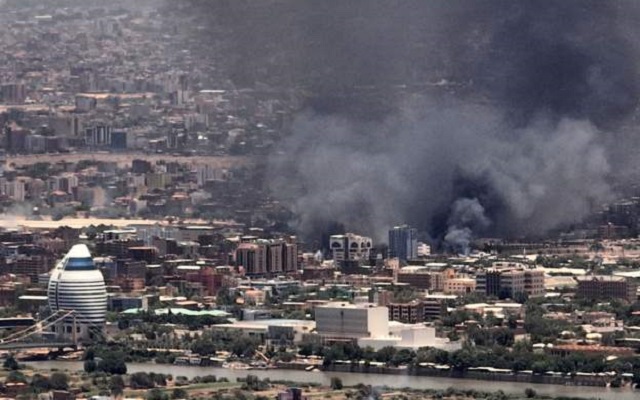
NEWS ANALYSIS | IAN KATUSIIME | Three years into Sudan’s brutal war, the country has become a fractured map of collapsing cities, displaced families, and shifting frontlines that show no sign of settling. What began as a power struggle has hardened into one of the region’s most destabilizing conflicts, sending shockwaves far beyond its borders.
The conflict in Sudan, which began in April 2023, has killed over 150,000 people, according to some estimates. The war has created the world’s largest displacement crisis and resulted in severe food shortages and famine-like conditions, with 33.7 million people in need of aid.
Intense fighting between the Sudanese Armed Forces (SAF) and the Rapid Support Forces (RSF) has forced over 11 million people from their homes, sending them fleeing into Chad, Egypt, South Sudan, Ethiopia, the Central African Republic and Kenya.
For neighbouring South Sudan, which has had sporadic outbreaks of war, the fighting has pushed hundreds of thousands to seek safety across the region, including Uganda, where the ripple effects are increasingly visible.
Against this backdrop, Uganda has made fitful and uneven attempts to position itself as a regional peacemaker. President Yoweri Museveni has tried to revive a role he has long tried to claim in African diplomacy, even as his relationship with Sudan has swung between cooperation, suspicion, and open rivalry.
Uganda finds itself balancing humanitarian responsibility with quiet diplomacy: hosting refugees, managing security concerns, and navigating the delicate politics of a war that is not its own yet deeply affects its regional interests.
As the conflict marks its third anniversary, Kampala’s role reveals the complexity of conflict and how wars fought elsewhere inevitably reshape the politics, pressure, and moral choices of its neighbours.
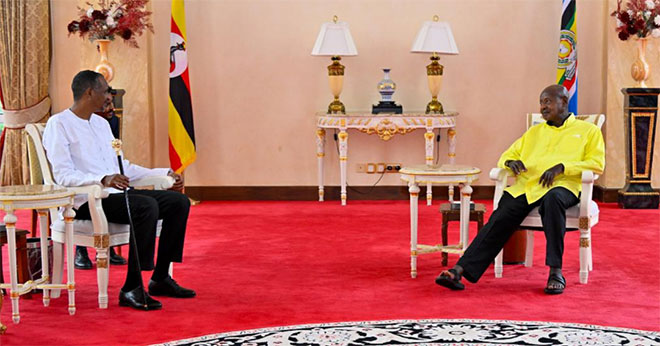
When President Museveni hosted RSF leader Gen. Mohammad Dagalo at State House Entebbe on February 20 in efforts aimed at finding peace in Sudan, there was uproar internationally.
In a statement, the Sudanese Ministry of Foreign Affairs condemned the Ugandan government for hosting Dagalo. Sudan described the actions as “an unprecedented move that is an affront to humanity as a whole before it is an affront to the Sudanese people.”
Museveni said that “dialogue and a peaceful political solution are the only sustainable paths to stability for Sudan and the region.”
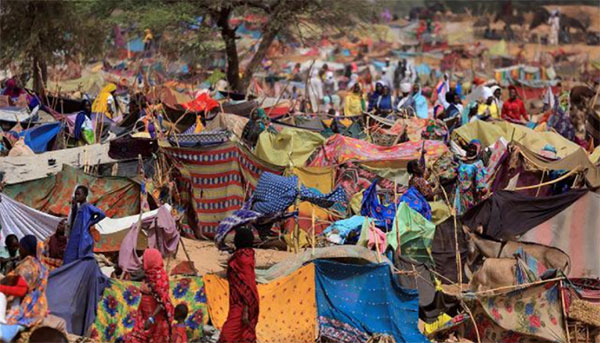
As global attention swivels toward the escalating confrontation in the US/Israel-Iran war, Sudan’s grinding conflict has been pushed further into the background—another casualty of a world that can only focus on one crisis at a time.
Since the US and Israel started their bombing campaign in Iran two months ago, the conflict has dominated headlines, driven by its immediate impact on global oil supplies, trade routes, and great-power tensions, effectively crowding out coverage of slower-burning wars elsewhere.
The result is a stark imbalance: while Sudan remains the world’s worst humanitarian crisis, with millions displaced and aid systems collapsing, it is increasingly treated as peripheral noise in a geopolitical landscape now defined by the war in the Middle East.
Analysts note that the Iran war has not only redirected media and diplomatic bandwidth but also disrupted aid flows and economic lifelines into Africa, worsening conditions on the ground even as international urgency fades. In this reshuffled hierarchy of crises, Sudan has not become less deadly, only less visible.
Uganda and Kenya are grappling with fuel shortages and inflationary pressures arising out of Iran’s closure of the Strait of Hormuz, the narrow water channel where a fifth of the world’s oil flows.
Pre-occupied leaders
President Museveni and his regional counterparts like President William Ruto of Kenya are also pre-occupied with domestic politics. Museveni at 81 has shown signs of intellectual and physical exhaustion, leaving diplomats to handle the finer details of geopolitical issues which may need more attention than the obligatory meetings.
Museveni was recently elected the chairman of the East African Community (EAC), the fast-growing bloc that stretches all the way to the DRC and Somalia, and is expected to forge peace in the Sudan conflict because of the spillover effect on neighbouring countries.
Ruto is under pressure over the escalating fuel crisis in Kenya, not to mention the tough re-election battle he is facing ahead of next year’s election. The two leaders who are expected to deal with the unending conflict are quite busy with other foreign and domestic affairs.
Regional diplomats are increasingly pulled toward more immediate geopolitical flashpoints, leaving Sudan’s war to drift into a dangerous diplomatic neglect where the Sudanese people will most likely have to fend for themselves.
On the other hand, Museveni’s son and Uganda’s Chief of Defence Forces Gen. Muhoozi Kainerugaba, had a Twitter onslaught against the RSF saying the Uganda Peoples Defence Forces (UPDF) could attack the RSF for killing blacks in Sudan. Muhoozi’s tweets sent mixed signals for those closely watching Sudan.
“We are ready to work with our South Sudanese brothers against the menace of RSF! When they captured El Fasher last year they killed our black brothers and sisters worse than you would kill a dog. They are going to pay for that one way or another!!” Muhoozi tweeted a day before Dagalo was ushered into State House Entebbe. Some observers have called Muhoozi’s posture a negotiating tactic.
President Museveni met with the High Command of the UPDF at State House shortly after to “review our security situation and the strategic priorities of our country.” The meeting was attended by Gen. Muhoozi and all the UPDF top brass. Sudan likely featured on the agenda since the RSF boss had been in Uganda a few days ago.
A week before Dagalo’s controversial visit, Museveni hosted Malik Agar, Deputy Chairman of Sudan’s Transitional Sovereignty Council where they discussed the security and political developments and the ongoing efforts to restore stability. The fledgling STC is the internationally recognised head of State of Sudan that is caught in the fighting between SAF and RSF.
Uganda’s decision to host Dagalo sparked debate on its neutrality as a mediator. Sudan no longer views Uganda as a neutral arbiter of the conflict and now there is uncertainty on the direction of the mediation process and finding peace.
Tsega’ab Amare, a Researcher writing in the Horn Review says Uganda’s decision to host Mohamed Hamdan Dagalo at State House Entebbe “represents a qualitative change in the political economy of Sudan’s conflict.”
Amare writes that although Kampala seeks to portray this engagement as part of an African Union-led mediation process, for the de facto government, headed by General Al-Burhan, this represents the “political normalization of a paramilitary group accused of grave international crimes.”
The RSF has been sanctioned by the U.S., U.K., UN, and E.U. for the atrocities committed in Sudan. The latest round of sanctions were announced by the UN Security Council on four leaders of the RSF for atrocities committed in the city of El Fasher.
The group captured El Fasher in October in what some say was the most brutal chapter of the three year conflict. A UN fact-finding mission determined the atrocities by RSF in the city pointed to a genocide. RSF has also been accused of genocide in the western city of Darfur.
Commentators are saying that Uganda’s reception of Dagalo is tantamount to backing a genocidal group. Dagalo is one of the most sanctioned individuals on the African continent.
RSF strength
The RSF sustain their war effort in Sudan through a combination of illicit gold mining, external financial and military backing, a decentralized looting economy, and mercenary work, which has enabled them to evolve into a dominant paramilitary force.
A primary funding source is control over Darfur’s lucrative gold mines, particularly in the Jebel Amer region, which Dagalo secured in 2017. They reportedly smuggle this gold to the United Arab Emirates (UAE) to fund operations and purchase weapons.
Reports suggest the UAE provides logistical and weapon supplies to the RSF, often routed through eastern Chad and Libya. The RSF has also received support from the Russian Wagner Group (now rebranded) and has aligned with Eastern Libyan military leader Khalifa Haftar to facilitate supply lines. Uganda has also been a route to supply arms to RSF which some critics point out as the reason for Dagalo’s frequent visits to Kampala.
On the other hand, SAF uses a combination of control over state infrastructure, a massive military-industrial business network, foreign support, and the mobilization of allied armed groups.
Since relocating its government to Port Sudan, the SAF has utilized its status as the “recognized” government to control state resources, taxation, and financial systems, including oil transit fees from South Sudan.
Several countries have provided varying degrees of military, diplomatic, and logistical support to the SAF, viewing them as the legitimate entity against the RSF. These include Saudi Arabia, Egypt, Iran and Turkey.