The Independent Uganda: You get the Truth we Pay the Price


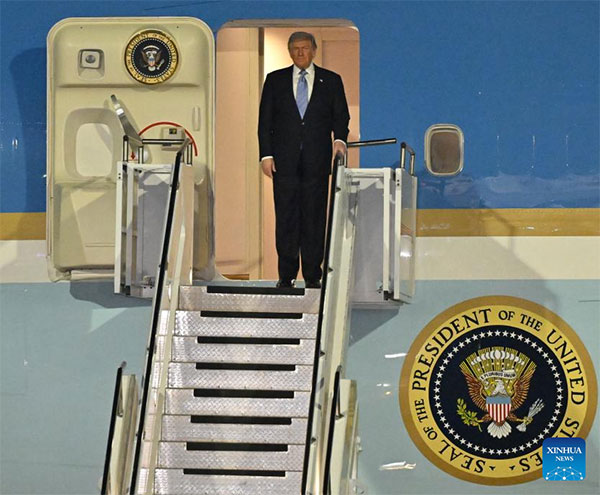
U.S. President Donald Trump arrives in Beijing on May 13, 2026, for a state visit to China. At the invitation of Chinese President Xi Jinping, Trump is visiting China from May 13 to 15. (Xinhua/Yue Yuewei)
COMMENT | NNANDA KIZITO SSERUWAGI | China–US relations are the most important bilateral relationship in the world. The two are the world’s leading economic and military powers. Both carry influence far and wide, across the geographical spread of this pale blue dot. You would imagine it must be in the interest of the two powers, and indeed, of the entire world, for both countries to keep close ties. It is therefore not amusing that it had been nine years since an American president had last set foot in Beijing. Give it to Trump: this ongoing visit is his second presidential trip, having last visited in 2017. Biden, “Sleepy Joe”, as Trump calls him, never went. At all. He was the first US president since Carter – have you heard of him? – to leave office without visiting China.
Although I give kudos to Trump for tugging at the heartstrings of this relationship better than Biden, his presidency hasn’t been without scratches at his Chinese counterparts. I analyse this from a Trump-critical standpoint because you cannot find an inch of provocation from China against America. China is always playing by the rules, boring, you may say. Its escalation usually stems from trying to keep up with America – think of the tariff wars. But it has not been just tariffs that highlighted cracks in this relationship. It was the pandemic; a spy balloon which China insisted was a stray weather balloon; a near-crisis over Taiwan; and now the Israeli-American war against Iran.
These crises are not very surprising since it is shown that there has been a declining rhythm in high-level leader exchanges between the two countries from 5.6 in the 2000s to 4.6 in the 2010s, down to 2.5 per year in this decade. You can’t thin out contact at such a critical level of bilateral relations and not attend to some crises eventually.
Even the delay of the summit from the earlier scheduled March-April timelines was due to the war against Iran, which might have been avoided had the two powers talked over it. They sure will talk about it now, and from a position that favours China since it has leverage over Iran as its largest trade partner and top oil buyer. If America wants a big brother to talk to Iran, it is certainly China. Trump can now borrow President Xi Jinping’s leverage over Iran.
There are five dimensions to this summit. The first is on stabilising trade. This is a fundamental joint in China-US relations. This meeting does not promise to strike a comprehensive deal. Jamieson Greer, the American Trade Representative, has signalled that what Trump is seeking is “stability” rather than a reset. The fundamental proposition on the table is a bilateral Board of Trade entrusted to manage commerce in non-sensitive goods. To this is added a parallel body called the Board of Investment, with a responsibility to coordinate government-to-government business. The goal is to have a modest but substantial institutional infrastructure which can meaningfully mitigate disputes before they cascade into tariff wars.
Trump will also likely brandish headline-worthy numbers on Chinese purchases of energy and American agricultural products.
Perhaps the most critical bargain of all bargains will be on rare earths. China unilaterally banned the export of critical minerals to America, Europe, Japan and South Korea. This upended the supply chain for a key element in a wide variety of electronic products made by those countries. The White House has revealed that Trump will be keen to clinch agreements easing the restrictions on rare earth exports from China. This will likely help Xi Jinping to harness the bargain by conceding partial offers on reopening rare earth flows while requiring an easement on semiconductor export controls in return. Trump himself has applauded the Chinese for being ferocious negotiators. So, it will not be an easy day at the dealing table even for the King of Deals. And historically, little has come out of such short visits in fundamentally restructuring the direction of the relationship. But it is the small steps that accumulatively matter.
Xi also holds leverage over the second issue of Iran and reopening the Strait of Hormuz. Shipping at this artery, which controls 20% of the global oil supply, is now down to just 5% of pre-war levels. Trump’s America is feeling the pinch most, suffering a spiralling 28% increase in gasoline prices. For Trump, it is time to end this crisis, lest he lose more domestic support on the ground.
Since China has the most direct economic relationship with Iran of any major power, Trump will likely supplicate to Beijing to push something through with Tehran, despite playing big boy in the media, where he claims he needs no support from China on Iran. But his White House has simultaneously revealed that it is pressing Beijing to lean on Tehran and get the damn strait opened.
By far the most sensitive flash point in the China-US relationship for the last several decades has been and remains Taiwan. Taiwan, China insists, is part of China. The reunification might be taking a bit longer than Chinese patience can endure, but China has maintained that it will do all it can to reunite with Taiwan peacefully and, only if necessary, militarily. Therefore, it is expected that Beijing will press America to limit arms sales to Taiwan and mitigate political alliances.
Although this is unlikely to be the trip where America will dampen its commitments to Taiwan, it is possible that some leverage is gained by China over the prevailing status of the relationship, and Taipei will certainly read the communique out of the summit on this issue character by character.
Lastly, the summit will be a success even if not much is fundamentally shifted as long as there is sufficient reassurance that the bilateral architecture holding the two powers in harmony still stands. This can be judged by whether there will be a scheduled future leader conference and a tenable restoration of communication lines. Even if the big issues go unresolved, it will be important that functional issues are smoothed out, e.g., by deepening a working relationship on arms control. It is also important that channels for military-to-military communication between the US and China are widely opened. It is not safe for the entire world for these two big powers to periodically sever military communication, since a small military manoeuvre in the oceans could easily result in full-scale dystopian war.
***
 The writer is a Ugandan thinking about Uganda.