 The Independent Uganda: You get the Truth we Pay the Price


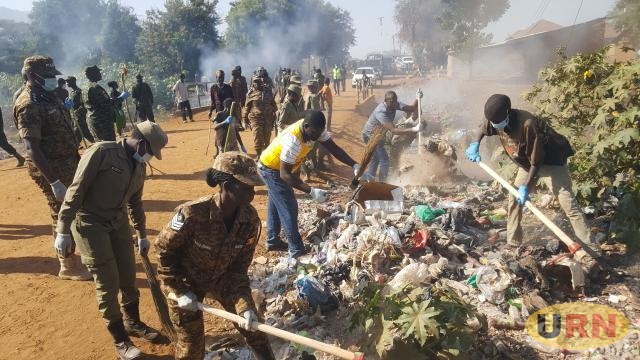
Kampala, Uganda | URN | The second National Cleaning Day has exposed mixed levels of public participation across the country, with some communities voluntarily embracing the exercise while security agencies and local authorities were forced to compel residents and businesses to comply.
The three-hour exercise was held on Saturday, August 29, from 7:00 am to 10:00 am as part of a government initiative to make community cleaning a monthly activity and improve sanitation and waste management. In several areas, police, UPDF personnel and local authorities stopped people found moving on roads, ordered businesses to close and compelled residents who had remained indoors to join the exercise.
In Kiwoko Town Council, Nakaseke District, Area Member of Parliament and Minister of State for Kampala Metropolitan Affairs Kyofatogabye Kabuye, backed by police officers, moved from house to house after reports that some residents had locked themselves indoors to avoid the exercise.
Those found inside were ordered out and given brooms to participate. Robert Kampora, LC1 Chairperson of Kibizzi Zone in Kiwoko Town Council, said authorities resorted to enforcement after some residents refused to participate, leaving others to clean their communities.
Minister Kyofatogabye also directed police and town council authorities to close businesses whose owners failed to comply with the cleaning directive.
In a statement in Luganda, Kyofatogabye directed local leaders to ensure residents complied with the exercise.
In Wobulenzi Town Council, Luwero District, travellers who were not among the categories exempted from the exercise were stopped and ordered to participate. Town council authorities also confiscated chapati stalls and stoves found along roadsides, accusing operators of failing to comply with directives to clean their surroundings.
Moses Ssebalamu, the LC3 Chairperson of Wobulenzi Town, said the confiscated items were taken to the town council offices, where the owners would be required to explain their actions. In Luwero Town Council, State Minister for the Luwero Triangle Alice Kaboyo led the exercise and urged residents to embrace the initiative. Unlike the first exercise, town councils across Luwero District hired additional garbage trucks to ensure that waste collected during the exercise was promptly removed.
The councils also received wheelbarrows, spades and other cleaning equipment donated by State Minister for Finance in charge of General Duties, Cissy Mulondo. In Masaka District and Masaka City, authorities relied largely on mobilisation and community participation rather than force. Public address systems were used to mobilise residents, while civil servants were deployed to different zones and streets to coordinate and supervise the cleaning exercise and ensure that collected waste was properly disposed of.
Ronald Kasekende, the Nyendo-Mukungwe Division Chairperson, said government workers participated alongside residents as part of a community-led approach. Ibrahim Kabugo, the Senior Assistant Secretary for Kyannamukaaka Sub-county, said security leaders were also brought on board and participated in the exercise, arguing that the involvement of leaders encouraged residents to join.
Kabugo said the exercise was also being used to sensitise communities about household hygiene, including the importance of having proper latrines and bathrooms and maintaining clean homesteads. In Kapchorwa District, participation was lower than during the previous exercise, leaving some streets in Kapchorwa Municipality littered.
While many residents cleaned their homes, only a few turned up to clean public spaces. Boda boda riders and public transport operators were among those who participated, with some stopped by police and ordered to join the exercise. Sam Kusuro, a resident of Taxi Park Cell in Central Division, said he eventually cleaned his home after waiting for other residents who did not turn up.
Ann Chelangat, LC1 Chairperson of Sosio Cell, said residents had been mobilised beforehand and directed to ensure that every household participated. At Kapchorwa Hospital, patient caretakers joined health workers in cleaning the hospital premises.
The municipality, however, continues to face challenges in garbage disposal because of limited space for waste management. Some municipal waste is dumped at Camp Swahili near the hospital lagoon, an area surrounded by residents. In Kabale District, the exercise was widely embraced, although some residents concentrated on cleaning public roads and streets while neglecting their homes.
In Bungongi, Northern Division, Kabale Municipality, some residents were observed burning garbage instead of transporting it to designated dumping sites. Police officers were deployed to enforce compliance, with some motorists stopped and questioned during the designated cleaning period. Tourism vehicles and cargo trucks bearing foreign registration plates, however, were seen moving freely.
In Moroto Municipality, joint security teams comprising the UPDF, Police, Anti-Stock Theft Units and local leaders took to the streets at about 7:00 am. Unlike the previous exercise, most residents remained at home and cleaned their compounds rather than joining the cleaning of public spaces.
Security personnel intercepted pedestrians, cyclists and motorists who were moving during the exercise and tasked them to clean before continuing with their journeys. Brig. Gen. Michael Walaka Hyeroba, the UPDF 3rd Division Commander, said although many residents did not participate in cleaning public areas, maintaining cleanliness at household level was still important.
He encouraged communities to maintain hygiene and sanitation and dedicate at least one day at the end of every month to general environmental cleanliness.
Moroto Resident District Commissioner Benon Kwikiriza said the exercise focused on densely populated areas, including the market, hospital and bridges, which he said had increasingly become dumping grounds. Kwikiriza said residents were slowly embracing the initiative but lacked basic cleaning equipment such as rakes, hoes, spades and wheelbarrows. He urged residents to voluntarily embrace the exercise rather than wait for enforcement.
Moroto Municipality MP Francis Adome welcomed the initiative, saying it had increased awareness about hygiene and sanitation and that residents were gradually improving their waste management practices. In Soroti City, participation was also low, with several shops found operating as usual at the start of the exercise. UPDF officers ordered some businesses to close and called for stricter action against people who prioritise business over participation.
Lt. Paul Ochoria said the exercise should be community-driven and should not be viewed as punishment, but warned that continued resistance to the government directive could attract legal action. In Busia, district and municipal leaders joined residents in cleaning streets and public areas, including Majanji Road, Tororo Road, Busia Customs and Busia Main Market. Busia Deputy Resident District Commissioner Nassar Wandera Kisuyi moved from house to house waking residents who were still asleep and asking them to participate.
He said the approach was intended to ensure residents understood the importance of the national activity and took responsibility for cleaning their surroundings. Dick Maena, the Assistant District Health Officer in charge of Environmental Health, said the exercise had improved hygiene and sanitation in the area, which previously faced challenges associated with cholera outbreaks.
Busia Municipality Councillor Juma Odero said poor garbage management remained a challenge and disclosed that plans were underway to engage four contractors to improve garbage collection and management. In Mbarara City, more than five people were arrested after allegedly disguising themselves as medical workers to avoid participating in the exercise.
Three of those intercepted claimed they were travelling to Mbarara Regional Referral Hospital but could not produce identification proving that they were essential workers. They were later released on caution and required to participate in the cleaning exercise. Mbarara Deputy Resident City Commissioner Gerrard Tukamuhabwa said authorities were forced to compel some residents to leave their homes and clean their surroundings.
Tukamuhabwa said some areas had accumulated large amounts of garbage and residents lacked adequate sensitisation on proper waste disposal. “From what we have witnessed, people have not taken it up as we expected. We hoped people would do it voluntarily, but what we are seeing may mean we need to apply some force. Therefore, we are going to sit back on the drawing board and see how next Saturday will be handled,” he said.
Mbarara City Mayor Robert Mugabe Kakyebezi also criticised the low participation, saying residents needed to be compelled to take part in cleaning activities. Francis Basiima, the Kiswahili Cell Chairperson, called for increased public sensitisation alongside enforcement. “Unlike the first time, when people overwhelmingly participated, today people are seriously sleeping. I think we need people to be forced and also more awareness is wanted to see all people participate,” Basiima said.
The mixed response comes as the government seeks to turn National Cleaning Day into a permanent monthly culture rather than a one-off campaign. The first National Cleaning Day was held in July 2026, with the government directing citizens to suspend non-essential activities during the three-hour exercise and participate in cleaning their communities.
The government says the initiative is intended to reduce diseases associated with poor sanitation, improve waste management and make cleanliness a shared responsibility between citizens, local authorities and other stakeholders. However, the second exercise has highlighted the challenge of securing voluntary participation, with authorities in several parts of the country resorting to police and military enforcement.
The government now faces the task of balancing enforcement of the directive with its stated objective of building a culture in which communities voluntarily take responsibility for maintaining clean and healthy surroundings.


I’m still saying that National Cleaning Day deprives unemployed people (not just youth) of employment opportunities, especially those who have no skills, and those who cannot read and write.
Every area can have cleaning contracts (possibly tens or even hundreds of thousands of jobs) for the unemployed people of that area, which are renewed on condition that the areas pass inspection standards (inspectors will be in the thousands jobs. There can even be trainers (more jobs) who train them how to separate kasasiro into different categories and other skills for waste management not known by the general public. And we can even give contacts to groups of unemployed people to make local brooms and suitable baskets for cleaning (more jobs) and even train others how to produce the materials used for those cleaning tools in an environmentally friendly and sustainable way.
There are literally thousands and thousands of employment opportunities being thrown away by National Cleaning Day… and we’re not getting the best results by forcing people who don’t want to clean because they will do a lousy job and just scatter kasasiro while cleaning or create mounds of kasasiro that won’t be collected.
The intention was good but this thing needs more careful thought, as they say “the road to hell is paved with good intentions”.
As taxpayers, most of us would be very happy if our taxes are used to kill two birds with one stone – the burning issue of unemployment (this can create thousands and thousands of desperately needed jobs) while also cleaning up our country and keeping it clean in ways that will make people very reluctant to spoil the newly established and properly maintained cleanliness (this strategy has worked very well in many of the cleanest towns of Uganda).
My point, exactly. I did express the same opinion.