The Independent Uganda: You get the Truth we Pay the Price


Concerns growing over the privacy, security, and sovereignty of Ugandans’ health data
NEWS ANALYSIS | RONALD MUSOKE | A new report by Human Rights Watch has renewed scrutiny of a new generation of health cooperation agreements between the United States and African governments, raising concerns about data-sharing provisions, pathogen access arrangements and the broader implications for health sovereignty across the continent.
The report, released on June 8, examines seven bilateral health agreements signed in late 2025 between the United States and Ethiopia, Kenya, Mozambique, Nigeria, Rwanda, Liberia and Uganda under Washington’s America First Global Health Strategy.
Human Rights Watch argues that the agreements condition critical health assistance on extensive access to health surveillance data and biological samples, while providing insufficient guarantees on privacy protections, equitable benefit-sharing and transparency.
“The agreements show the US intends to condition vital health assistance for millions of people on acquiescence to troubling conditions,” said Julia Bleckner, the senior health researcher at Human Rights Watch. “After the sudden and devastating pullback from US assistance in 2025, governments are now being pressured to accept agreements with contingencies that jeopardize human rights.”
The rights organization also called on Washington to publish all agreements signed under the programme, noting that only a handful have become publicly available. The report arrives amid an increasingly visible debate across Africa over the future of international health partnerships and the terms under which governments share health data, disease surveillance information and biological specimens with foreign partners. At the centre of that debate is Uganda, which became one of the first African countries to embrace the new U.S. approach.
Uganda’s landmark agreement
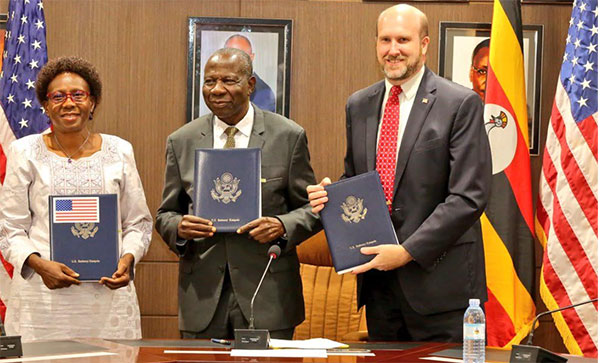
On Dec. 10, 2025, Uganda and the United States signed a five-year bilateral health cooperation Memorandum of Understanding valued at an estimated US$2.3 billion under Washington’s America First Global Health Strategy. The agreement committed US$1.7 billion from the United States while Uganda pledged to increase domestic health spending by approximately US$577 million over the duration of the partnership.
Signed at the Ministry of Finance headquarters in Kampala, the deal was presented by both governments as a major shift away from traditional donor-recipient relationships toward what officials described as a partnership based on shared responsibility, co-investment and long-term sustainability. Outgoing Finance Minister, Matia Kasaija, hailed the agreement as an opportunity to strengthen Uganda’s health systems.
“This collaboration will yield not only disease-specific outcomes but also significant improvements in national systems, institutions, and workforce capacity,” Kasaija said at the signing ceremony. “This is highly commendable.”
The partnership covers HIV/AIDS, tuberculosis, malaria, maternal and child health, disease surveillance and emergency preparedness. It also promises investment in laboratory systems, pharmaceutical supply chains, digital health infrastructure and workforce development.
For Washington, the agreement represented part of a broader restructuring of U.S. global health assistance following sweeping changes to foreign aid programmes in 2025. Outgoing U.S. Ambassador to Uganda, William W. Popp, described the arrangement as a strategic evolution of American engagement.
“We are building on prior successes and making a significant shift towards promoting self-reliance in the health sector through strong community health systems, clear performance metrics, and a foundational commitment to data systems and global health security that will prevent and stop outbreaks from threatening Uganda, the United States and the world,” Popp said.
Ugandan officials also emphasized that national sovereignty would remain protected. The outgoing Health Minister, Dr. Jane Ruth Aceng, said Uganda’s biological resources and health information would remain under national control.
“Uganda’s sovereignty over its biological resources and health data is invaluable and non-negotiable,” Dr. Aceng said. “We are leaving behind outdated, extractive models. Every aspect of data sharing must adhere to three non-negotiable principles: mutual benefit, prior sovereign consent and full transparency in compliance with Ugandan law.”
She added that the partnership marked a broader shift in Uganda’s development trajectory. “Today we elevate that relationship from traditional aid to a strategic, sovereign-driven partnership that fully aligns with and accelerates Uganda’s health sector development plan,” she said.
A new model for global health aid
Uganda’s agreement was among the earliest signed under the America First Global Health Strategy, unveiled by Washington in September 2025. The strategy represents a significant departure from previous approaches through which much U.S. health assistance was delivered via multilateral institutions and large global programmes. Under the new framework, countries enter direct bilateral agreements with Washington that combine health financing, domestic co-investment commitments, performance targets and integrated reporting requirements.
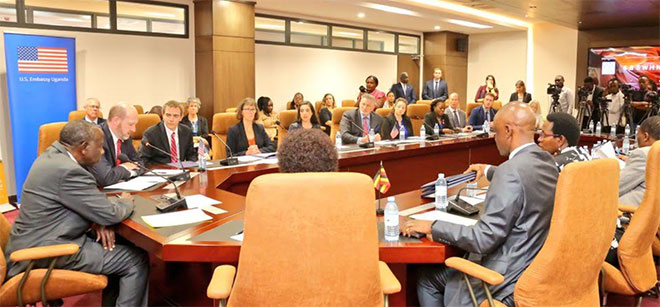
According to U.S. officials, the objective is to reduce long-term dependency on foreign aid by encouraging governments to assume greater responsibility for financing and managing their own health systems. Uganda’s agreement illustrates this transition. While Washington provides the bulk of the financing, Kampala committed to gradually increasing domestic health spending over the life of the partnership.
The agreement also places strong emphasis on digital transformation, including electronic medical records, integrated surveillance systems and centralized health information platforms. Supporters argue these investments are critical to strengthening outbreak detection, improving accountability and preparing countries for future pandemics. But it is precisely these provisions that have become the focus of growing controversy.
Questions over data governance
At the heart of the debate is a question that extends far beyond Uganda: who controls the vast amounts of health information generated by increasingly digital health systems? Human Rights Watch argues that the agreements grant Washington broad access to health surveillance information while failing to establish clear and uniform safeguards for privacy and confidentiality. The organization said the agreements raise “serious concerns about use of people’s private health data, without clear limits, uniform safeguards, or meaningful protections for patient confidentiality.”
The report also notes that several participating countries have limited or evolving data protection frameworks. According to Human Rights Watch, some agreements include provisions allowing extensive monitoring of compliance with U.S. legal requirements, including restrictions linked to the Helms Amendment, a U.S. law prohibiting foreign assistance for abortion services.
The organization warned that governments could risk losing funding if they fail to comply with reporting obligations. Ugandan officials have rejected suggestions that the agreement compromises national control over health information.
Shortly after the U.S.-Uganda agreement was signed, Dr. Aceng said data sovereignty remained protected under the arrangement. “The aggregate data is for supporting the U.S Congress in taking its decisions on the progress we are making at every step,” she said. “The raw data remains with the government of Uganda as a sovereign country and whatever form of data that is required will be agreed to according to all the laws of Uganda.”
However, concerns have continued to emerge from legal and policy analysts. David Waboga, a legal researcher with LawPoint Uganda, argued that the most consequential aspects of the arrangement may lie in supplementary agreements governing long-term access to health information.
“I am particularly concerned about how this agreement handles the privacy, security, and sovereignty of Ugandans’ health data,” Waboga wrote in an analysis published after the agreement became public. “Modern health systems increasingly rely on digital technologies, raising serious questions about data governance, accountability, and compliance with Uganda’s Data Protection and Privacy Act,” he added.
Waboga noted that health information systems routinely collect highly sensitive data including HIV status, tuberculosis records, pregnancy information and maternal health indicators. “Major investments, especially those tied to digital health, must come with strong safeguards,” he warned.
Beyond Uganda
The debate unfolding in Uganda mirrors developments elsewhere on the continent. In Kenya, a similar agreement quickly became the subject of litigation. On Dec. 11, 2025, one day after Uganda signed its deal, Kenya’s High Court suspended implementation of a US$1.6 billion health cooperation agreement following a petition filed by the Consumers Federation of Kenya and Senator Okiya Omtatah. The petitioners argued that aspects of the agreement could conflict with Kenya’s Data Protection Act and sought safeguards against the transfer of sensitive health information.
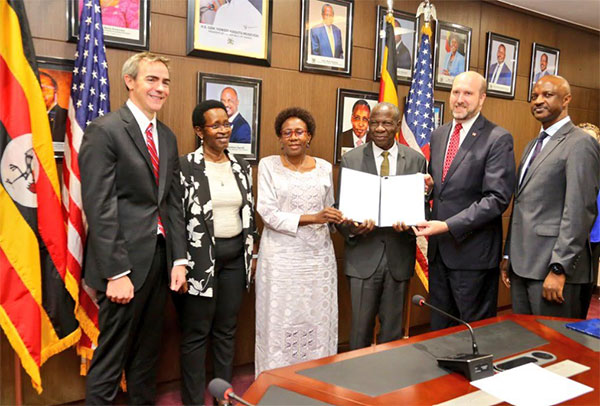
Despite the legal challenge, Kenyan and U.S. officials have continued preparations for implementation. During a recent review meeting in Nairobi, between Kenya’s Health Cabinet Secretary Aden Duale and a U.S. delegation led by Chargé d’Affaires Susan Burns, both sides reported progress toward a July 1, 2026 implementation timeline. According to Kenya’s Ministry of Health, discussions focused on programme management structures, transition planning, risk assessments and broader health-system strengthening initiatives.
But, further south, Zambia opted for caution. In February, Zambian authorities delayed signing a proposed US$1 billion health agreement after reviewing revised provisions. A spokesperson for the Ministry of Health said one section of the agreement failed to align with government interests. “That section did not align with the position and interests of the government of Zambia,” the spokesperson told Reuters. “We have therefore requested further revisions to the content in question.”
Civil society organizations in Zambia subsequently raised concerns about transparency and data-sharing arrangements Owen Mulenga of the Treatment Advocacy and Literacy Campaign argued that any partnership should be accompanied by greater public disclosure. “The data sharing will be one way from Zambia to the U.S and the information will benefit the U.S,” Mulenga said. “We need support from the U.S. but there should be transparency.”
Zimbabwe took an even stronger position. On Feb. 25, the government withdrew entirely from negotiations over a proposed US$367 million health cooperation agreement. Government spokesperson Nick Mangwana said the arrangement failed to provide adequate reciprocity. “At its core, the arrangement was asymmetrical,” Mangwana said.
“Zimbabwe was being asked to share its biological resources and data over an extended period, with no corresponding guarantee of access to any medical innovations… such as vaccines, diagnostics, or treatments… that might result from that shared data.” He also criticized the absence of reciprocal data-sharing commitments from Washington. “The U.S was not offering reciprocal sharing of its own epidemiological data,” he said.
At the same time, Mangwana stressed that Zimbabwe’s position should not be interpreted as opposition to cooperation with the United States. “This growing continental reflection should not be misconstrued as an anti-American sentiment,” he said. “It is a sign of Africa’s maturation as a geopolitical actor, one that seeks partnerships based on equality rather than patronage.”
Africa CDC weighs in
The debate has also attracted the attention of continental health institutions. Dr Jean Kaseya, the Director-General of the Africa Centres for Disease Control and Prevention (Africa CDC), has publicly defended the right of African governments to seek clarification or renegotiate provisions they consider problematic.
“It’s not a joke, it’s a serious issue,” Dr. Kaseya said during a virtual press briefing in February. Dr. Kaseya said African health ministers had long sought greater transparency regarding U.S. claims about the scale of health assistance provided to the continent.
“None of them — I say none of them — recognised this amount of money that the U.S. was saying it was providing to African countries,” he said. While welcoming aspects of Washington’s health strategy, he expressed concern that negotiations had proceeded without fuller engagement from continental institutions.
“We cannot be an observer when a partner is coming to talk to our countries,” he said. “We are talking about sovereignty. We are talking about global health security.” “There are huge concerns regarding data and pathogen sharing,” he added. “We want to hold our data in Africa. We want to hold our future.”
At the same time, Dr. Kaseya stressed that Africa CDC would support whichever decisions individual governments ultimately make. “I’m supporting Zimbabwe if they want further negotiation. I’m supporting Zambia and other countries,” he said. “But for countries who decided to sign, we will also support them for implementation.”
Transparency concerns
Human Rights Watch is not the only organization calling for greater transparency. According to Public Citizen, a Washington-based consumer advocacy organization, the U.S. State Department briefly posted several agreements online in March, this year, before removing them days later.
The organization said the documents represented only a fraction of the agreements reportedly signed under the programme. Public Citizen has since called on the State Department to publish all agreements and respond to outstanding Freedom of Information Act requests seeking additional documentation.
“The affected communities, service providers and experts need to be able to read the deals, to prepare for implementation and know what could change for health, and to advocate for improvements in future deals,” said Peter Maybarduk, the Director of Public Citizen’s Access to Medicines programme. “The State Department’s secrecy degrades America’s standing as a partner and may cost lives,” he added.
Human Rights Watch echoed those concerns in its report, arguing that governments and citizens should be able to scrutinize agreements that could shape public health systems for years to come. The organization also called for disclosure of any negotiations involving access to natural resources in countries participating in the programme following reports that broader strategic considerations have featured in some discussions.
A debate likely to continue
For now, the agreements remain at different stages of implementation across the continent. Some governments have embraced them as an opportunity to secure long-term financing, modernize health systems and strengthen preparedness for future disease outbreaks. Others have demanded revisions, sought judicial review or withdrawn altogether.
What is increasingly clear is that the debate extends beyond questions of aid. It touches on issues of sovereignty, data governance, global health security and the evolving nature of partnerships between African states and major powers. As countries move from negotiation to implementation, Human Rights Watch’s latest report is likely to intensify calls for transparency and greater public scrutiny of agreements that could shape the future of health systems across Africa for decades to come.