The Independent Uganda: You get the Truth we Pay the Price



The Asian nation was absent from the pitch, but its technology, factories and brands helped power football’s biggest spectacle
NEWS ANALYSIS | IAN KATUSIIME | The irony could hardly be greater. China, a country that has struggled for decades to become a football powerhouse, did not feature at the expanded 48-team FIFA World Cup in North America. China has only played at the 2002 World Cup in its history.
Yet as billions tuned in, they watched a tournament supported by Chinese technology, branded by Chinese sponsors and supplied through Chinese manufacturing. China’s industrial and technological dominance underscored a different kind of victory in the age of global supply chains.
China’s fingerprints were perhaps most visible in the tournament’s technology ecosystem. Lenovo, the Chinese technology giant and FIFA’s official technology partner, supplied AI-enabled devices, servers and digital infrastructure that supported tournament operations across the expanded competition.
Lenovo deployed over 17,000 devices and 350 engineers across the 16 host stadiums in the U.S., Canada and Mexico. Instead of just running ads, they built the tournament’s back-end IT framework and the Football AI Pro platform used by coaches for advanced match analysis.
“What Chinese companies export today is no longer a single product,” Qiao Jian, chief strategy officer and chief marketing officer of Lenovo was quoted by China Daily.
“Increasingly, they are exporting integrated technology capabilities and becoming part of the infrastructure that powers global events.”
Qiao described the World Cup as the world’s largest AI testing ground. Lenovo showcased hybrid AI systems that generate 3-dimensional digital twins of players and real-time offside alerts.
Hisense became part of football’s officiating infrastructure. As FIFA’s Official VAR Review TV Provider, the Chinese electronics giant supplied its MiniLED displays for the Video Operation Room (VAR) at the International Broadcast Centre in Dallas, Texas where video assistant referees reviewed contentious incidents with the clarity and colour accuracy demanded by elite-level officiating. Match officials had the visual precision needed to review goals, offsides, penalty decisions and red-card incidents during the tournament.
Hisense went from being a company displaying its logo to one whose technology officials relied on to make some of the tournament’s most consequential decisions.
Chinese manufacturing
Many physical items at the World Cup were deeply tied to Chinese manufacturing. From stadium infrastructure (like cooling systems and LED screens) to official merchandise like footballs, replica jerseys, flags, and fan toys, there was a reckoning that few countries possess the industrial depth to supply a global event involving millions of fans across multiple continents.
This feat is attributed to Yiwu, a city in China’s eastern Zhejiang province that operates as the undisputed “Wholesale Capital of the World” and the ultimate manufacturing engine behind global sports merchandise.
Chinese manufacturing hubs were the lifeblood of the tournament’s physical footprint. China produces around 30% of global manufacturing output.
For decades, China’s role in global sport was largely invisible: a manufacturing powerhouse producing goods for international brands. But the World Cup illustrates how that relationship has evolved. Chinese factories are no longer merely the anonymous suppliers behind football’s biggest spectacle; they are part of the global supply chain that makes the event possible.

From Yiwu’s vast wholesale markets, where traders prepare everything from flags to scarves and supporter merchandise, to specialized manufacturers producing stadium equipment and electronics, there was a sense that China’s industrial capacity allowed FIFA’s global vision to be delivered at extraordinary scale.
China’s presence at the World Cup reflects a broader ambition that extends beyond commercial interests: the use of sport as an instrument of diplomacy and global influence. For years, Beijing has sought to transform football into a symbol of national rejuvenation.
President Xi Jinping has repeatedly spoken of his ambition for China to become a football powerhouse, with the country eventually hosting and winning a FIFA World Cup.
In 2015, China’s State Council unveiled an ambitious football reform plan aimed at developing thousands of academies, expanding participation and building a stronger domestic football industry.
“The dream of a strong sports power is an important component of the Chinese dream,” Xi said in 2017, highlighting the political importance Beijing attaches to sport.
Yet China’s football ambitions have produced a striking paradox. While its national team has struggled to qualify for the world’s biggest tournament, Chinese companies have become increasingly embedded in the global football economy.
Through sponsorships, technology partnerships and manufacturing capacity, Beijing’s influence has moved from the pitch to the infrastructure surrounding the game. The 2026 World Cup illustrates this evolution: China may not have had a team competing in the tournament, but its companies are helping build, finance and commercialise the spectacle.
This reflects a broader feature of China’s soft-power strategy, where influence is not only built through military strength or diplomatic alliances, but through visibility, commerce and cultural association.
By attaching Chinese brands to the world’s most watched sporting event, analysts said companies such as Lenovo, Hisense and dairy producer Mengniu gained something more valuable than advertising space, a place in the global conversation.
These companies invested roughly $350 million as some of the most prominent official sponsors of the 2026 World Cup. FIFA’s 2026 cycle is expected to generate around $11-13bn the bulk of which is broadcasting revenue.
The World Cup has become another arena where China competes for recognition and influence, even when its players are absent.
China’s influence also extended into broadcasting. China Media Group (CMG), the state-owned media conglomerate, secured the domestic broadcast rights for the 2026 FIFA World Cup in a deal that underscored the country’s importance as one of football’s largest television markets.
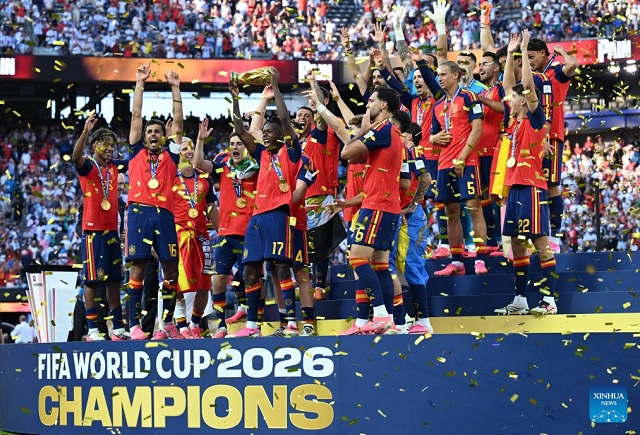
With a population of more than 1.4 billion, China represents one of the biggest audiences available to FIFA’s global broadcasters. The 2026 World Cup Final reached over 1.5 billion viewers.
According to media reports, FIFA initially sought as much as US$300 million for the Chinese rights but ultimately accepted a deal worth about US$60 million. The steep discount reflected a convergence of commercial realities.
With the tournament being staged in North America, many marquee fixtures kicked off during the early hours of the morning in China, reducing their appeal to advertisers and diminishing the value of the broadcast package.
CMG also negotiated from a position of strength. With no competing bidder for the rights and the tournament less than a month away, FIFA faced mounting pressure to conclude a deal rather than risk entering the World Cup without a broadcaster in one of its most important media markets.
The episode was a reminder that while FIFA commands enormous commercial power, it must ultimately bow to market forces.
U.S.-China interdependence
China’s growing presence at the World Cup comes against the backdrop of a tournament being staged in the heart of American economic power. The United States provides the commercial infrastructure behind the event, from its stadiums and transport networks to its global entertainment industry and financial markets.
FIFA’s biggest commercial partners remain drawn from a wide range of economies, reflecting the continued dominance of Western companies in global sport. Yet the 2026 tournament also highlights the extent to which the world’s two largest economies remain economically intertwined despite strategic competition.
While Washington and Beijing continue to compete over emerging technologies, trade and geopolitical influence, the World Cup reveals a different reality: global events of this scale rely on complex supply chains that cross borders. American infrastructure, FIFA’s global brand and Chinese manufacturing and technology are operating within the same ecosystem.
Despite the growing presence of Chinese companies around football, Beijing’s influence has not translated into success on the pitch. China’s national team failed to qualify for the 2026 World Cup, extending a decades-long struggle to establish itself among football’s elite despite significant investment in youth development, domestic leagues and overseas acquisitions.
Sports commentators say the contrast underscores the distinction between economic influence and sporting power.
Chinese companies can secure sponsorship agreements, provide technology and manufacture products used across the tournament, but the country’s football ambitions remain constrained by the challenge of developing a competitive national team.
For now, China’s strongest position in global football lies not on the field, but in the commercial ecosystem surrounding it.
Geopolitical analysts have stated that the World Cup demonstrates how influence in global sport is no longer determined solely by who plays or who hosts, but also by who supplies the technology, capital and infrastructure behind the spectacle.