 The Independent Uganda: You get the Truth we Pay the Price


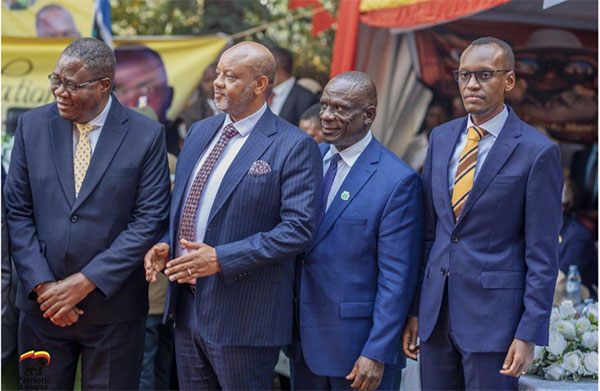
Mawanda, and Edwin Karugire at the event where Daudi Kabanda handed over the
office of Secretary General to Fadili Twalla.
How PLU is swallowing NRM
Kampala, Uganda | IAN KATUSIIME | Is the Patriotic League of Uganda (PLU) an opposition outfit? Is it a faction within the ruling National Resistance Movement (NRM), or does it operate as an independent political entity? Those are the questions dominating political discourse in Uganda as Gen. Muhoozi Kainerugaba, the chairman of PLU, looms large in Ugandan politics.
Gen. Muhoozi is the Chief of Defence Forces and son of President Yoweri Museveni. He is widely seen as the heir apparent to his father after 40 years of NRM. Age has taken a toll on Museveni, who is 81 years old.
Muhoozi ordered a military siege on Daily Monitor, NTV Uganda and sister companies of the Nation Media Group in the wee hours of June 27. The shutdown of the operations of two of Uganda’s leading media houses sparked condemnation and outrage from the public.
Muhoozi ordered the abduction of Miria Matembe, renowned activist and former minister of ethics and integrity. The CDF also ordered for the arrest of Susan Nsibirwa, the Managing Director of Monitor Publications. The whereabouts of the two remain unknown as a state of fear engulfs Uganda.
Also briefly arrested were Eunice Musiime, Director of Akina Mama wa Afrika, a women’s rights NGO, and Sarah Bireete, Executive Director of Centre for Constitutional Governance.
Critics have said the country has reached a crossroads as Gen. Muhoozi orders for the arrest of whoever opposes or disagrees with him. From generals to activists, journalists and opposition politicians.
The CDF has referred to the Speaker and Deputy Speaker of Parliament Jacob Oboth and Thomas Tayebwa as “my envoys to Parliament”. Commentators have spoken about PLU’s hostile takeover of the NRM in the workings of government.
The Ugandan Constitution, however, bars serving officers like Gen. Muhoozi from engaging in partisan politics or making political statements. Article 208 of the Constitution states that the Uganda People’s Defence Forces (UPDF) shall remain non-partisan in character.
In addition, Section 99 of the UPDF Act, 2005, bars serving personnel from engaging in partisan politics or making political statements unless they have been discharged from the army.
However Muhoozi has got a free pass by virtue of being the president’s son. Senior officers who exhibited similar behaviour in the past faced stern action.
PLU takeover
Muhoozi’s PLU has continued to mobilise and garner influence across the country. “I believe that every Ugandan should be a member of PLU,” Oboth said.The new Speaker has repeatedly praised the CDF, a stance critics say sits uneasily with the constitutional independence expected of Parliament.
NRM ministers and MPs happily identify with PLU and carry out the organisation’s objectives publicly. NRM honchos such as the vice chairman, secretary general, party cadres have all faded into oblivion as PLU officials like Daudi Kabanda take centre stage.
Muhoozi appointed Daudi Kabanda to the position of head of chairman’s office in PLU–an undefined role but one believed to be with access to the organisation’s leader. He was previously PLU Secretary General.
PLU’s political activities have continued to gain momentum. At Kabanda’s handover to new PLU Secretary General to Fadil Twaha, several ministers and MPs attended, including Kiryowa Kiwanuka, Frank Tumwebaze, Lydia Wanyoto, Balam Barugahara, Jane Ruth Aceng and other supporters of the organisation.
During the same event, Michael Nuwagira, also known as Toyota, a businessman and President Museveni’s younger brother, said PLU was not a political party but rather an organisation that supports the activities of the NRM.
“I want to thank the NRM for their cooperation and unity,” he said. Toyota’s remarks, however, also exposed what many observers see as PLU’s inherent contradiction.
“I know some double in NRM and PLU but we are one, tuko pamoja,” he said.

PLU chairman Muhoozi has, on several occasions, criticised the NRM, describing it as a “reactionary organisation” and denouncing the corruption within it.
Even so, PLU has relied heavily on the NRM as a political springboard, leveraging the ruling party’s organisational structures, grassroots networks and parliamentary numbers to build its own political vehicle.
The organisation rides on the personality and prominence of the First Son but derives much of its political capital from the NRM, which commands 342 MPs and thousands of cadres across the country.
The attendance of Speaker Jacob Oboth, who officiated as the chief guest was notable not to mention his remarks.
Oboth became Speaker following Muhoozi’s public endorsement on X. Tayebwa also retained his position after receiving Muhoozi’s backing, despite sustained public calls for his removal over corruption allegations.
Tayebwa served as Deputy Speaker during the tenure of former Speaker Anita Among, when Parliament approved a series of controversial expenditures, including generous travel budgets, household shopping allowances and what critics described as lavish spending.
PLU was instrumental in Among’s removal at the beginning of the 12th Parliament. Since then, the organisation’s influence has continued to expand as succession politics within the NRM gather momentum.
PLU also organised a thanksgiving ceremony at Oboth’s home just days after Muhoozi endorsed him for Speaker. The event attracted senior NRM figures, ministers, MPs, businesspeople, UPDF officers, religious leaders, socialites and other influential personalities.
PLU now operates with a fully-fledged secretariat headed by its chairman, Muhoozi. It has developed its own internal ranking system, assigning numbers to indicate seniority, while continuing to appoint individuals into various positions.
Political analysts and commentators argue that PLU is an unconstitutional organisation led by the country’s serving army chief and should not be involved in political mobilisation or the conduct of government affairs.
Muhoozi has continued to flout the law without consequences. But for Muhoozi, critics argue, the rules that applied to the likes of Kizza Besigye, David Sejusa and Henry Tumukunde appear to have been set aside to accommodate what has become a familiar political strategy aimed at positioning him to succeed his father.
The other move by Muhoozi and PLU is to have opposition Members of Parliament elect the Leader of the Opposition (LOP).
The position of Leader of the Opposition is currently appointed by the largest opposition party in Parliament, which is the National Unity Platform (NUP). The incumbent is Joel Ssenyonyi, the MP for Nakawa West and a relentless critic of Gen. Muhoozi and the NRM government. NUP recently reappointed Ssenyonyi to a second term.
Ssenyonyi is a vocal legislator who has consistently held the government to account over the abduction of opposition members, corruption and official incompetence. He has been described as one of the most effective Leaders of the Opposition since the position was created in 2006 at the start of the multiparty era.
Dennis Namara, the Buyaga West MP allied to PLU, wrote to Speaker of Parliament Jacob Oboth regarding the proposal. Namara’s Private Member’s Bill, titled the Administration of Parliament (Amendment) Bill, 2026, seeks to amend Section 8 of the Act to allow opposition legislators, together with their Independent colleagues, to elect the Leader of the Opposition.
“The LOP is selected from Kavule [NUP headquarters] by a few individuals without consulting other opposition MPs. Now for me and my colleagues who are seconding the motion, this is not enough,” said Namara at Parliament.
“For purposes of ensuring accountability, value for money and deepening democracy, we have given notice to the Clerk,” he added.
The proposal has drawn sharp criticism from political commentators and advocates of parliamentary democracy, who say it is the latest sign of Parliament’s capture by PLU, an organisation founded by a serving army officer.
PLU initiated the move to weaken the position of LOP Joel Ssenyonyi, who has emerged as one of Muhoozi’s fiercest critics in Parliament. Following the abduction of lawyer Erias Lukwago by the Special Forces Command on the orders of Gen. Muhoozi, Ssenyonyi convened a press conference at Parliament and urged the army chief to formally join politics.
“Remove the uniform and stop using the office to play politics,” he said.
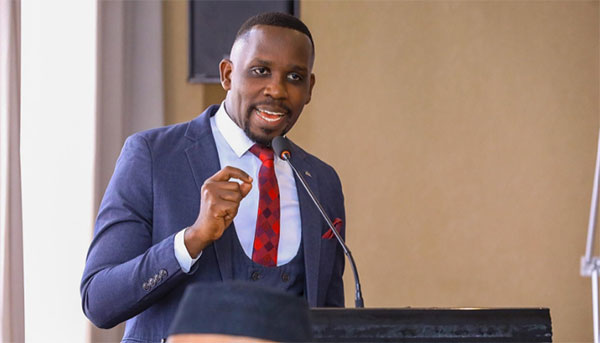
Ssenyonyi later posted on X about an alleged plan to add him to the treason charges facing former Butambala MP Muwanga Kivumbi. The second-term MP has become one of the opposition’s strongest pillars.
During the Kalangala Woman MP by-election, in which the NRM faced NUP, Ssenyonyi was travelling by ferry to the island district when the vessel reportedly turned around before reaching its destination.
“We were on the ferry for two hours when I learnt that they got instructions to move the ferry for as long as I am on it,” he told journalists.
Now PLU, Muhoozi’s political vehicle, is involved in efforts to amend the law and pave the way for the election of a potentially more pliant Leader of the Opposition.
The proposal has angered opposition legislators, who argue that PLU has no legitimate basis for driving such a change.
“It is like asking the Muslims to select a Bishop for a diocese,” former Buhweju MP Francis Mwijukye told journalists.
“They cannot remove the LOP. They are only threatening to bring him to his knees. They don’t have the energy and the grounds to do that,” said Medard Ssegona, former MP for Busiro South.
Abuse of the law
Muhoozi has continued to attract criticism over what opponents describe as repeated disregard for the law.
Just weeks ago, he ordered the abduction of former Kampala Lord Mayor Erias Lukwago as the lawyer prepared to serve court summons requiring the army chief to respond to a legal challenge.
Lukwago’s abduction provoked widespread outrage and condemnation from many Ugandans concerned about the country’s deteriorating human rights situation.
On X, many Ugandans demanded Lukwago’s immediate release. He built his reputation as Kampala Lord Mayor by championing the rights of ordinary citizens and later distinguished himself as a constitutional lawyer committed to defending the rule of law.
As a political organisation, PLU has increasingly found itself overshadowed by its chairman’s alleged disregard for constitutional safeguards.
Among its prominent members are renowned legal professionals, including Kiryowa Kiwanuka, the former Attorney General. Muhoozi’s brother-in-law, Edwin Karugire, a lawyer and partner at K&K Advocates, serves as the organisation’s legal director.
“I am still not getting how with years of Law School, legal practice and politics experience, you can rise to the highest political office as guardian of our Nation’s constitution and still proudly be conscripted in a vigilante group that is by all measure unconstitutional!” said Godber Tumushabe, lawyer and political analyst.
Tumushabe is also the director of the Great Lakes Institute for Strategic Studies (GLISS).
Dr Kizza Besigye and many other political prisoners, including Waiswa Mufumbiro, Olivia Lutaaya, Bobi Giant, Achileo Kivumbi and thousands of others, remain in detention.
Robert Kyagulanyi, president of the National Unity Platform (NUP) and the party’s 2026 presidential candidate, fled the country with his family to the United States after the army besieged his home in Magere, Wakiso District, during a nationwide manhunt. Muhoozi declared that he was hunting for Bobi Wine, dead or alive.
Bobi Wine has remained openly critical of Muhoozi on X, one of the few platforms over which Uganda’s military chief exercises no control.
Uganda’s political landscape remains tense and unpredictable as abductions, kidnappings and prolonged detentions increasingly become defining features of the country’s political environment under the growing influence of PLU.
No wonder M7 hates “Arts” courses – including the most prominent one – History, because he knows one can’t hide away from it. He is so afraid of the lessons History teaches us, one of which is dictators always fall and when they fall, its a hard fall from which they cannot recover. For all is experience and cunningness, can’t he really teach his son that if he continues down that path, he will end up like Seif Gadaffi, Uday Hussein and Qusay Hussein, Bongo in Gabon, Caucescu in Romania, Ben Ali Tunisia and Mubarak in Egypt, etc. Anyways, like any other sane Ugandan, i pray for a Mubarak “ouster” kind of revolution in Uganda soon – with both M7 caged in court and on a hospital bed, while Muhoozi is incacerated somewhere feeding on his own shame he so unashamedly gave to his opponents. Wait, i dont even have to pray, because HISTORY ALWAYS REPEATS ISTELF!!!