The Independent Uganda: You get the Truth we Pay the Price



New American sanctions target the commercial networks that turn Congo’s conflict minerals into global business
NEWS ANALYSIS | RONALD MUSOKE | For years, eastern Democratic Republic of Congo’s wars have been fought with rifles, rockets and militias. Increasingly, however, Washington believes the conflict is being sustained somewhere else entirely; in gold refineries, mining companies, financial networks and the opaque global supply chains that transform minerals extracted from rebel-held territory into international commerce.
That belief was on full display on June 25, when the United States imposed sanctions on a Rwandan gold refinery, two executives and three mining companies accused of facilitating the illicit trade in minerals from eastern Congo in support of the Rwanda-backed March 23 Movement (M23).
While sanctions have long been part of Washington’s response to the conflict in eastern Congo, the latest measures mark a notable departure. Rather than targeting another rebel commander or militia leader, their focus is turning to the commercial infrastructure that American officials say enables M23 to convert territorial control into financial power.
In doing so, the United States is signalling that the next phase of its engagement in the Great Lakes region will be defined as much by economics as by military or diplomatic pressure. The measures, announced by the U.S. Treasury Department’s Office of Foreign Assets Control (OFAC), target Gasabo Gold Refinery Ltd, its chairman, Jean Malic Kalima, the company’s general manager, Bosco Kayobotsi, and three mining firms; Bugambira Mines Ltd, Wolfram Mining and Processing Ltd, and Rwinkwavu Mining Corporation Ltd, which Treasury alleges form part of a network working with M23 to smuggle minerals from eastern Democratic Republic of Congo into Rwanda before they enter international markets.
Announcing the sanctions, Treasury Secretary Scott Bessent left little doubt about Washington’s intentions. “The United States will not allow rogue groups to profit from the illicit mineral trade and destabilize the region,” Bessent said. “The Democratic Republic of the Congo’s mineral wealth rightfully belongs to the Congolese people. Under President Trump’s leadership, we will continue to take decisive action against those who enable violence, exploitation, and attacks against the Congolese people.”
His remarks reflected a policy that extends beyond confronting an armed movement. Increasingly, U.S. officials are portraying eastern Congo’s mineral wealth not simply as a source of conflict but as a strategic resource whose illicit exploitation threatens regional stability, global supply chains and long-term economic development.
The State Department echoed that position. In a statement issued the same day, spokesperson Thomas Pigott said Washington was targeting “networks smuggling conflict minerals out of the Democratic Republic of the Congo (DRC) to support the Rwanda-backed M23 armed group.” Pigott said M23 and its backers exploit the DRC’s mineral wealth “to fund weapons, pay fighters, and sustain a destabilizing insurgency that has triggered a severe humanitarian crisis.”
He linked the sanctions to a much broader diplomatic project. According to Pigott, the measures directly support implementation of the Washington Accords for Peace and Prosperity, describing the agreement as a framework for establishing “transparent, traceable, and fully licit mineral supply chains” capable of unlocking legitimate investment while securing access to critical minerals vital to U.S. industries.
Those three words—transparent, traceable and licit—appear repeatedly throughout both the Treasury and State Department statements. They are more than bureaucratic language. They point to an increasingly important shift in Washington’s thinking. For decades, international diplomacy surrounding eastern Congo largely focused on ceasefires, peace agreements, peacekeeping missions and sanctions against armed actors. The latest U.S. measures suggest policymakers now believe that ending the conflict requires something more fundamental: dismantling the commercial networks that allegedly finance it.
A Strategy years in the making
The June 25 sanctions did not emerge in isolation. Instead, they represent the latest stage of an expanding American campaign against those accused of profiting from eastern Congo’s conflict economy. Treasury noted that Washington had already imposed sanctions linked to eastern Congo on March 2, April 30 and June 2, 2026, following an earlier package announced on August 12, 2025, targeting entities connected to illegal mining operations and the international sale of conflict minerals.

Viewed together, the chronology illustrates an important evolution. Earlier measures focused primarily on armed groups operating around strategic mining areas, companies involved in illegal extraction and traders accused of moving conflict minerals into international markets.
However, the June 25 designations move one step further. Rather than concentrating solely on activity inside Congo, they target businesses operating across the border in Rwanda that American authorities allege refine and commercialize minerals originating in territories under M23’s control. It is, in effect, an attempt to follow the money rather than merely the men carrying guns.
The shift was foreshadowed nearly a year earlier. When Treasury announced sanctions on August 12, 2025, then Under Secretary for Terrorism and Financial Intelligence John K. Hurley framed eastern Congo’s mineral trade not only as a humanitarian concern but also as a strategic challenge for the United States.
“The conflict minerals trade is exacting a deadly toll on Congolese civilians, fueling corruption, and preventing law-abiding businesses from investing in the DRC,” Hurley said. He then added a sentence that, in hindsight, appears remarkably prescient.
“The Treasury Department will not hesitate to take action against groups that deny the United States and our allies access to the critical minerals vital for our national defense.” That statement hinted at a broader geopolitical calculation.
Critical minerals; including gold, coltan, tin, tungsten and cobalt, have become indispensable to modern economies. They are essential components in semiconductors, telecommunications equipment, electric vehicles, renewable energy technologies and sophisticated defence systems. Eastern Congo possesses some of the world’s richest deposits of these resources. Yet for decades, much of that wealth has financed armed conflict rather than national development. The latest sanctions suggest Washington increasingly sees those two realities as inseparable.
Following the money
At the centre of the June 25 sanctions package lies what Treasury describes as a sophisticated cross-border mineral laundering operation linking mines in the eastern Democratic Republic of Congo to commercial enterprises in neighbouring Rwanda. According to U.S. authorities, Gasabo Gold Refinery Ltd became a crucial intermediary through which gold extracted from territories under M23’s control entered international markets.
The Treasury says that after gold was removed from mines in South Kivu occupied by the M23 and supported by the Rwanda Defence Force (RDF), Rwandan government forces maintained strict oversight of the shipments until they reached Gasabo Gold in Kigali. According to the department, RDF soldiers and M23 fighters escorted consignments from rebel-held territory across the border through Rusizi District, immediately adjacent to Bukavu, before handing them directly to refinery personnel for processing.
Treasury says that at least 60 kilograms of gold, representing millions of dollars in value, passed through this network during the early months of 2026 alone. American officials also noted that the European Union had previously sanctioned Gasabo Gold over its alleged role in transporting illegally extracted gold from the Democratic Republic of Congo.
For Washington, these details illustrate what officials argue is no longer an opportunistic smuggling enterprise but an organised commercial system capable of transforming minerals extracted in conflict zones into refined commodities destined for international markets. That distinction matters. Unlike previous sanctions directed primarily at battlefield actors, the latest measures focus on the economic infrastructure that allegedly enables conflict minerals to acquire commercial legitimacy.
From mines to markets
Besides Gasabo Gold, Treasury sanctioned the refinery’s chairman, Jean Malic Kalima, and its general manager, Bosco Kayobotsi, together with three mining companies; Bugambira Mines Ltd, Wolfram Mining and Processing Ltd, and Rwinkwavu Mining Corporation Ltd,which U.S. authorities say are controlled by Kalima.
Under U.S. sanctions regulations, all property and interests belonging to the designated persons and entities that fall within American jurisdiction are blocked, while U.S. persons are generally prohibited from conducting transactions involving them. Treasury also warned that foreign financial institutions and companies risk exposing themselves to sanctions if they knowingly facilitate transactions involving the designated entities.
Although such sanctions are often viewed primarily as diplomatic tools, their consequences can extend far beyond the United States. International banks, insurers, logistics firms and commodity traders frequently avoid doing business with sanctioned entities to minimise legal and reputational risks. In practice, designation by OFAC can make it significantly harder for companies to secure financing, maintain correspondent banking relationships or participate in global markets.
It is precisely this commercial isolation that Washington appears to be pursuing. Rather than attempting to intercept every shipment crossing the porous borders of eastern Congo, U.S. policymakers are seeking to raise the economic cost of trading minerals allegedly linked to conflict.
The economics of war
The sanctions also provide perhaps the clearest indication yet of how Washington believes M23 has financed its military resurgence. According to Treasury, the rebel movement has exploited territories under its control to generate revenue through mineral extraction and trafficking, using the proceeds to purchase weapons, acquire military equipment and pay fighters. Officials say M23’s control over mineral-rich areas has enabled the group to sustain operations while deepening one of Africa’s most severe humanitarian crises.
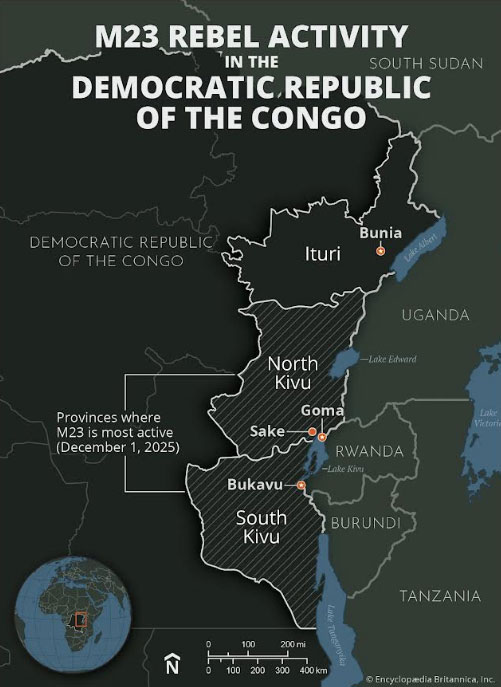
That assessment reflects a growing consensus among many analysts of the Great Lakes region that eastern Congo’s wars cannot be understood solely through military, political or ethnic lenses. They are also economic conflicts. The provinces of North Kivu and South Kivu contain significant deposits of gold, coltan, tin and tungsten, minerals indispensable to the global production of electronics, telecommunications equipment, renewable energy technologies and advanced defence systems. Control over those resources has repeatedly translated into military advantage. Treasury argues that M23 has exploited precisely this dynamic.
In announcing the sanctions, the department said the group’s control and trafficking of illicit minerals “directly fuel its destabilizing operations and further exacerbates the humanitarian crisis in the DRC.” The humanitarian consequences extend well beyond the financing of armed groups. Treasury linked conflict mineral extraction to forced labour, child labour, sexual and gender-based violence and dangerous working conditions, citing the collapse of a mine shaft at the M23-controlled Rubaya coltan mine in March 2026, which reportedly killed more than 200 people, including children.
The tragedy served as a stark illustration of how illicit mineral economies affect not only governments and armed movements but also thousands of civilians whose livelihoods depend on mining. The State Department reinforced that message. Pigott urged all actors involved in mineral supply chains; including refiners, manufacturers, end-users and financial institutions, to exercise greater due diligence, arguing that illicit mineral trading finances armed groups while enabling “forced and child labour” and perpetuating “sexual violence in mining communities.” His remarks suggest Washington increasingly views responsible mineral sourcing as a shared responsibility extending beyond governments to multinational corporations and financial institutions that ultimately purchase or finance minerals entering international markets.
Peace through economics
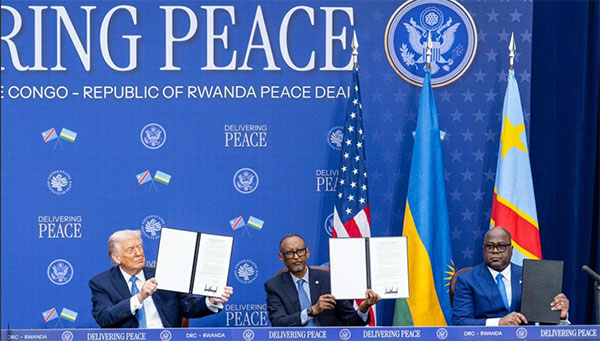
The June 25 sanctions are equally significant because they fit within a broader American diplomatic strategy that increasingly links peace, economic integration and mineral governance. Both the Treasury and the State Department were careful to describe the sanctions not as isolated punitive measures but as part of implementing the Washington Accords for Peace and Prosperity, the U.S.-brokered framework intended to improve relations between the Democratic Republic of Congo and Rwanda while encouraging lawful regional trade.
Treasury said the sanctions reinforce commitments to a Regional Economic Integration Framework designed to expand trade and investment, strengthen transparency across critical mineral supply chains and lay the foundation for long-term economic opportunity throughout the region.
That represents an important evolution in policy. For decades, international efforts in the Great Lakes region concentrated on ceasefires, peace negotiations and military stabilization. Washington now appears to be advancing a broader proposition; that lasting peace depends not only on silencing guns but also on replacing illicit mineral economies with legitimate commercial systems capable of generating prosperity instead of conflict.
Pigott captured that ambition when he argued that transparent and lawful mineral supply chains would “unlock greater opportunity for legitimate companies to invest in the region” while securing access to critical minerals vital to U.S. industries. His remarks reveal that eastern Congo is no longer viewed exclusively through the lens of humanitarian intervention. It has also become part of a wider geopolitical conversation about resilient supply chains and competition for strategic resources.
As governments seek to diversify access to critical minerals, ensuring those resources are sourced legally and transparently has become an issue of economic security as much as corporate responsibility. Treasury’s repeated observation that minerals smuggled from eastern Congo frequently transit through Rwanda before reaching major refining and processing destinations, including China, underscores that broader strategic concern.
Independent experts urge caution
Yet while Washington has presented the sanctions as an important escalation in its campaign against conflict minerals, independent analysts caution that sanctions alone are unlikely to transform eastern Congo’s political economy.
Successive reports by the United Nations Group of Experts on the Democratic Republic of the Congo have consistently documented how armed groups, including M23 and numerous rival militias, finance their operations through mineral extraction, illegal taxation and cross-border smuggling networks.
The experts have also repeatedly highlighted the regional nature of the conflict, noting that illicit mineral flows often move across national borders before entering international markets. Those findings broadly reinforce Washington’s conclusion that targeting commercial intermediaries may be as important as targeting armed commanders.
However, researchers at the International Crisis Group and other organisations have long argued that sanctions are most effective when combined with broader political and economic reforms. They contend that illicit mineral economies are highly adaptive. Networks frequently reorganize under new commercial identities, establish alternative trading routes or exploit weak border controls whenever existing channels come under pressure. Without stronger regional governance, effective customs enforcement, security sector reform and viable economic alternatives for mining communities, sanctions alone may simply redirect rather than eliminate illicit trade.
That reality partly explains why the United States has repeatedly linked the latest sanctions to the Washington Accords instead of presenting them as a stand-alone solution. Read together, the Treasury and State Department statements suggest Washington hopes sanctions will create space for lawful commerce rather than merely punish alleged wrongdoing.
The limits of allegation
As with all sanctions imposed by OFAC, the June 25 designations are administrative actions based on information assessed by the U.S. government. In its notices, Treasury sets out what it says are the factual and legal grounds for designating the companies and individuals, noting that they materially supported M23 and facilitated the illicit trade in minerals from eastern Democratic Republic of Congo. The sanctions themselves do not constitute criminal convictions.
Rather, they are economic measures intended to deny designated persons and entities access to the U.S. financial system while discouraging others from engaging in similar conduct. At the time of writing, the official U.S. statements accompanying the sanctions did not include responses from the designated companies or individuals. Likewise, the sanctions announcements did not include a response from the Government of Rwanda to the specific allegations contained in the June 25 designations.
However, Rwanda has consistently denied allegations that it supports M23, maintaining instead that its security concerns stem from the continued presence in eastern Congo of the Democratic Forces for the Liberation of Rwanda (FDLR), an armed group Kigali says poses a threat to Rwanda’s national security. Kinshasa, the United Nations and several Western governments, however, have repeatedly accused Rwanda of providing military and logistical support to M23, allegations Kigali rejects.
That distinction is important. While Washington has presented the sanctions as part of a broader effort to dismantle the financial networks allegedly sustaining the M23 insurgency, their effectiveness and the accuracy of the underlying allegations will ultimately be judged not only through financial enforcement but also through continued diplomatic engagement, independent monitoring and developments on the ground.
For the United States, however, one conclusion already appears clear. The war in eastern Congo is no longer viewed simply as a contest over territory. It is increasingly seen as a contest over the mineral wealth beneath that territory and over the commercial networks that transform those resources into revenue capable of sustaining conflict.
As Treasury Secretary Scott Bessent put it, Washington intends to continue taking “decisive action against those who enable violence, exploitation, and attacks against the Congolese people”. Whether that strategy succeeds remains uncertain. Eastern Congo’s conflict has repeatedly demonstrated that armed groups survive not only because of access to minerals but also because of weak governance, entrenched corruption, porous borders and unresolved regional rivalries. Disrupting illicit mineral finance may weaken one pillar of the conflict economy, but it cannot by itself resolve the political grievances that have fuelled instability for more than three decades.
Still, the June 25 sanctions mark an unmistakable shift in American policy. Rather than focusing exclusively on those who wage war, Washington is increasingly targeting those it believes profit from it. The new front in Congo’s conflict, at least from the perspective of U.S. policymakers, is no longer confined to the hills of North and South Kivu. It now stretches into refineries, financial institutions, corporate boardrooms and the global supply chains through which the region’s extraordinary mineral wealth reaches the world.
By following the money instead of focusing solely on the men carrying guns, Washington is betting that lasting peace in eastern Congo will depend not only on who controls territory, but also on who controls, and ultimately profits from, the minerals beneath it.