The Independent Uganda: You get the Truth we Pay the Price


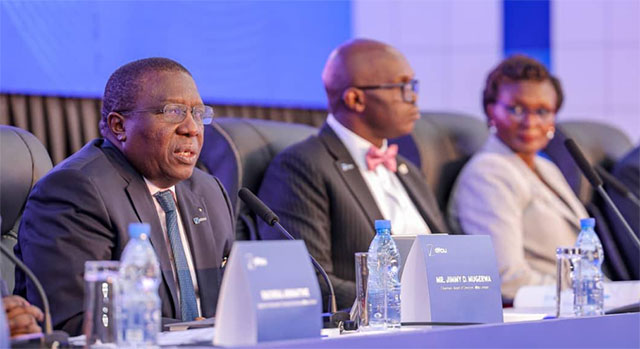
The increase followed a rise in group profit after tax to Shs74.9 billion, compared with Shs72.1 billion in 2024
Kampala, Uganda | JULIUS BUSINGE | Uganda’s financial services group dfcu Limited is entering a new phase of growth after shareholders approved a Shs16.32 billion dividend payout as it seeks to move beyond balance-sheet recovery towards expansion driven by lending, technology investment and operational discipline.
The dividend, approved at dfcu’s 61st Annual General Meeting in Kampala on July 15, represents a higher return to investors after the group reported stronger earnings for the year ended December 31, 2025. Shareholders approved a payout of Shs21.81 per share, up from Shs20.09 the previous year.
The increase followed a rise in group profit after tax to Shs74.9 billion, compared with Shs72.1 billion in 2024. Earnings per share increased to Shs100.2 from Shs96.4, supported by improved performance at dfcu Bank, the group’s principal operating subsidiary.
The results mark an important milestone for a lender that has spent recent years strengthening its foundations, improving governance and managing risk. Board Chairman Jimmy Mugerwa described 2025 as a transition year, moving the institution from recovery towards a more execution-focused growth strategy.
“As we reflect on 2025, a year that marked the transition from a rigorous period of consolidation to a future defined by execution, I am pleased to report that dfcu Limited has emerged with a sharper sense of purpose,” Mugerwa said.
He said dfcu’s long history — spanning 62 years since its origins as a development finance institution — underscored the importance of building sustainable value rather than chasing short-term gains.
“Our 62-year journey, which began as a development finance institution, has taught us that longevity demands more than short-term earnings. It requires disciplined stewardship and a deliberate approach to consistently grow the Group’s long-term intrinsic value,” he said.
The chairman said the Board had focused on improving execution, strengthening capital allocation and directing resources towards areas capable of generating sustainable returns.
Rather than measuring success only through immediate profitability, Mugerwa said the institution was increasingly focused on the quality and durability of future cash flows.
The group’s strategy comes against a backdrop of changing conditions in Uganda’s banking sector, where lenders are under pressure to improve digital capabilities, manage credit risks and find new sources of growth beyond traditional lending models.
Rebuilding the core business
dfcu Bank, which accounts for the bulk of group operations, reported profit after tax of Shs81.6 billion in 2025, up from Shs75.1 billion a year earlier.
Management attributed the performance to tighter cost controls, disciplined capital management and renewed focus on lending to productive sectors of the economy, including agriculture, manufacturing, infrastructure and small and medium-sized enterprises.
Chief Executive Officer Charles Mudiwa said the bank’s strategy of rebuilding its core business had started to translate into measurable gains.
“Our strategy to rebuild the core has already begun to yield clear, measurable outcomes. In a departure from previous years where we held a heavy position in government securities, 2025 saw us return to our primary purpose – lending to our customers,” Mudiwa said.
The shift reflects dfcu’s effort to increase its role as an intermediary between savers and businesses seeking financing, after maintaining a more conservative balance sheet during its recovery period.
“In 2025, we began to see the benefits of that discipline reflected in renewed growth. We saw simultaneous growth across all three of our primary value drivers; deposits, loans, and fee income,” he said.
Technology and sustainability agenda
Beyond financial performance, dfcu is investing in technology, governance and sustainability as part of its long-term strategy.
Mugerwa said the Board had strengthened oversight frameworks, improved risk intelligence and accelerated investment in technology platforms to respond to changing customer expectations and growing cybersecurity risks.
The group also maintained a governance structure separating dfcu Limited from its subsidiaries, dfcu Bank and dfcu Foundation, allowing each entity to operate independently while maintaining strategic alignment.
On sustainability, Mugerwa said environmental, social and governance principles were becoming increasingly embedded in business decisions as dfcu prepares for evolving sustainability disclosure requirements under IFRS S1 and S2 standards.
The lender said its social impact priorities include supporting women entrepreneurs, small businesses, agribusinesses, financial literacy initiatives, green enterprises, healthcare access and community development.
Building for the next cycle
Looking ahead to 2028, dfcu said it will focus on diversifying revenue streams, modernising its operating model, strengthening stakeholder trust and delivering growth based on disciplined risk management.
“We are not building dfcu for a single reporting cycle. We are building an institution capable of delivering value consistently across economic cycles and generations,” Mugerwa said.
The strategy reflects a broader challenge facing African financial institutions: balancing shareholder returns with the need to invest in technology, expand financial inclusion and build resilience in an increasingly competitive market.
For dfcu, the latest dividend signals confidence that the institution has moved past its recovery phase and is preparing for a period of more deliberate growth.