The Independent Uganda: You get the Truth we Pay the Price


Kampala, Uganda | URN | ”Currently 33 percent of every shilling invested in infrastructure is lost in poor planning, project delays and weak maintenance.” -World Bank Director for Uganda, Kenya, Rwanda and Somalia, Qimiao Fan.
The World Bank has said Uganda needs to triple the current allocation for human capital development if it is to have a resource capable of achieving it’s Tenfold Growth Strategy.
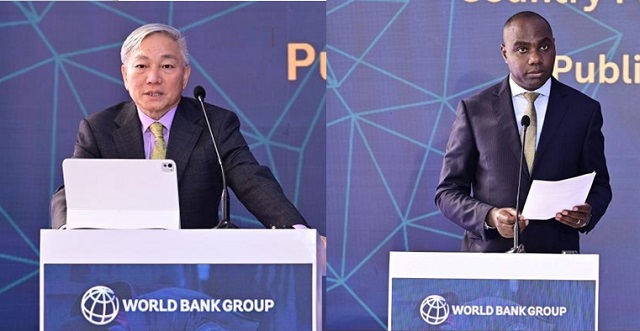
Speaking at the launch of the Country Partnership Framework and the Public Finance Review, WB Director for Uganda, Kenya, Rwanda and Somalia, Qimiao Fan, acknowledges Uganda’s focus on improving education and health services, but said it isn’t adequate to support the growth to a “competitive upper middle-income” economy by 2040.
In the 2026/27 national budget, the government allocated 13.5 trillion shillings (about 16 percent of the total national budget) to the Human Capital Development programme, broadly covering education, healthcare, social protection, and water and sanitation.
Comparatively, debt servicing has been allocated 33 trillion.
Nurturing better-skilled people is one of the pillars of the new 10-year framework.
”The Public Finance Review proposes a human capital compact which involves more than tripling human capital spending and rebalancing investment in public health and education,” said Qimiao.
The Uganda Country Partnership Framework -CPF, is a 10-year operational strategy that lays out how the World Bank Group will support Uganda’s ambition to transform into a modern, prosperous and competitive upper-middle income country by 2040.
This World Bank approach, aligned with Uganda’s tenfold growth strategy and NDP IV priorities, plans to mobilize and enable private capital at scale to the tune of USD 3.8bn.
It puts emphasis on wealth creation, better jobs, strengthened economic governance, healthier and better skilled people as well as better connected communities through access to quality infrastructure.
It also focuses on having a more productive and inclusive Private Sector.
The Public Finance Review on other hand provides timely analysis as Uganda enters its oil decade, with a key recommendation that sustainable prosperity will not only depend on oil revenues but also strong institutions, efficient public expenditure, enhanced domestic revenue mobilization and continued investment in the people of Uganda.
The World Bank representative says that under the current trend, a child born and raised in Uganda can only hope achieving 39 percent of its productivity potential, far below what the country requires to achieve it’s ambitious targets.
He cautioned the country to ensure it takes full advantage of the oil and gas era it is entering, to invest in the future, but cautions against relying on the oil revenues for everything.
”Commercial oil production will bring significant, but I don’t think transformational, windfall to the budget. It will be significant, but I don’t think it is going to be transformational,” he cautioned.
He says after the oil era, the question will not be how big the economy of Uganda was during the oil years, but what permanent productive human and physical capital Uganda has built with that resource.
On the other hand, the PFR provides a set of actionable fiscal reforms needed to support the Tenfold Growth Strategy ambitions.
Qimiao says that to achieve this strategy, the Bank will help the country to strengthen economic governance.
”Uganda will need a comprehensive approach to moderate tax reforms to broaden the tax base, not necessarily to raise the tax rates, enhancing spending efficiency notably in public investment and procurement, reprioritising expenditure towards job enablers and reducing debt servicing.”
On public investment, WB notes that up to a third of the resources sunk into public projects is lost.
”Currently, about 33 cents out of every shilling invested in infrastructure is lost in poor planning, project delays and weak maintenance. We must ensure that infrastructure budgets translate into functional roads, reliable energy, good schools and health facilities.”
He also urged government to reduce on the costly domestic borrowing because “it crowds out private sector credit.”
A major recommendation too, was that government changes its approach to spending on the ATMS (agriculture and agro industry; tourism; mining including oil and gas; and science, innovation and technology), priority areas to drive the growth strategy.
”Public spending on key growth sectors, ATMS, must shift away from subsidies to private firms towards shared public goods that lower the cost of doing business for everyone, not just a few,” he said.
The World Bank is moving away from isolated projects to comprehensive sector-wide interventions, while also transiting to the “One World Bank Group” approach, an operational strategy that unites the institution’s specialized agencies, to deliver integrated public and private solutions for economic development.
These are IDA (International Development Association), IBRD (International Bank for Reconstruction and Development), IFC (International Finance Corporation) and MIGA (Multilateral Investment Guarantee Agency).
The new approach eliminates institutional silos to maximize impact, address global challenges, and mobilize private capital at scale adding that the Bank is fully committed to supporting Uganda’s transformation agenda.
Francisca Ayodeji (Ayo) Akala, the World Bank Country Manager for Uganda, focused on the importance of deepening collaboration between the Government of Uganda and development partners as the country advances the implementation of its the CPF).
She says that under the new approach, the World Bank is moving towards fewer but more focused engagements and strong emphasis on results.
“The emphasis is no longer how we invest, but how efficiently those investments translate into development outcomes,” she says, adding, “we see enormous potential in Uganda and we look forward to working with you to translate this shared vision into a reality for the people of Uganda.”
Minister of Finance, Planning and Economic Development, Henry Musasizi, assured that Uganda was making and implementing a wide number of reforms going into the oil era.
“The PFR provides timely clarity as Uganda enters the oil-decade. The government recognises that fiscal policy is one of the key instruments in economic growth,” he says, adding, “Despite micro-global shocks, Uganda has persevered. We recognise that further reforms remain necessary to narrow the fiscal gap by expanding revenue mobilisation to finance our development agenda.”
Musasizi stressed that the focus going forward remains on prudently executing the tenfold growth strategy to turn Uganda into a 500-billion-dollar-economy, enforcing absolute discipline, enhancing revenue mobilization, wealth creation and oil revenue management.
“As we scale up public investment, let us remember that development is not measured by the size of our budgets, the number of projects approved or policies adopted but by the lives transformed, opportunities created and lasting impact on citizens,” said Musasizi.
The World Bank hopes to see 14 million people using financial services including 9 million women.
”The CPF presents an ambitious program and we are confident that it will deliver transformational impact for the people of Uganda.
”The CPF will focus on enabling reforms to lay the ground for the transformational period. The first entry point is to improve the regulatory environment in Uganda,” says Amantchi Jean-Noel Gogoua, Senior Operations Officer, at the World Bank.