The Independent Uganda: You get the Truth we Pay the Price


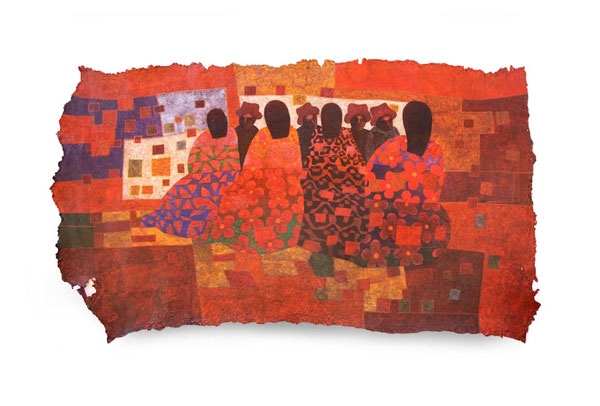
Through a series of research on barkcloth conducted with barkcloth makers in his local community, Fred Kato Mutebi has conceived his personal interpretation of the complete trajectory of the organic fabric production and through this engagement, brings to attention the contribution made by women in the value chain of barkcloth production.
ARTS | DOMINIC MUWANGUZI | It is difficult to have a conversation on barkcloth (lubugo) innovation in Uganda and not mention Fred Kato Mutebi. Mutebi, a multimedia artist, has over the years worked tirelessly with barkcloth in his art and, through the process, explored themes of innovation, knowledge and enterprise in the organic fabric. His latest solo exhibition, “Kulega” to “Kuleega”: Okubaziira mu Kuteenga, at Bumu Art Gallery in Mengo, is built on these themes, particularly innovation and knowledge, where he paints on the fabric as a canvas but also explores a very interesting aspect in the production trajectory of the fabric. The artist focuses on Kubaziira, which is a critical stage that highlights the contribution of women within the barkcloth value chain. Kubaziira is the meticulous process of stitching and repairing holes that emerge as the bark is beaten from its original thickness into a thin, flexible fabric.
Mutebi’s technique to preserve the mended patches on the fabric as he paints on it and sometimes metaphorically represents the mended patches by use of acrylic paint illustrates his appreciation of the value in preserving traditional forms of art making in as much as preserving his cultural heritage as observed through working with the fabric and deliberately avoiding altering its identity, even when he innovates and experiments with it. Additionally, by exploring themes that are familiar to the African identity, like family, solidarity and togetherness (Ubuntu) in his paintings he is able to not only demonstrate his pride as an African, but also as a Muganda (citizen of Buganda Kingdom) where the fabric has immense historical and cultural relevance. This approach is visible in paintings like Before the Vows, Family and Different colours, one people which are inspired by the commonality in African traditional norms and practices.
The artist’s deployment of women figures on his barkcloth canvas is recurrent, symbolizing the role played by women in society but also reverberating the theme of women participation in the production chain of the organic fabric. Notably, Mutebi holds a strong conviction that women are best suited as community leaders and agents of social political change that is needed to better our respective communities. In previous works, the artist has asserted this philosophy by not simply portraying women in political or social spaces but advocating for their recognition as both capable and potential individuals in the different spaces they occupy, outside the home environment. This notion of advocacy and awareness is a singular attribute in the artist’s works and is also present in this body of work that critically transcends the recognition of women in bark cloth production but also subtly subverts the common stereotype attached to the female gender as inferior and weak in many African communities.
Therefore, the “Kulega” to “Kuleega” exhibition acquires a multi-purpose identity of not only celebrating the bark cloth as an enduring organic fabric in Buganda but also a platform to appreciate the contribution of women in different sectors of the community.
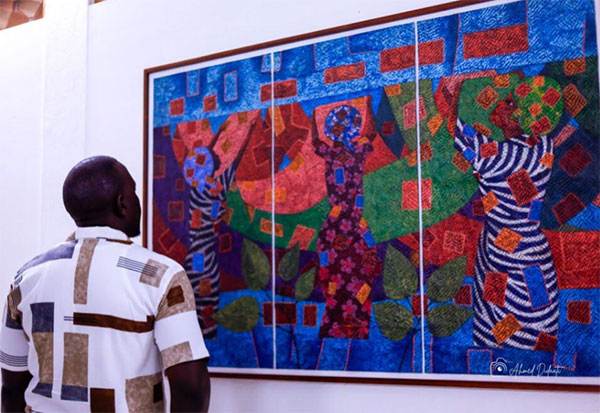
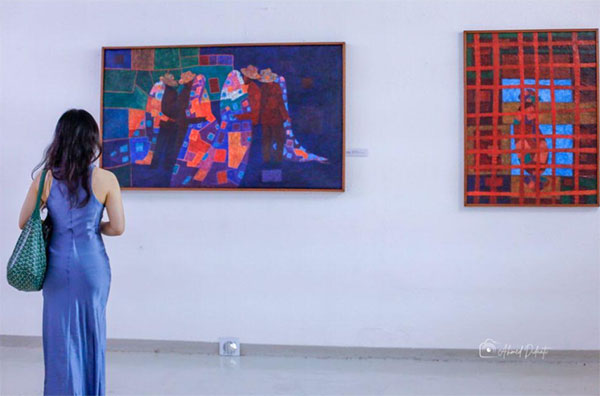
Through research supported by his frequent engagement and involvement with his community in his home village of Bukomasimbi in Masaka, the artist has been successful in creating an authentic narrative around barkcloth from the time it is planted, harvested, processed and turned into a final product. The most fascinating aspect of this research is the artist’s ownership of the fabric, demonstrated through birthing a new vocabulary for the organic fabric he works on: Bark Tenga Canvas. This approach is intertwined with documentation and sets him apart from other artists who have worked with the fabric before and presently as it ushers in depth in his creative practice but also closes the gap in limited knowledge and understanding of the cultural, technical and artistic processes involved in barkcloth production.
Mutebi’s grounding of his artistic practice in indigenous cultural practices is exemplary for many artists seeking global relevance and attention. This exhibition, although set in Mengo and is part of the celebrations to mark the 33 years’ anniversary of Kabaka of Buganda Ronald Muwenda Mutebi II sitting on the throne, has the hallmarks of a world-class exhibition because of the immense effort the artist put in to prepare for it. As such, the exhibition goes beyond the notion of celebrating a special occasion in the Kingdom with art but also importantly offers a perfect moment to pause and reflect on the centrality of barkcloth in Buganda and how best it can be sustainably preserved for future generations.
****
The exhibition is open at Bumu Art Gallery, located within the premises of Buganda Heritage and Tourism Board, next to Butikiiro building in Mengo. The exhibition is curated by Lyton Hillary and Fred Kato Mutebi. Images are courtesy of the Bumu Art gallery.