The Independent Uganda: You get the Truth we Pay the Price


The government unveiled a record Shs84.4 trillion spending plan; Ordinary people to shoulder costs through pricier fuel, sugar and secondhand apparel
COVER STORY | JULIUS BUSINGE | Uganda’s national budget for financial year 2026/27 marks a clear shift in economic emphasis, moving from a broad-based wealth creation agenda towards a more aggressive push for industrialisation, export expansion and job creation, as the country prepares for first oil production and a new political cycle.
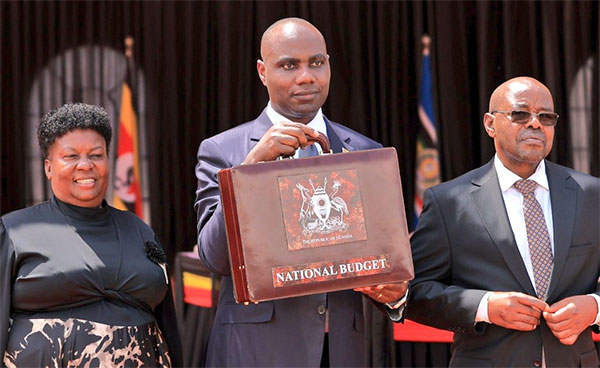
The budget, presented by Finance Minister Henry Musasizi at Kololo Independence Grounds on June 11, maintains the theme of “Full Monetisation of Uganda’s Economy through Commercial Agriculture, Industrialisation, Expanding and Broadening Services, Digital Transformation and Market Access” — a policy direction first consolidated in earlier financial years.
However, compared to the previous year, the focus is sharper, more targeted, and increasingly anchored in large-scale productive sectors and export performance. It builds on the FY2025/26 framework delivered by Finance Minister Matia Kasaija, which emphasised structural transformation through agriculture, industry, services and digitalisation under Uganda’s Tenfold Growth Strategy.
The Shs 84.4 trillion spending plan, up from Shs 82 trillion for this financial year ending on June 30, is anchored on accelerating implementation of the government’s Tenfold Growth Strategy, which seeks to grow Uganda’s economy from about USD 53 billion in 2025 to USD 500 billion by 2040.
The budget comes at a time when the country’s economy has shown strong resilience. The economy is estimated to have expanded by 6.4% to USD 69.3 billion (about Shs250.4 trillion) in nominal terms, while government projects growth of up to 10% in FY2026/27, driven by investments in Agro-industrialisation, Tourism, Minerals including oil and gas, and Science, Technology and Innovation (ATMS), alongside major infrastructure spending and the anticipated commencement of commercial oil production.
For the first time in nearly two decades since Uganda confirmed commercial petroleum deposits, government expects oil revenues of Shs1.4 trillion, marking the beginning of a new fiscal chapter.
“We are implementing a comprehensive reform agenda aimed at eliminating waste, corruption, delays and inefficiency,” Musasizi said.
He, however, added that implementing this budget requires discipline. It requires accountability. It requires efficiency. And it requires integrity.”
Resource envelope
The Shs84.4 trillion budget will be financed through a combination of domestic revenues, oil receipts, grants and borrowing. Domestic revenue is projected at Shs45.6 trillion, up sharply from Shs35.7 trillion realised in FY2025/26. Of this amount, Shs40.1 trillion will come from tax collections, Shs4 trillion from non-tax revenues and Shs1.4 trillion from oil revenues earmarked for budget support.
External financing is projected at Shs12.5 trillion, comprising Shs1.2 trillion in budget support and Shs11.3 trillion in project financing through grants and concessional and non-concessional loans.

Government also plans to raise about Shs12 trillion from domestic securities, although authorities say domestic borrowing will gradually reduce as part of fiscal consolidation efforts.
The fiscal strategy reflects a balancing act between financing development priorities and maintaining debt sustainability. Uganda’s public debt stood at USD 34.86 billion (approximately Shs126.19 trillion) by December 2025, representing about 53% of GDP.
A notable fiscal shift is the reduction of planned domestic borrowing from Shs11.4 trillion to Shs9 trillion, a move expected to ease pressure on interest rates and improve access to private sector credit.
Speaking at the 5th Absa Post-Budget Forum in Kampala on June 12, Permanent Secretary and Secretary to the Treasury Ramathan Ggoobi defended the budget’s growth assumptions and broader economic direction.
“The economy is doing well at a macro level, and it’s only someone who’s not actually very honest and good-willed who can say any different,” Ggoobi said.
He pointed to stable inflation, exchange rate resilience, improved export performance and expanding economic activity as evidence of strengthening fundamentals.
Growth strategy
At the centre of the budget is government’s continued emphasis on ATMS—Agro-industrialisation, Tourism, Minerals including oil and gas, and Science, Technology and Innovation. Ggoobi said approximately 95% of budget resources have been directed toward these productive sectors and their enablers.
The strategy is intended to transform Uganda from a predominantly raw-material-exporting economy into a value-adding industrial economy capable of generating jobs, exports and higher incomes.
Government projects that exports, which reached USD18 billion in the 12 months ending March 2026, will continue growing as Uganda diversifies into pharmaceuticals, ICT products, steel products, refined gold, dairy products, plastics and ceramics.
Sector allocations
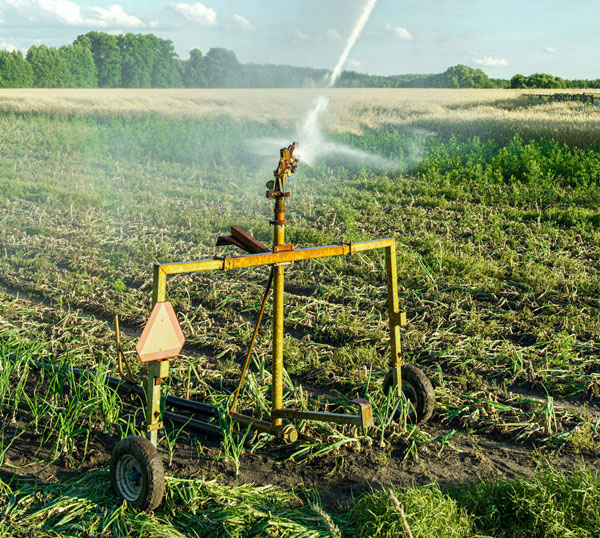
Agriculture emerged among the biggest winners, receiving a record Shs2.26 trillion under the agro-industrialisation programme. The funding will support agricultural research, irrigation, water for production, extension services, post-harvest handling, agro-processing and market access.
The allocation reflects government’s recognition that agriculture remains the backbone of Uganda’s economy and the primary source of livelihood for most households.
Yet questions remain about whether spending levels match the sector’s importance.
“We do not have money in our economy. We have not focused a lot on growth of our economy. Seventy-two percent of our population are in agriculture but we seem not to be clear on what our strategy is for the sector,” said Allan Ssenyondwa, director of policy research and advocacy at Uganda Manufacturers Association.
“We are a poor country and are the 22nd poorest country in the world in terms of GDP per capita. Higher prices in industries will lead to increased costs of products and lead to increased demand for goods and services and that affects the economy.”
Tourism received Shs567.32 billion to fund destination marketing, tourism infrastructure, hospitality standards, wildlife conservation, health tourism and economic diplomacy. Government hopes to build on recent international recognition under the “Explore Uganda, the Pearl of Africa” campaign.
Science, Technology and Innovation, including ICT and creative industries, was allocated Shs1.14 trillion. Priorities include commercialising innovations such as Kiira Motors vehicles, Dei BioPharma products, coffee and banana value-addition initiatives, establishment of a Hi-Tech City, and expansion of digital infrastructure.
Minerals, oil and gas development will receive Shs473.51 billion, with emphasis on mineral exploration, operationalisation of the East African Crude Oil Pipeline (EACOP), establishment of mineral markets and advancement of the oil refinery project.
Government continues to channel substantial resources into social sectors. Education receives Shs6.66 trillion, with an additional Shs568.65 billion dedicated to enhancing salaries for primary school teachers and arts teachers.
The allocation will support Universal Primary Education, Universal Secondary Education, STEM education, vocational training and sports infrastructure ahead of AFCON 2027.
Health has been allocated Shs5.23 trillion to strengthen maternal and child health services, immunisation, nutrition, specialised healthcare and essential medicines.
Water and sanitation receive Shs1.013 trillion, while social protection programmes will receive Shs173.55 billion. Together, direct investment in people amounts to Shs13.56 trillion.
Infrastructure remains a cornerstone of Uganda’s development strategy. Transport infrastructure commands Shs 8.79 trillion, supporting construction of the Standard Gauge Railway, roads, bridges, ports, ferries, airports and expansion of Uganda Airlines.
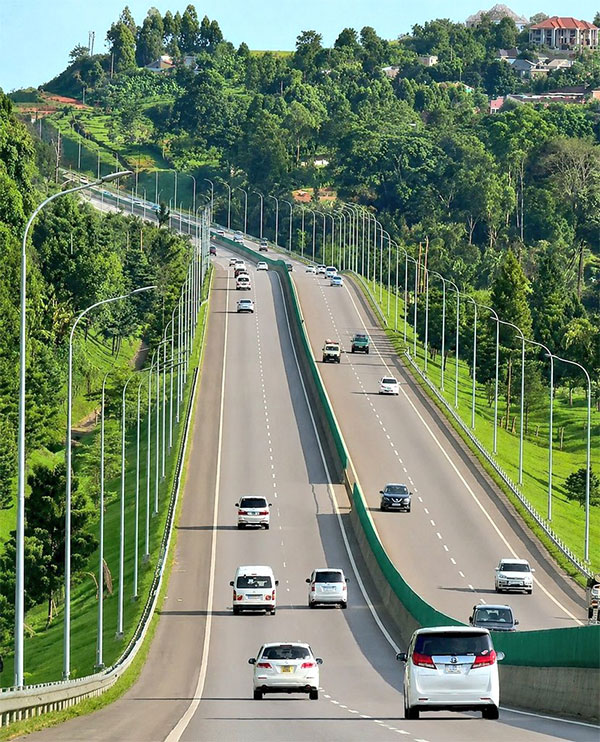
Energy development receives Shs2.07 trillion to expand electricity generation, transmission and rural electrification. Government plans to commence the 380MW Kiba hydropower project, develop utility-scale solar projects and advance preparations for nuclear energy generation.
Security, governance and rule of law institutions have been allocated Shs10.21 trillion, reflecting government’s continued emphasis on stability, crime prevention and national security.
To meet the planned budget, parliament approved a broad package of excise duty increases and new levies, hiking taxes on diesel, alcoholic spirits, single-use plastics, and imported second-hand clothing.
The measures, aimed at raising additional revenue in the next financial year, will significantly raise operating costs for manufacturers, transporters, and consumers already grappling with inflation.
Lawmakers approved a Shs 200 per-litre increase on both petrol and diesel, projected to generate Shs 450 billion. The hike is expected to feed directly into transport and logistics costs, potentially raising prices for goods across the economy.
In a related move, parliament introduced a stamp duty of Shs 200,000 on first registration and transfer of all motor vehicles, and Shs 30,000 for motorcycles. A separate measure raises excise duty on new motorcycle registrations to Shs 500,000, up from Shs 200,000.
Alcohol, cooking oil, and sugar hit
Excise duty on premium spirits such as Uganda Waragi, Black Label, and Cognac will double to Shs 3,500 per litre from Shs 1,700, raising an estimated Shs 85 billion.
Cooking oil duties will rise to Shs 400 per litre from Shs 200, while a new levy of Shs 500 per litre has been imposed on cooking fat. Sugar will be taxed at Shs 200 per kilogram, up from Shs 100.
Cement prices are also set to increase, with excise duty rising to Shs 750 per 50-kilogram bag from Shs 500.
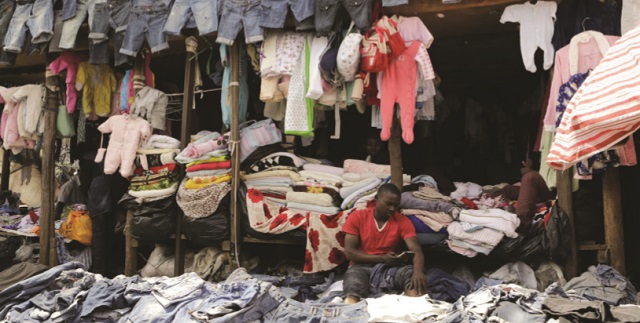
The government more than doubled the environmental levy on imported used clothing — known locally as mitumba — to 30% of cost, insurance, and freight (CIF) value from 15%, targeting Shs 40 billion in revenue to support local textile manufacturing.
In a sharp escalation against plastic waste, excise duty on single-use plastics was raised to 25% or $1,500 per tonne, up from 2.5% or $70 per tonne. Parliament also introduced a 3% excise duty on locally manufactured paints and varnishes (or 50 shillings per litre/kilogram) and a 10% duty on imported versions (or Shs 2,000 per litre), expected to yield Shs 24 billion.
Betting tax was also increased to 30% from 20% to harmonise levies across gaming activities, generating an additional Shs 24 billion.
While the government is celebrating stronger revenue mobilisation, analysts argue that the tax burden continues to weigh heavily on consumers and businesses.
Samuel Sejjaka, Country Team Leader at MAT ABACUS Business School, noted that much of the budget’s revenue growth is being driven by indirect taxation.
“I do not know how much the coffee farmer in Masaka pays in taxes, but he or she is largely outside the revenue mobilisation system, except to the extent that they consume goods. One of the things we have seen in the budget is an increase in indirect taxes,” Sejjaka said.
He added: “If I were the minister of finance, the key question for me would be: how do I put more money in the pockets of the people so that they can consume more? For any of us who are not a ‘planned child,’ the budget numbers do not translate into reality.”
The concern reflects a broader challenge confronting policymakers: translating impressive macroeconomic indicators into tangible improvements in household incomes and living standards.
Uganda’s GDP per capita now stands at USD1,278, above the USD1,136 threshold for lower middle-income country status. Yet poverty, unemployment and informality remain widespread.
Accountability drive
Perhaps the most striking policy shift in the budget is government’s renewed emphasis on implementation discipline.
Beginning in FY2026/27, all Accounting Officers will be required to sign a Budget Discipline and Accountability Charter, exposing them to sanctions for breaches in planning, budgeting and execution.
Government has also suspended state-funded public holiday celebrations except for religious functions, part of a wider effort to eliminate wasteful expenditure.
The reforms are aimed at addressing a longstanding criticism that Uganda often performs well in planning but struggles with implementation.
“When taxes are paid, the expectations are to construct good roads, improve transport areas, education, security, medical among others,” said Garry Kizito, Assistant Commissioner Compliance Management at Uganda Revenue Authority.
“We ought to have discipline on resource utilization and expenditure. Once our government looks into those areas, we believe that we shall be on the right course.”
Private sector lens
The private sector has broadly welcomed the macroeconomic direction but remains cautious about execution.
At the Absa Post-Budget Forum, Absa Bank Uganda Executive Director and Chief Finance Officer Michael Segwaya underscored the need to translate policy ambitions into real economic outcomes.
“Every national budget tells a story. Beyond the numbers, it reflects the choices a country is making about its future, the opportunities it seeks to unlock and the challenges it is prepared to confront,” Segwaya said.
“Optimism alone is not enough. The real question is how we convert this moment into lasting impact for businesses, households and communities across the country.”
Segwaya reaffirmed Absa’s commitment to financing private sector growth and revealed that the bank is exploring alternative credit assessment tools, including mobile money transaction data, to improve access to affordable financing.
Outlook
The 2026/27 budget arrives with significant expectations. Government is counting on first oil, stronger exports, disciplined spending and strategic investments in productive sectors to accelerate growth toward double digits and support Uganda’s ambition of graduating from Least Developed Country status by March 2027.
The numbers tell an ambitious story: a Shs84.4 trillion budget, projected GDP growth of 10%, exports worth USD18 billion, GDP of USD69.3 billion and an economy preparing for oil production after a 17-year wait.
Whether those ambitions translate into jobs, incomes and improved living standards will depend less on the size of the budget and more on the effectiveness of its implementation.
Budget analysts say, as government tightens accountability and pushes for execution discipline, the ultimate test of this budget will be whether it succeeds in bridging the gap between macroeconomic progress and the everyday realities of Ugandans.
Sector Allocations FY2026/27
| Sector/Programme | Allocation (Shs Trillion) |
| Security, Governance & Rule of Law | 10.21 |
| Transport Infrastructure | 8.79 |
| Education, Skills & Sports | 6.66 |
| Health | 5.23 |
| Agro-industrialisation | 2.26 |
| Energy Development | 2.07 |
| Science, Technology, ICT & Creatives | 1.14 |
| Water & Sanitation | 1.01 |
| Manufacturing & Industrial Development | 1.03 |
| Tourism Development | 0.567 |
| Minerals, Oil & Gas | 0.474 |
| Environment & Climate | 0.494 |
| Social Protection | 0.174 |
Key Numbers
| Indicator | Figure |
| Total Budget | Shs84.4 trillion |
| Projected GDP | USD69.3 billion |
| Projected Growth FY2026/27 | 10% |
| Domestic Revenue | Shs45.6 trillion |
| Tax Revenue | Shs40.1 trillion |
| Oil Revenue | Shs1.4 trillion |
| External Financing | Shs12.5 trillion |
| Public Debt | Shs126.19 trillion |
| Debt-to-GDP Ratio | 53% |
| Exports (12 months to March 2026) | USD18 billion |
| GDP per Capita | USD1,278 |
| Domestic Borrowing | Shs12 trillion |
| UDB Capitalisation | Shs1.6 trillion |
| PDM Beneficiaries | 3.7 million households |