The Independent Uganda: You get the Truth we Pay the Price


New planes expected to open up long-planned routes in Africa, Europe and Asia
Kampala, Uganda | IAN KATUSIIME | Uganda Airlines has placed the largest aircraft order in its history, committing to the purchase of ten Boeing jets as it seeks to expand its international footprint and position itself as a stronger player in regional and global aviation.
The deal, valued at Shs3.7 trillion ($982m), will see the national carrier acquire a mix of 787 Dreamliners, 737 Max aircraft, and two freighters (a 767 and a converted 737) to scale its operations. It is the largest investment in Uganda’s aviation sector since the airline was revived in 2019.
President Yoweri Museveni witnessed the signing of the agreement between Uganda Airlines and Boeing at State House Entebbe on June 10. Uganda Airlines CEO Girma Wake signed the deal, while Boeing Vice President of Sales Anbessie Yitbarek represented the American aircraft manufacturer.
In a statement, Uganda Airlines said: “The proposed acquisition will significantly increase Uganda Airlines’ capacity to serve regional, continental and international markets while supporting Uganda’s economic transformation agenda.”
The statement added that the additional aircraft will support trade, tourism and investment in Uganda. Uganda has burgeoning business and trade links with East African nations, Gulf countries such as the United Arab Emirates and Saudi Arabia, and the vast Asian market, from which 80% of imports originate.
The aircraft purchase comes at a precarious time for the airline industry, following the US–Israel war on Iran that has caused global fuel supply disruptions.
IATA, the airline industry lobby group, held its AGM in Rio de Janeiro, Brazil, in early June, reported that the net profit for the sector in 2026 is projected to fall from $41bn to $23bn—more than half—following Middle East disruptions and subsequent jet fuel price shocks.
However, resilience has been a defining feature of airlines. Analysts say the industry rebounded remarkably after the biggest setback in global air travel during the Covid-19 pandemic.
Delivery of the jets will take five to seven years, according to insiders. Unlike car dealerships, where orders are delivered instantly, the aviation industry operates on a far more complex timeline.
Every airline requires highly customised, bespoke interior configurations that take months to design and install. A fully integrated airline such as Emirates, which has its own ground-handling company, dnata, is known for its distinctive cabin layouts—including first-class suites and onboard bars—that set it apart in luxury offerings.
This is not the case with flydubai, a budget airline also owned by the Dubai government.
In addition, aircraft manufacturers are grappling with backlog bottlenecks. Airbus and Boeing are said to be victims of their own commercial success, operating under a massive order backlog system in which airlines must queue based on when contracts were signed. Airbus has an active backlog of over 8,500 aircraft, while Boeing’s stands at over 5,600.
To buy or to lease
Uganda’s decision to spend Shs3.7 trillion on the acquisition has sparked intense debate. While proponents view it as a strategic milestone for the national airline, critics question whether such a large capital outlay is justified.
Choosing between outright purchase and leasing is a constant dilemma for African airlines, with both options carrying significant financial and operational trade-offs. Most airlines maintain a mixed fleet of owned and leased aircraft.

The argument for ownership is that it is the cheapest way to operate an aircraft over its 20-to-25-year lifespan. Those in favour of leasing argue it allows airlines to expand fleets without placing pressure on balance sheets.
Aircraft leasing companies have become major players in global aviation. Airlines frequently bypass Airbus and Boeing entirely by leasing from mega-lessors such as AerCap or Air Lease Corporation (ALC). These firms act as intermediaries.
Experts say they do not wait for airlines to request aircraft; instead, they place large speculative orders of 100 or more aircraft—such as the A320neo or 737 MAX—years in advance. As a result, they secure deep discounts from manufacturers that new entrants like Uganda Airlines can only aspire to. The debate over ownership versus leasing remains highly divisive.
According to the F(Air) Report, an agency tracking the African aviation market, an African carrier cannot build a viable business model on wet-leased capacity.
“It cannot fund owned fleet acquisition without access to affordable financing. It cannot grow to the scale where owned fleets become economically viable without liberalised routes that generate sufficient demand,” it noted.
The report added that airlines relying solely on leasing struggle to compete with international carriers that operate with lower cost bases, newer owned fleets, and access to capital markets beyond the reach of most African airlines.
However, Andrew L., an aviation analyst at Complete Aviation Solutions, argues that ownership advantages may not apply immediately, noting that Uganda Airlines’ new aircraft will not arrive until at least 2031.
“The real issue isn’t ACMI. It’s carriers using wet lease as a permanent base fleet solution because they lack the balance sheet for dry leases or ownership. That’s a capitalisation problem. ACMI didn’t create it,” he said.
“Ethiopian Airlines wet-leasing to Uganda Airlines isn’t exploitation—it’s a well-capitalised African carrier monetising spare capacity for a smaller airline that needed a short-term solution. That’s exactly how the market is supposed to work.”
In March, Uganda Airlines wet-leased an Ethiopian Airlines B787 under an Aircraft, Crew, Maintenance and Insurance (ACMI) arrangement. The aircraft arrived with a 48-member crew and currently operates the Entebbe–Gatwick route, opened a year ago.
Aircraft acquisitions are structured in phases, beginning with initial commitment fees. For Uganda Airlines, this requires an upfront payment of between $100,000 and $500,000 per aircraft.
Industry documents show that the real financial commitment comes during the 24 to 36 months before delivery, when manufacturers require pre-delivery payments (PDPs) to fund raw materials, including titanium and specialised labour.
By the time an aircraft enters final assembly, the airline has typically paid around 25% to 30% of its total purchase price in PDPs.
The delivery of these new jets will expand Uganda Airlines’ fleet to 17 aircraft. This capacity boost is expected to ease pressure on the state-owned carrier, which has struggled in recent months to meet growing passenger demand across international routes stretching from Johannesburg to Dubai and Mumbai.
Uganda appointed Girma Wake as CEO of Uganda Airlines earlier this year. Wake is widely regarded as one of the most accomplished and disciplined aviation executives on the continent, brought in to rebuild the airline following years of mismanagement.
The former chairman and CEO of Ethiopian Airlines is known for his low-profile leadership style and insistence on insulating airline operations from political interference.
As part of his mandate to instil commercial discipline, Wake’s first major move was shifting away from ad hoc scheduling by signing a landmark ten-aircraft acquisition agreement with Boeing.

The new planes are expected to open long-planned routes including Accra, Cape Town, Jeddah, Riyadh, and Guangzhou. Uganda Airlines is banking on the Accra route to connect into broader traffic flows handled by Ethiopian Airlines, which channels significant passenger volumes between East Africa and West Africa.
Additional European routes, including France and Germany, are also under consideration. At present, Uganda Airlines flies only to London via its Entebbe–Gatwick route.
While labour migration to Saudi Arabia remains politically sensitive, aviation analysts view the corridor as a major opportunity for the national carrier. Uganda Airlines currently operates on the fringes of this market, relying on seasonal charter flights to Jeddah and Medina during peak religious periods.
With its expanded Boeing fleet, the airline could transition these routes into regular scheduled services. This expansion mirrors the success already seen on the Entebbe–Mumbai route, which has become one of the airline’s strongest performers, serving traders, students, and medical travellers who previously relied on complex Middle East connections.
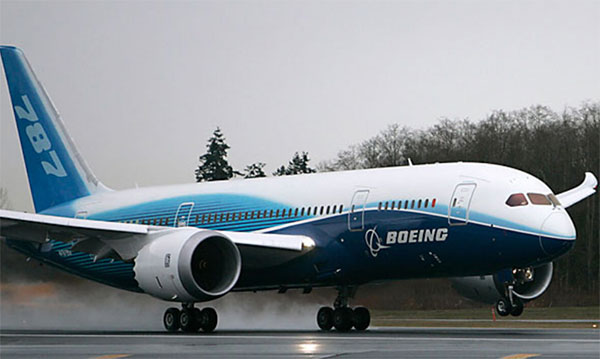
Boeing 787 Dreamliner
The Boeing 787 Dreamliner is Boeing’s most advanced commercial aircraft in service. It is the first commercial airliner built primarily from lightweight carbon-fibre composites, making it up to 25% more fuel efficient than previous generation aircraft.
The 787 is a wide-body aircraft seating roughly 210–250 passengers, with a range of 13,000km. It relies heavily on electrical systems that enhance its aerodynamic performance.
With the 787, analysts say Uganda Airlines will join a group of carriers prioritising comfort, efficiency and scale.
Regional airlines Kenya Airways and Ethiopian Airlines both operate Dreamliners, with Kenya Airways operating nine and Ethiopian Airlines—Africa’s largest carrier—operating 30.
The Boeing 737 MAX remains a polarising aircraft, regarded by airlines and regulators as a technically improved workhorse, but by the public as a symbol of corporate failure.
Although it has accumulated millions of safe flight hours since its grounding following two fatal crashes, public confidence remains fragile due to lingering concerns and legal disputes over its original certification process. It remains one of the most scrutinised aircraft in aviation history.
In the next decade, the success of this fleet will not only be measured by aircraft numbers on runways worldwide, but by its impact on tourism, the global competitiveness of Ugandan exporters, and the emergence of a financially independent national carrier operating with the commercial discipline envisioned by Girma Wake.