The Independent Uganda: You get the Truth we Pay the Price


COMMENT | NNANDA KIZITO SSERUWAGI | Germany is currently undergoing a profound political crisis, and being one of Africa’s major international development partners, we should be reasonably concerned. It is a crisis that goes against the very ethos of how Germany’s politics usually works. The German political culture values stability more than anything. This is why, for decades, its ruling parties have been reliable, predictable, centre-right or centre-left parties. The Christian Democratic Union of Germany (CDU) has been one of the largest, most successful and most resilient of these traditional parties. It was the party of Angela Merkel, who ruled Germany for 16 years. But the CDU under Chancellor Friedrich Merz is now in crisis, caused by several factors, including a tanking economy, an unpopular chancellor, and a voting shift to extreme political parties.
It is plausible that the current political turmoil in Germany will have a direct effect on the country’s foreign policy, and particularly its relationship with African countries. One of Germany’s primary vehicles for soft power diplomacy across the continent is the Konrad Adenauer Stiftung (KAS), an independent organisation which is, however, ideologically tethered as the political foundation for the CDU.
Now, since, in practice, German political foundations are funded directly by the federal budget based on how strong their parties are in parliament, the CDU’s internal weaknesses will gradually be felt in German-African relations, unless the party regains strength in the Bundestag and retains its grip on power.
Germany’s political organisations like KAS are at an operational risk due to their dependency on their political parties’ standing in the German parliament, the Bundestag. This directly affects their funding and financial stability, since they use public money allocated by the parliament. As such, their parent party’s influence and size in the parliament matter in determining the operational budget they receive in a multi-year cycle.
Given the current circumstances, KAS risks losing part of its baseline federal budget if the CDU loses in the next federal election to be held in January 2027.
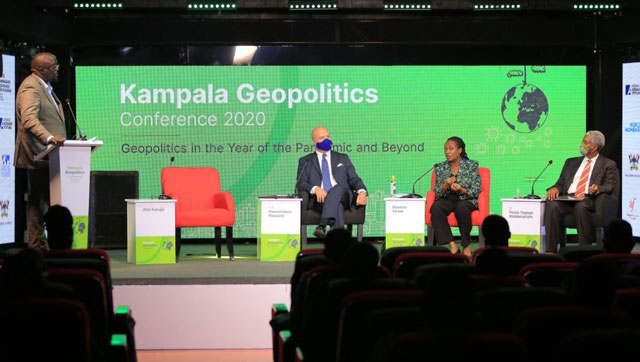
This will have direct implications for the funding the organisation has been providing for democracy, civil society activities, and rule of law projects in its various African regional programs. Note that the Konrad-Adenauer-Stiftung (KAS) operates across Africa in Algeria, Angola, the Democratic Republic of the Congo, Egypt, Ethiopia, The Gambia, Ghana, Kenya, Morocco, Namibia, Nigeria, Senegal, South Africa, South Sudan, Tanzania, Tunisia, and Uganda. As for Uganda, we are one of the countries where KAS has deep and long-standing partnerships, supporting political parties such as Alliance for National Transformation (ANT), sponsoring the Kampala Geopolitics Conference, and funding the work of several organisations.
The crisis and pressure that CDU is experiencing at home make it even more difficult for the German government to pursue other foreign policy objectives due to compromises under domestic pressure. Merz has attempted to appease conservative voters by linking development aid directly to migration management, by demanding that only African countries which accept to take back deported asylum seekers would receive Germany’s development funds. This policy shift did not bear much fruit. China, India, Turkey and the Gulf States are already filling the development finance gaps that Western countries had leveraged in the past. Now, if Germany is unsure about it, China will certainly do it, or Qatar, or some other country. So, Merz’s policy there didn’t stick.
How did this political turmoil start? It began with a weak election victory in February 2025. At that time, the ruling party, CDU and Friedrich Merz won the national election with a paltry 28.6% of the national vote. Such a weak performance had never happened in the party’s history. To navigate these complex political circumstances of a brittle victory, Merz did not have a majority to establish a government, and therefore had to pragmatically ally with bitter rivals, the centre-left Social Democratic Party, to form a “Grand Coalition” government. This alliance was the beginning of what would turn out to be a clumsy and divided government.
Another strategic mistake that Germany, alongside the whole of Europe, committed was to fight a proxy war against Russia in Ukraine. No wonder the far-right Alternative for Germany is putting pressure on Merz’s government to change its Ukraine and Russia policies. For years, Germany had been a wealthy country because it imported very cheap energy from Russia, which supported its giant factories and the automobile industry. With cheap Russian gas, Germany could fuel its factories and export volumes of goods around the globe.
However, when the war in Ukraine started, Russian gas was cut off. This effectively broke down Germany’s economic engine. What followed was severe economic stagnation and massive layoffs at major German companies, culminating in high unemployment. Within a short time, ordinary German citizens who had grown accustomed to economic safety were suddenly unsure about their financial futures. This predicament was not helped by the unpopularity of Mr Friedrich Merz, whose approval ratings, just 16 months into office, had fallen to a historic low of 13%. Basically, he was the most unpopular Chancellor in modern German history.
In the disastrous September 2026 elections, an angry German public, frustrated by these challenges, punished Merz’s CDU government by voting for extremist parties. The radical, far-right Alternative für Deutschland (Alternative for Germany) party won huge victories in the east, while Die Linke (The Left) won in Berlin. The worst outcome of all was the kicking out of the CDU entirely from the regional parliament of Mecklenburg-Western Pomerania, where the party secured 4.9% of the votes, yet Germany’s law requires a party to reach a minimum 5% threshold to gain seats in a parliament.
Mr Merz is now facing pressure to resign, despite the attempts by his political allies to protect him and avert chaos. But his rivals are also powerful. For instance, the Alternative for Germany (AfD) is formidable, particularly in eastern Germany, while the Social Democratic Party (SPD), which is CDU’s oldest and principal rival for leadership, is also a strong challenger in the federal government.
That said, Germany is still a development partner that Africa needs. It is not good for Africa to experience the effects of hollowed-out external partnerships when Germany starts prioritising economic stabilisation and industrial subsidies at home.
***
 Senior Research Fellow, Development Watch Centre.