The Independent Uganda: You get the Truth we Pay the Price



The corporation expanded from 258 to 287 towns in five years, with connections rising from 724,000 to over one million
NEWS ANALYSIS | JULIUS BUSINGE | Uganda’s National Water and Sewerage Corporation (NWSC) is accelerating one of the most ambitious public utility transformation programmes in sub-Saharan Africa, combining large-scale infrastructure expansion with digital water systems, climate-linked financing and a growing export of technical services.
The state-owned utility, which has evolved from a domestic water provider into a regional reference point for public service delivery, has unveiled a Shs8.2 trillion (about $2.2bn) strategic plan for the 2025–2030 period. The plan aims to extend piped water access to 26 million people, expand the asset base, and deepen operational efficiency through technology and institutional reform.
Approved by Uganda’s National Planning Authority, the strategy marks a decisive shift in the corporation’s mandate — from a traditional utility focused on distribution to a multi-dimensional infrastructure operator, climate resilience actor and regional knowledge exporter.
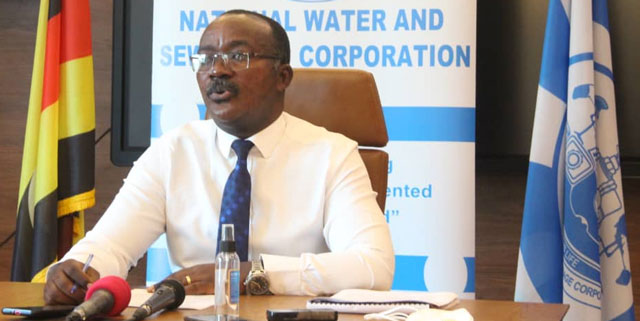
NWSC Managing Director, Silver Mugisha, has framed the plan as central to Uganda’s long-term development ambitions.
“Water for all is not a slogan. It is a structured programme of investment, technology deployment and institutional discipline,” Mugisha said, adding that the plan aligns with Uganda Vision 2040 and the Sustainable Development Goals.
A utility scaling at speed
NWSC’s transformation over the past decade provides the backdrop to its current ambitions. The corporation has expanded its service footprint from 258 towns to 287 in five years, while increasing customer connections from 724,000 to more than one million.
The population served by piped water has risen from 15 million to 20 million people over the same period. Annual turnover has grown from Shs385bn to Shs649bn, reflecting both higher consumption and improved collection efficiency.
Behind these headline figures is a broader institutional shift toward commercial discipline within a public utility framework. NWSC has increasingly operated under performance-based targets, with internal efficiency gains helping to finance part of its capital expenditure programme.
In the 2024/25 financial year, the corporation recorded its highest-ever operating surplus of Shs162bn, up from Shs142bn the previous year. That surplus is now being channelled into a Shs660bn investment programme, jointly financed by government allocations and internal resources.
However, the utility’s leadership acknowledges that financial sustainability remains constrained by structural issues, particularly unpaid water bills from government ministries, departments and agencies — a recurring challenge in public-sector utilities across the region.
Digital water: from pipes to platforms
At the core of NWSC’s strategy is a transition from conventional water distribution systems to digitally enabled utility management.
In Gulu city, the corporation has deployed prepaid smart water meters integrated with Uganda’s mobile money ecosystem. The system allows customers to purchase water credits using mobile phones, replacing traditional post-paid billing and reducing dependence on intermediaries.
Each unit of water is purchased digitally, with households able to access affordable pricing as low as Shs25 for a 20-litre jerrycan — a significant reduction compared to the Shs500 often charged by informal vendors in underserved areas.
The rollout includes 140 prepaid water dispensing points, locally described as “water ATMs”, designed to decentralise access points and improve transparency in consumption and billing.
According to city authorities, the system is already reshaping water consumption patterns. Officials in Gulu project that daily water usage could increase from 6 million litres to 20 million litres as access expands and leakage is reduced.
For NWSC, the Gulu pilot is part of a broader shift toward smart utilities. The corporation is deploying geographic information systems (GIS), advanced metering infrastructure and real-time monitoring tools across multiple service areas.
These technologies are designed to address one of the sector’s most persistent inefficiencies: non-revenue water, which currently stands at 34.4 per cent. This includes losses from leakages, illegal connections, metering inaccuracies and infrastructure vandalism.
A partnership under the WaterWorX programme with Dutch utility VEI has introduced district metered areas in Kampala and surrounding branches, allowing engineers to isolate network segments, detect leaks and improve pressure management.
Early results from pilot areas, including Bulenga, suggest that system segmentation and monitoring can significantly reduce water losses when combined with targeted maintenance.
“Technology is changing the way we think about utility management,” said Eng. Johnson Amayo, NWSC’s deputy managing director for technical services. “We are moving from reactive maintenance to predictive system management.”
Climate pressure reshaping operations
Uganda’s water sector is increasingly exposed to climate variability, with NWSC at the frontline of its impacts.
Prolonged dry seasons are reducing raw water availability in key catchment areas, while intense rainfall events are increasing sedimentation, flooding and damage to intake infrastructure.
NWSC officials say these dynamics are raising both operational costs and capital expenditure requirements. Treatment plants require more chemicals during periods of poor raw water quality, while infrastructure repairs are becoming more frequent due to extreme weather events.
Anna Nyadoi, principal economist for corporate strategy and business financing at NWSC, has described climate change as both a physical and financial risk to the utility’s operations.
“Climate variability affects water quality, increases production costs and puts pressure on infrastructure designed for a different environmental reality,” she said.
In response, NWSC has adopted a multi-layered climate adaptation strategy focused on catchment restoration and ecosystem protection.
Projects in Arua, Gulu, Mbale and Bushenyi include riverbank reinforcement, construction of erosion control structures, reforestation of degraded buffer zones and community-based conservation programmes. These interventions are designed not only to protect infrastructure but also to stabilise long-term water availability.
In September 2025, NWSC signed a €22.6mn grant agreement with Germany’s KfW Development Bank and the European Union to support water and sanitation infrastructure in refugee-hosting areas in northern Uganda.
The project targets Arua city and surrounding districts of Maracha and Terego, focusing on rehabilitation of water systems, expansion of sanitation networks and improved storm-water and solid waste management.
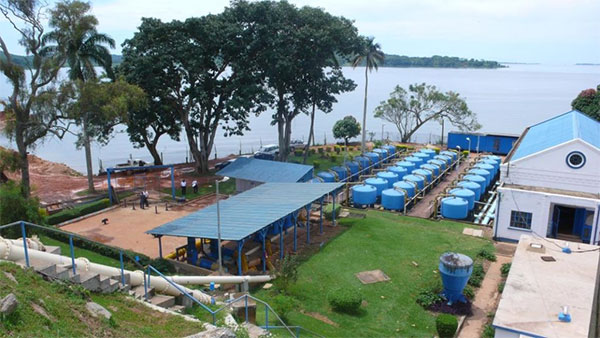
The initiative reflects a broader shift toward climate-resilient infrastructure financing, particularly in regions hosting vulnerable populations affected by displacement and environmental stress.
Building a regional services hub
Beyond its domestic mandate, NWSC is positioning itself as a regional technical services provider.
Its External Services Unit (ESU), developed with support from the Japan International Cooperation Agency (JICA), is being restructured into a regional consultancy and training hub for water utilities across Africa.
The ESU’s 2025–2030 strategy outlines five priorities: expanding technical assistance to peer utilities, strengthening internal capacity, developing new revenue streams from consultancy services, digitising internal systems and deepening partnerships with regional institutions such as the African Water and Sanitation Academy (AWASA).
The cabinet has already approved Uganda’s hosting arrangement for AWASA, a move expected to position Kampala as a continental training centre for water sector professionals.
NWSC says it has already provided technical support and capacity building to more than 50 utilities globally, reflecting a growing demand for its operational model in other developing-country contexts.
In 2023, the corporation received the International Diamond Prize for Excellence in Quality from the European Society for Quality Research in Brussels. The award recognised improvements in service delivery, governance systems and organisational performance.
Workforce development and institutional reform
NWSC’s transformation strategy is also anchored in human capital development. In May 2026, the corporation graduated 259 staff members under its internal skills certification programme held at the Ggaba Water Works Complex. The programme is designed to formalise practical skills in water engineering, operations and customer service.
Of the graduates, 107 received full occupation qualifications, while 152 were certified under the Workers’ Practically Acquired Skills framework in partnership with the Uganda Vocational and Technical Assessment Board.
Female participation in the programme reached 24 per cent, the highest level recorded in its history, reflecting gradual progress in gender inclusion within technical water sector roles.
Board chair Eng. Badru Kiggundu urged graduates to focus on innovation and problem-solving in service delivery, while managing director Mugisha highlighted internal efficiency gains that have helped reduce operational costs by Shs17bn.
Despite progress, NWSC continues to face significant operational constraints. Non-revenue water remains high at 34.4 per cent, driven by illegal connections, vandalism and ageing infrastructure. Rapid urbanisation is also placing pressure on systems designed for smaller populations, particularly in fast-growing urban centres.
Infrastructure sabotage has emerged as a recurring challenge. In one recent incident, damage to the Karuma–Gulu bulk water pipeline led to several days of supply disruption in northern Uganda, requiring emergency repairs.
These disruptions highlight the vulnerability of large-scale transmission infrastructure and the cost implications of maintaining ageing assets under expanding demand conditions.
The investment frontier
Looking ahead, NWSC’s success will depend heavily on its ability to finance and execute large-scale infrastructure expansion while maintaining operational efficiency.
The utility’s leadership argues that future growth will require a combination of concessional financing, development grants, internal surpluses and stronger public-sector payment discipline.
At the same time, NWSC is betting on digital transformation, climate finance and regional partnerships to bridge the gap between rising demand and constrained supply.
The underlying assumption is that water infrastructure can no longer be treated as a static public asset. Instead, it must function as a dynamic system — responsive to climate shocks, population growth and technological change.
For Mugisha, the long-term vision is clear.“Universal access is not a destination. It is a continuous process of adaptation, investment and innovation,” he said.
Whether NWSC can sustain this trajectory will depend on execution as much as ambition. But in a sector often defined by underinvestment and fragmentation, Uganda’s national water utility is increasingly being watched as a test case for what a modern African utility might look like when scale, finance and technology converge.