The Independent Uganda: You get the Truth we Pay the Price


COMMENT | CRISPIN KAHERU | As Uganda marks 64 years of independence, one word lingers in my mind to explain both our progress and our unfinished work. It is organisation.
Way before 1962, the development question in the area that became Uganda was, how could people, land and capital combine to produce income and transformation?
At the start of the twentieth century, Buganda was under pressure. Taxes required cash, yet most households remained outside the money economy. In Bulemezi, covering present-day Luweero, Nakaseke and parts of Nakasongola, a man called Samwiri Mukasa decided to act. He secured cotton seed through the Uganda Company, distributed it and mobilised mass cotton cultivation.
After the first seasons produced nine tonnes, cotton exports rose to 716 tonnes in 1907/08 and nearly 2,500 tonnes by 1910/11. Cotton connected land to labour, labour to markets, and markets produced household income. That was organisation.
Coffee followed the same logic. African smallholders, chiefs, extension workers, public institutions and cooperatives built a production system that reached about two million 60-kilogram bags by the early 1960s and exceeded three million by 1969/70. Estates organised tea and sugar. One thing we have to realise is that the models differed, but the principle remained the same. Wealth followed organisation.
Uganda’s 1962 independence inherited this productive base. But the turmoil that followed demonstrated how quickly production collapses when peace and institutions break down.
After 1986, Uganda therefore had to organise peace before reorganising production.
The Luweero Triangle, once a war zone, subsequently became a nursery bed for wealth creation. Operation Wealth Creation emerged in 2013, initially among civilian veterans, before being rolled out nationally against a striking reality where 68 per cent of Uganda’s households were outside the money economy. Luweero which had once organised a political struggle was now being used to organise a pilot struggle against poverty.
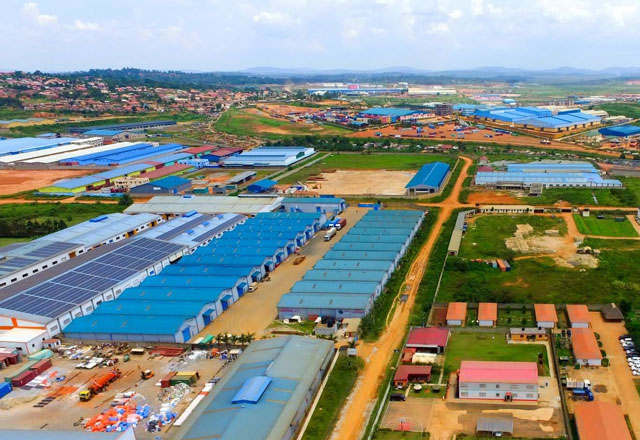
The Kapeeka Industrial Park in Luweero carries that story from mobilisation into industrialisation. By 2025, the industrial park had grown to 34 factories producing more than 1,000 products, supporting over 6,000 direct jobs and about 30,000 indirect jobs. This is a testament of what happens when land, infrastructure, capital, skills, technology and markets are organised around production.
Uganda must now go further. We must organise not merely crops and factories, but complete value chains. We must ask what we can grow, process, finance, package, brand, transport, market and ultimately own.
Coffee reveals this opportunity. In 2024/25, Uganda exported about 7.8 million bags worth US$2.21 billion. Yet this represented less than one per cent of a global coffee economy worth about US$460 billion. Much of the greater value lies beyond the Ugandan farm, in processing, roasting, packaging, branding, logistics and retail.
A Ugandan coffee bean should remain part of Uganda’s economic story even when it crosses the border. Our task is to retain more value, create more jobs and convert agricultural strength into industrial power. That is organization.
That is the scale of thinking required for Uganda’s ambition of a US$500 billion economy by 2040. The Tenfold Growth Strategy centres agro-industrialisation, tourism, minerals including oil and gas, and science, technology and innovation. But ambition must now meet quick and disciplined execution.
We do not lack land, young people, natural resources or enterprise. Our challenge is organising these into productive systems. The farmer must connect to affordable finance; finance to production; production to processing; processing to standards; standards to brands; and brands to markets.
Economic independence is therefore not simply about producing more. It is about owning more, earning more and retaining more of the value we create.
Sixty-four years ago, Uganda organised itself into a sovereign state. Our next task is to organise that state into a productive system capable of carrying millions of households out of poverty, into prosperity.
Our history has already supplied the method that has been tested and tried. Organise people, orgnise the production, organize the capital, organize the markets and organize the value.
Uganda has agonised long enough over its potential. Now we must organise it.
******

Crispin Kaheru is a Member, Uganda Human Rights Commission (UHRC)