The Independent Uganda: You get the Truth we Pay the Price


The Aston Villa deal is Rwanda’s boldest attempt yet to transform football visibility into tourism, investment and international influence
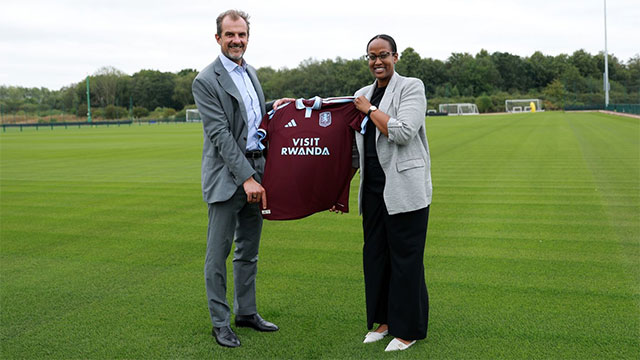
NEWS ANALYSIS | IAN KATUSIIME | When English Premier League side Aston Villa walks onto the pitch next season, Visit Rwanda will occupy the most coveted piece of commercial real estate in football—the front of the club’s shirts. The landmark partnership marks the latest and most ambitious step in a strategy that has steadily elevated Rwanda’s global profile through sport.
Aston Villa announced Visit Rwanda as the club’s principal partner, official tourism partner and official coffee provider on July 14. Media reports value the agreement at approximately £20 million (US$26 million) per year, making it the club’s most lucrative shirt sponsorship to date.
The Visit Rwanda logo will appear on the front of the shirts worn by Aston Villa’s men’s, women’s and academy teams. The agreement also grants Rwanda, a country of just over 14 million people, branding across the club’s commercial platforms and matchday experience in what Aston Villa described as “the most important sponsorship deal in the history of the football club”.
Aston Villa is based in Birmingham, the UK’s second-largest city and one of its most multicultural. A promotional video released to announce the partnership hinted at the tourism ambitions behind the deal, depicting Villa supporters exchanging the terraces of Villa Park for Rwanda’s mist-covered mountains, mountain gorillas and rolling green landscapes.
It was a clear attempt to transform football fandom into tourism demand by introducing millions of supporters to the country’s attractions. Rwanda has spent the better part of two decades positioning itself as one of Africa’s premier high-end tourism destinations.
From the endangered mountain gorillas of Volcanoes National Park to the ancient rainforest of Nyungwe, the savannah wildlife of Akagera National Park and the tranquil shores of Lake Kivu, the country has carefully cultivated an image of conservation, exclusivity and natural beauty.
By placing those attractions before Aston Villa’s global audience, the East African nation is betting that football’s enormous reach can attract tourist arrivals, investment interest and a stronger international brand.
The partnership extends beyond destination marketing. Rwanda’s speciality coffee, one of the country’s most celebrated exports, will be brewed and served throughout Villa Park, from the club’s offices to its corporate lounges and hospitality suites.
On matchdays, thousands of supporters and business guests will not only see Rwanda’s name on the players’ shirts but also sample a product that has become synonymous with the country’s premium export strategy.
The land of a thousand hills meets the city of a thousand trades.
🤝 @VisitRwanda_Now pic.twitter.com/KG1ratbnbG
— Aston Villa (@AVFCOfficial) July 14, 2026
Aston Villa was established in 1874 and is one of the oldest and most historic clubs in English football. They were a founding member of both the Football League (1888) and the Premier League (1992). Aston Villa are the 2025/2026 UEFA Europa League champions.
The club’s statement said Rwanda has a growing reputation as a destination for business, investments, major events and sports.
Francesco Calvo, Aston Villa President of Business Operations, described the deal as “a very exciting partnership” and a symbol of the club’s continuing expansion and “growth into international markets”.
He added, “We are looking forward to working with Visit Rwanda to deliver meaningful activations through tourism, investment and sporting development.”
Janet Karemera, Chief Executive Officer of the Rwanda Convention Bureau (RCB), said: “This sponsorship is a powerful expression of Rwanda’s ambition to engage global audiences through one of the world’s most influential platforms and position our country as a destination to visit, invest and do business.
She added, “Bringing together the Land of a Thousand Hills and the City of a Thousand Trades celebrates a shared commitment to enterprise, innovation and ambition.”
After eight years as Arsenal’s sleeve sponsor and partnerships with Paris Saint-Germain, Bayern Munich and Atlético Madrid, Rwanda has now graduated to the front of a Premier League shirt, dramatically increasing its visibility before hundreds of millions of television viewers worldwide.
The deal reflects a broader ambition: to use football not simply to attract tourists, but to project a small, landlocked nation as a destination for investment, business and global influence.
Global visibility
Rwanda’s earlier football partnerships gave the country a level of global visibility that few countries of its size could afford through conventional advertising. The country’s association with top-flight European football clubs ensured the Visit Rwanda brand was regularly beamed into millions of homes across Europe, Asia and Africa.
The timing could hardly have been better. Arsenal capped the final season of its eight-year partnership with Rwanda by winning the Premier League title, ensuring the campaign concluded on a high note.
In the same year, PSG won its second consecutive UEFA Champions League trophy, giving the Rwanda brand significant exposure during one of the most watched annual sporting events in the world.
Rwanda’s partnership with Arsenal, signed in 2018 and reportedly worth about £80 million (US$108 million) over eight years, marked the country’s first major foray into elite European football sponsorship.
While the Rwanda Development Board (RDB) has not published data directly linking the partnership to tourism bookings or investment inflows, government officials have consistently cited growth in tourism receipts and international visibility during the period, although the precise contribution of the Arsenal deal is difficult to isolate.
Rwanda expanded the strategy the following year by signing a partnership with PSG, reportedly valued at between €56 million and €70 million, with the Visit Rwanda logo featuring on the French club’s training and warm-up kits under an agreement that runs until 2028.
In subsequent years, Rwanda broadened its football diplomacy portfolio through partnerships with Bayern Munich and Atlético de Madrid. The Bayern Munich agreement was later restructured to focus on youth football development in Rwanda.
Some analysts argue that, much as precise commercial return is difficult to quantify, the sustained exposure generated by partnerships with some of Europe’s most successful clubs delivered a branding dividend that would have been extraordinarily difficult to replicate through traditional tourism campaigns.
President Paul Kagame, an avid sports enthusiast, has been a driving force behind Rwanda’s global sports partnerships. A passionate Arsenal supporter who regularly comments on the club’s fortunes on X, Kagame has publicly championed the Visit Rwanda campaign and has, according to Rwandan officials and previous reporting, taken a personal interest in forging several of the country’s high-profile football partnerships.
In May, Kagame travelled to Madrid to watch Arsenal take on Atlético Madrid in the first leg of their UEFA Champions League semi-final at the Riyadh Air Metropolitano Stadium.
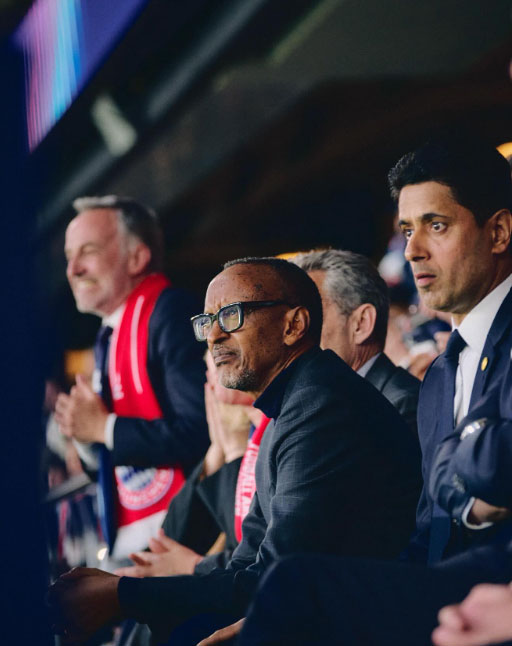
Days later, he was at the Parc des Princes in Paris as PSG defeated Bayern Munich in another Champions League classic. The two fixtures brought together three clubs that have partnered with Visit Rwanda, illustrating how football has become intertwined with Rwanda’s broader strategy of economic diplomacy and international branding.
Rwanda’s expansion into the lucrative U.S. sports market represents the latest evolution of its soft-power strategy, extending its nation-branding campaign beyond European football and into the heart of American professional sport.
Through landmark partnerships with the Los Angeles Rams of the National Football League (NFL) and the Los Angeles Clippers of the National Basketball Association (NBA), Rwanda has deliberately positioned itself within one of the world’s most influential sports and entertainment ecosystems, targeting California’s affluent consumers, investors and business leaders.
American billionaire Stan Kroenke sits at the intersection of Rwanda’s European football partnerships and its expanding ambitions in the U.S. Through Kroenke Sports & Entertainment (KSE), he owns Arsenal Football Club as well as the Los Angeles Rams and the Denver Nuggets in the NBA among other sports franchises.
Criticism of the deals
Rwanda’s growing investment in global sports sponsorships has also attracted criticism, with opponents questioning whether a low-income country facing significant development challenges should be committing tens of millions of pounds to overseas marketing campaigns.
Critics argue that the expenditure sits uneasily alongside Rwanda’s continued reliance on foreign development assistance, even as the government maintains that the partnerships are long-term investments in tourism, trade and international visibility.
The UK remains one of Rwanda’s longstanding bilateral development partners, supporting programmes in areas including health, education and poverty reduction. The juxtaposition of donor-funded development initiatives and high-profile football sponsorships has fuelled debate over whether such investments represent prudent nation branding or an expensive public relations exercise.
With a nominal GDP of about US$17 billion, Rwanda’s economy is modest by African standards, making the scale of its international sports sponsorships a recurring subject of political and public debate.
Sports business professor Simon Chadwick argues that elite sport has become a strategic arena in which governments compete for influence, investment and international recognition. Rather than viewing football sponsorships as conventional advertising, he sees them as instruments of economic diplomacy that enable countries to engage global audiences far beyond the reach of traditional diplomacy.
Critics, however, contend that such investments can blur the line between legitimate nation branding and reputation management, particularly when governments face persistent scrutiny over governance and human rights.
The debate over Rwanda’s sports partnerships came into sharp focus during its association with Bayern Munich. The deal became increasingly controversial as fan groups, politicians and human rights organisations called on Bayern Munich to review the agreement, citing concerns over Rwanda’s support for the M23 rebels in eastern Democratic Republic of Congo.
Amid the growing pressure, Bayern and Rwanda later restructured the partnership, shifting its focus from tourism promotion to youth football development.
Signed in August 2023, the five-year, multi-million-dollar “Platinum Partnership” was designed to promote Rwanda as a tourism destination while supporting youth football development. The Visit Rwanda brand featured prominently on pitch-side LED advertising at Bayern’s Allianz Arena and through a range of commercial and community initiatives before the agreement was reconfigured.
British journalist and author Michela Wrong, a long-time critic of the Rwandan government, questioned Aston Villa’s decision to partner with the country in a tweet.
“This beggars belief. The Prince of Wales’ favourite soccer team is now being sponsored by Rwanda, whose government and army are sanctioned by UK, US, EU and UN for invading DRC and looting its minerals. Do these soccer clubs do no due diligence? Mind-boggling.”
Rwanda’s embrace of elite sport reflects a broader shift in international relations, where influence is increasingly measured not only by military strength or economic size but also by a country’s ability to shape perceptions.
Football shirts, basketball arenas and NFL stadiums have become unlikely theatres of diplomacy, allowing nations to compete for attention as fiercely as they compete for trade and investment. For Rwanda, sport is no longer simply entertainment; it has become an instrument of statecraft.