 The Independent Uganda: You get the Truth we Pay the Price


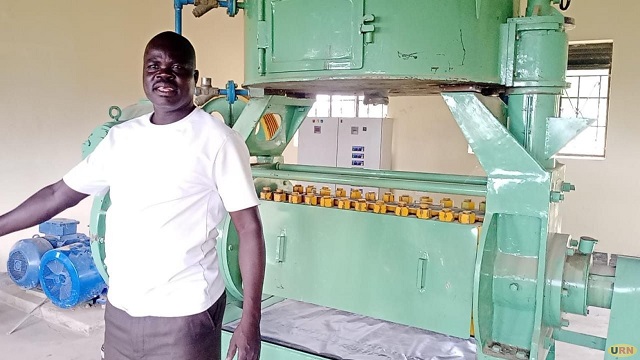
Agago, Uganda | URN | A multi-million-shilling sunflower processing machine installed in Lapono Sub-county, Agago District, is expected to boost value addition in the region, with farmers in Agago, Kitgum, and Abim districts being encouraged to increase production to supply the facility.
Zakalia Atom, the Secretary Manager of Karenga, Kaabong, Abim, Kotido, Kitgum, and Agago-(KKAKKA Community Wildlife Conservation) said the machine would benefit farmers in Agago, Kitgum, and Abim districts and potentially beyond due to its large processing capacity of 10 tons of sunflower daily.
He noted that the facility would reduce farmers’ dependence on processors in Lira, cutting transportation costs and allowing producers to access competitive market prices closer to home, but if production isn’t increased, what is produced will all be processed in a week, and the machine would remain idle.
“We may eventually stop transporting sunflowers to Lira for processing. Farmers should grow more sunflowers because the machine belongs to them. KKAKKA only secured it on their behalf,” he said.
According to Atom, KKAKKA plans to mobilise Shs10 million as start-up capital to purchase sunflower grain from farmers before eventually handing over management of the facility to a cooperative owned by the community. He added that the processing plant is expected to create at least 18 permanent jobs, which will be filled by residents.
Acellam Okidi, the Parish Chief of Amyel Parish, urged farmers, particularly young people, to embrace commercial agriculture and focus on oilseed crops as a source of income. “My appeal to the youth is to avoid excessive gambling and alcohol consumption. Those habits will only keep them poor. Let us concentrate on growing crops not only for food but also for income,” Okidi said.
He also called on the government to ensure the timely distribution of seeds to help farmers cope with increasingly unpredictable weather patterns. “If farmers receive seeds early, they have a better chance of getting good harvests. Weather patterns are becoming difficult to predict, and delayed planting often results in poor yields,” he said.
Farmers, however, raised concerns about wildlife destruction and access to quality seeds.
Paska Awili, a farmer from Kabulubulu Village in Ongako Parish, Lapono Sub-county, appealed to the government to address the growing problem of stray elephants destroying crops. She also called for the timely distribution of quality sunflower seeds and better prices for produce.
“We invest time and resources in farming, but elephants come and destroy our crops. This affects our income and livelihoods. The government should help protect farmers from wildlife so that we can benefit from our hard work. Sunflower farming is profitable, but farmers need viable seeds delivered on time. Prices should also improve because many farmers are forced to sell their produce at very low prices,” she added.
Margaret Akello, a farmer from Lokole Sub-county, said wildlife raids have become a major threat to food security. “We spend a lot of money preparing gardens and buying seeds, but when the crops are about to mature, elephants come and destroy everything. Many families are losing hope because there is no compensation,” Akello said.
She noted that some farmers have abandoned cultivating large portions of land due to repeated crop destruction. Another farmer, Peter Ocen of Parabongo Sub-county, said communities living near wildlife corridors bear the greatest burden. “At night, people take turns guarding gardens instead of resting. Even then, the animals still invade and destroy crops. Government needs to strengthen measures to protect farmers,” Ocen said.
The sunflower oil press machine was acquired in 2024, under the Biodiversity for Resilience (B4R) project funded by USAID and implemented by the Uganda Oil Seed Producers and Processors Association (UOSPA). The machine was handed over to the KKAKKA, which will oversee its management on behalf of farmers in the region. The project aims to add value to locally grown sunflowers by producing refined cooking oil, improving household incomes, and stimulating the local economy.
Part of the profits generated from the processing plant will be used to establish a Wildlife Damage Compensation Scheme to support farmers whose crops are destroyed by wild animals. Uganda’s annual demand for vegetable oil is estimated at between 450,000 and 480,000 metric tonnes, while local production stands at only about 80,000 metric tonnes.
The shortfall forces the country to spend between US$300 million and US$370 million annually on vegetable oil imports. Government and industry stakeholders have identified sunflowers as one of the key crops that could help close this gap, increase household incomes, and support agro-industrialisation across the country.



How much is crude sunflower oil?
How music is crude sunflower oil?