The Independent Uganda: You get the Truth we Pay the Price



Lifebox and Smile Train bring critical anesthesia monitors to Ugandan hospitals
Kampala, Uganda | PATRICIA AKANKWATSA | In a quiet operating room at CoRSU Rehabilitation Hospital, a small monitor flickers with waveforms that trace each breath of a patient under anaesthesia. To most, it looks unremarkable. To anaesthesiologists, it’s a lifesaver.
The device is a capnograph, a tool that measures how well a patient breathes during surgery. It alerts doctors immediately if breathing stops, if the breathing tube is misplaced, or if oxygen flow drops.
“It tells you in real time that oxygen is reaching the tissues, that carbon dioxide is returning, and that the heart and lungs are working together. Without it, you’re operating blind,” says Dr. Julianna Nanimambi, an anaesthesiologist at CoRSU.
In most developed countries, a capnograph is a standard part of every anaesthesia machine. In Uganda, it’s a luxury many hospitals still lack.
“Operating without capnography is unsafe. I don’t even want to think about it,” says Dr. Nanimambi.
While global standards require continuous monitoring of oxygen and carbon dioxide levels during surgery, most operating theatres in Uganda still lack the equipment to do so, and anaesthesia safety has been one of the most neglected areas of the nation’s health care.
Senait Bitew, Chief Program Officer at Lifebox, says this disparity has deadly implications.
“Capnography is universally used during surgery in high-resource countries,” she explains, “But in Uganda and many other low-resource settings, anaesthesia providers often work without it due to cost and access barriers. That gap puts patients’ lives at risk.”
Lifebox a global nonprofit has spent years addressing what it calls “the hidden crisis of unsafe surgery.”
In Uganda, the organisation partnered with Smile Train, the world’s largest cleft charity, to supply 54 capnographs to 35 hospitals nationwide, including Mulago National Referral Hospital, Mbale Regional Hospital, Makerere University Teaching Hospital, and CoRSU.
The impact has been immediate. “We have six operating theatres. At one point, three anaesthesia machines broke down. The Lifebox–Smile Train capnographs came in handy; they kept us running and allowed us to monitor patients safely,” says Dr. Moses Fisha Muhumuza, Medical Director of CoRSU.
Unlike traditional hospital equipment, the Smile Train–Lifebox capnograph is designed specifically for resource-limited settings: it’s portable, battery-powered, and durable.
“It can be used in district hospitals and rural theatres with unreliable electricity. It’s simple and flexible and has transformed how we work,” says Dr Muhumuza.
The partnership does not stop at donations. Lifebox combines equipment with training and mentorship. In collaboration with the Association of Anaesthesiologists of Uganda (AAU) and the Ministry of Health, the organisation has trained 142 anaesthesia providers since 2022.
“We work across three pillars. We equip surgical teams with essential tools, build their skills through training, and sustain partnerships with clinicians and institutions to ensure long-term impact,” Bitew explains.
Each capnograph comes with detailed troubleshooting guides, access to technical support, and follow-up visits to ensure maintenance and correct use.
“We weren’t just taught to use the machine,” recalls Dr. Nanimambi. “We learnt how to interpret the readings, what every curve and waveform means. That knowledge improves outcomes and saves lives.”
Uganda’s progress in anaesthesia safety mirrors a broader awakening in surgical and perioperative care across sub-Saharan Africa. Globally, the World Health Organization estimates that 5 billion people lack access to safe surgery and anaesthesia. In Africa, one in seven surgical patients suffers a major complication, and one in 150 dies, which is ten times higher than in high-income countries.
Experts argue that these outcomes are not inevitable but a symptom of systemic neglect. Essential monitoring tools like the pulse oximeter and capnograph remain out of reach for many facilities, even though they cost a fraction of what a single critical-care complication can cost to treat.
Lifebox and its partners advocate for the inclusion of capnography in Uganda’s national anaesthesia guidelines as essential monitoring equipment.
“Safe anaesthesia monitoring should not be a privilege reserved for wealthy countries,” says Bitew.
“Capnography must become standard practice in Uganda and across all low-resource settings to prevent avoidable anaesthesia-related deaths.”
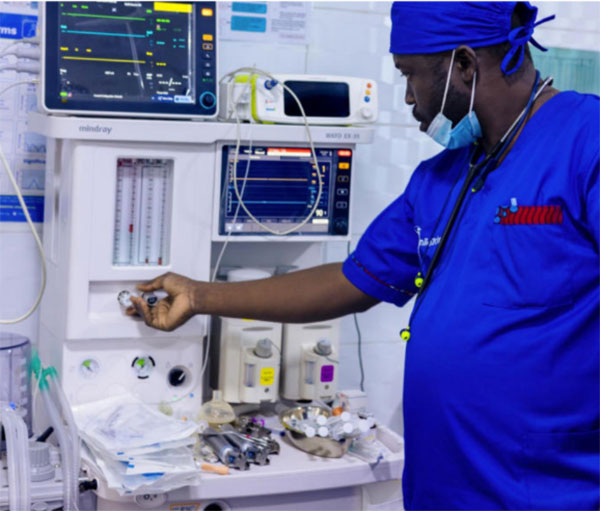
For Dr. Rose Alenyo, a plastic and cleft surgeon at Trinity International and Surgical Hospital, capnography has revolutionised how surgical teams collaborate.
“In cleft surgery, we operate in the same airway that the anaesthetist is managing,” she explains.
“Capnography allows us to detect any breathing difficulty immediately. It’s no longer guesswork; it’s precision. The monitor even provides pulse rate readings, so it doubles as a safety backup. It has made surgeries safer for both patients and providers.”
“Before these devices, anaesthetists relied solely on oxygen saturation and blood pressure readings useful but incomplete. Now we can detect trouble seconds earlier, not minutes. That difference can save a life,” says Dr. Alenyo.
Dr. Nanimambi agrees. “When I see the waveform on the capnograph, I know the patient is breathing, that the heart is working, and that the body is circulating gases as it should. It summarizes five different processes in one line. Without it, you’re always on edge.”
Despite these gains, access to capnography remains inconsistent across Uganda.
Most large public hospitals have received newer anaesthesia machines that include capnography, but smaller mission and private hospitals continue to struggle.
Uganda’s Health Sector Development Plan III (2020/21–2024/25) identifies surgical and anaesthesia safety as a priority, yet implementation remains slow. Many district hospitals still lack even basic monitoring tools. Experts argue that making capnography mandatory in all surgical procedures would align Uganda with global safety standards and save countless lives.
According to Bitew, policy adoption and local ownership are crucial for sustainability.
“When national policies recognize capnography as essential, procurement and budgeting follow. That’s how you close the safety gap for good,” she says.
At the recent All Africa Anaesthesia Congress, global health organizations including Lifebox, Smile Train, and the World Federation of Societies of Anaesthesiologists called for urgent policy reform. Their joint statement emphasized that anaesthesia safety is not a luxury it’s a fundamental component of universal health coverage.
For Uganda’s surgical teams, the effects of these small, beeping machines are already tangible. Complications are fewer, stress levels lower, and patient outcomes better.
At CoRSU, Dr. Muhumuza sums it up: “The capnographs have kept our theatres running and our patients safe. They’ve literally kept hearts beating.”