The Independent Uganda: You get the Truth we Pay the Price


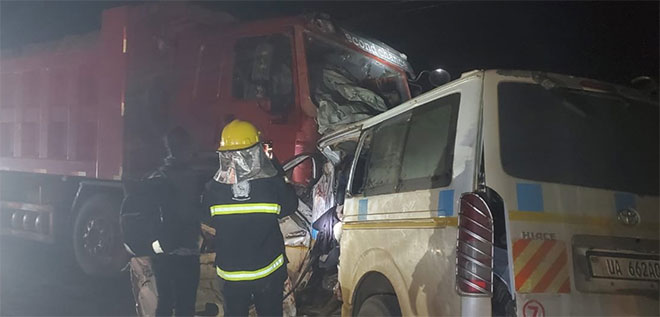
COMMENT | THE INDEPENDENT | At least 14 people were killed this week when a truck carrying sand collided with a commuter taxi van in Kalungu District. All of the dead were passengers in the van. Four others were injured. The truck driver fled the scene and remains at large.
It is a familiar story, told too often, in too many districts and on too many highways. Road accidents have become one of Uganda’s most persistent and most preventable public health crises — and yet, year after year, the response remains largely the same: police statements, condolences, and roadblocks that catch a handful of offenders while thousands more drive on unchecked.
The pattern behind these crashes is well documented. Speeding, poor vehicle maintenance, poorly regulated commuter transport, and drivers who know that the odds of being caught — let alone meaningfully penalised — are slim. Manual enforcement simply cannot keep pace with the scale of Uganda’s road network or the volume of traffic moving through it every day.
This is precisely why the rollout of smart enforcement matters, and why it can no longer wait. A system capable of detecting violations automatically and issuing penalties consistently would do more to change driver behaviour than any number of additional roadblocks — not because the fines are harsher, but because the odds of being caught stop being close to zero. Smart enforcement does not tire, cannot be negotiated with, and does not need a driver to be stopped in order to record an offence.
Uganda does not need to guess whether this works. Rwanda already proved it. In April 2021, Rwanda became the first low-income country in Africa to roll out a nationwide network of automated speed cameras — operating around the clock, issuing fines automatically, with no officer to negotiate with at the roadside. Independent research tracking the rollout found it was associated with a roughly 38 percent drop in monthly road deaths compared to the period before the cameras went live. Rwanda did this with fewer resources than Uganda in almost every comparable respect. So, the question is not whether smart enforcement works in this region — it already does, next door. The question is why Uganda is still debating its analogue — the Express Penalty System (EPS). Are we really worse placed to do this than Rwanda?
Namibia, meanwhile, offers a caution worth heeding in the other direction. Earlier this month, senior Namibian police officials called for traffic fines to be reduced, arguing that penalties disconnected from what ordinary motorists can actually afford have simply piled up as unpaid warrants of arrest — an administrative backlog that does nothing to improve road safety. As one traffic law-enforcement commissioner put it, a motorist who cannot afford a new tyre cannot afford the fine for driving on a worn one either, and punishing him harder does not fix the tyre. The lesson is not that enforcement should be softer. It is that enforcement has to be consistent and collectible, not merely harsh on paper. A fine nobody pays deters nobody. That is precisely why automation matters more than the size of the penalty — EPS works by making detection near-certain, not by making the fine large enough to break someone who was already struggling.
Government has rightly recognised this. The ongoing review of Uganda’s Express Penalty System is aimed precisely at the fix Namibia’s police are calling for — lowering fines and extending the payment period, so that penalties are collectible rather than merely punitive on paper. That is the right instinct, and it should not be diluted by the temptation to simply make fines bigger. What is needed now is urgency in finishing that review. Every month of delay in reviewing and deploying EPS is not measured in paperwork or procurement timelines — it is measured in lives. Fourteen more of them this week alone.
Uganda’s roads do not need more sympathy after the fact. They need discipline enforced before the next crash, not condolences after it.