The Independent Uganda: You get the Truth we Pay the Price


Kampala, Uganda | URN | The Uganda Railways Corporation (URC) has defended its failure to install automated barriers and warning systems at many railway crossings, arguing that reckless driving remains the leading cause of collisions even as road safety advocates call for urgent investment in safer crossing infrastructure.
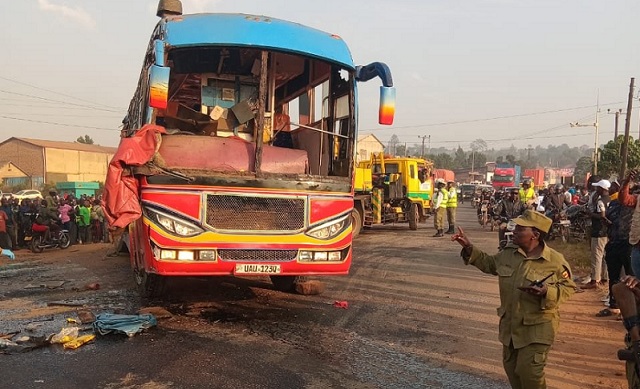
The debate has intensified following last week’s collision between a passenger train and a Friendship Company bus carrying students of Mwebaze High School in Mukono District.
The crash left one person dead and several students injured, renewing scrutiny of safety measures at railway level crossings across the country.
The accident has also revived questions about whether Uganda’s expanding passenger rail services are being matched with adequate investment in crossing infrastructure such as boom barriers, flashing warning lights and audible alarms, which are standard safety features at busy level crossings in many countries.
Speaking to Uganda Radio Network, Fred Tumwine Kuruho, Chairperson of the Road Safety Advocacy Coalition Uganda (ROSACU), said many railway crossings in Uganda lack basic engineering controls designed to warn motorists of approaching trains.
According to Tumwine, standard railway level crossings are marked with advance warning signs and road markings before the crossing itself, while busier crossings are equipped with flashing red lights, bells and boom barriers that automatically stop road traffic whenever a train approaches.
He argued that many of these features are absent at Uganda’s railway crossings, increasing the risk of crashes.
“I have concerns about our driving behaviour, but I also have a big problem with the government. You can’t operate a train without these measures in place because there must be systems that stop drivers to allow the train to pass. Even when they haven’t procured these installations, they should deploy officers to guard these crossing points to save lives,” Tumwine said.
URC, however, insists that infrastructure alone cannot eliminate collisions.
The corporation’s Public Relations Officer, John Linnon Ssengendo, said investigations into railway crashes frequently point to motorists ignoring warning signs or attempting to beat approaching trains.
“Boom barriers cannot prevent accidents at level crossings that are caused by poor driving,” he said.
“If they are installed and Ugandan drivers do not stop speeding, the barriers will be knocked down daily, forcing government to incur continuous repair costs.” Ssengendo said government is procuring automated barriers under a five-year railway modernization programme funded through an African Development Bank loan, but noted that implementation is subject to government procurement procedures.
“We have a five-year project whose loan from the African Development Bank was approved by Parliament, but everything must follow the phased government procurement process as required by law. Once that process is complete, we shall have barriers at the level crossings,” he said. He added that the project also includes expansion of the railway network to Malaba, introduction of passenger train services to Jinja and Kyengera, and construction of additional railway lines by 2028.
As an interim measure, Ssengendo said URC is working with the Ministry of Works and Transport to install speed humps some distance from railway crossings to slow approaching vehicles.
Railway level crossings have long been among the most hazardous points on Uganda’s road network.
Over the years, numerous motorists, boda boda riders and pedestrians have been killed or injured in collisions with trains, particularly within the Kampala Metropolitan Area where passenger rail services have resumed.
In November 2023, a commuter train struck and killed a boda boda rider at an informal railway crossing in Namanve, Mukono District. In June 2022, a freight train collided with a truck that had stalled on the railway in Kampala’s Industrial Area, causing hours of traffic disruption as emergency teams cleared the wreckage.
Road safety experts say those incidents underscore the need for both improved driver behaviour and safer railway infrastructure.
Under Uganda’s traffic rules and internationally accepted railway operating principles, trains have the right of way at level crossings because they cannot stop quickly or swerve to avoid collisions. Motorists are therefore required to slow down, stop where necessary, look in both directions and only cross when it is safe to do so.
However, experts argue that driver responsibility should be complemented by engineering measures that reduce the risk of human error.
They say warning lights, audible alarms, boom barriers, proper signage and clear visibility at level crossings provide an additional layer of protection, particularly on busy roads where trains and vehicles interact frequently.
As Uganda continues to expand passenger rail services, the challenge for policymakers is not simply choosing between better infrastructure and better driver behaviour.
Road safety specialists argue that reducing fatalities will require both stricter compliance with traffic rules by motorists and sustained investment in modern railway crossing safety systems to protect lives.