 The Independent Uganda: You get the Truth we Pay the Price


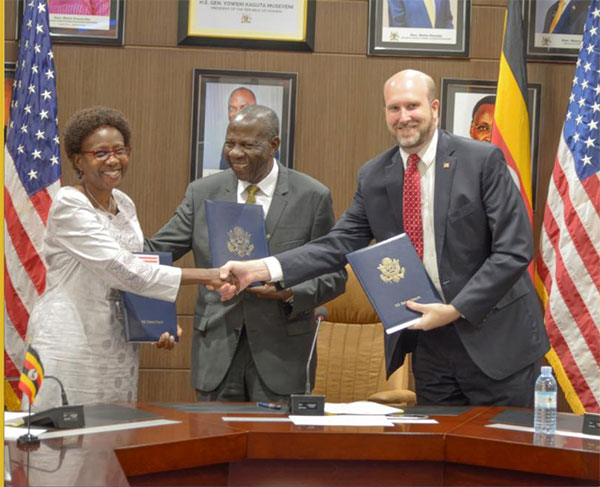
Kampala, Uganda | THE INDEPENDENT | Uganda and the US have today signed a $2.3 billion bilateral health cooperation Memorandum of Understanding (MOU) that should, after five years, produce an effective health system that is sustained and owned by the Government of Uganda’s institutions and communities.
In the MOU, the government of the United States and the government of Uganda outlined a comprehensive vision to save lives, strengthen Uganda’s health system, and make America safer, stronger, and more prosperous. It underscores a mutual commitment to safeguarding health gains and protecting their citizens.
The MOU advances the U.S.–Uganda bilateral relationship and supports Uganda in developing a resilient health system that prevents the spread of emerging and existing infectious diseases globally.
Under the MOU, the United States plans to support priority health programs, including HIV/AIDS, TB, malaria, maternal and child health, polio eradication, global health security, human resources, disease surveillance, and emergency preparedness. Over the five-year period, the United States Government plans to provide up to $1.7 billion of support, and the Government of Uganda pledges to increase domestic health expenditures by more than $500 million to gradually assume greater financial responsibility over the course of the framework. The agreement includes support for faith-based healthcare providers in Uganda.
Ambassador William W. Popp speaking at the signing ceremony with the Minister of Finance, Planning, and Economic Development Matia Kasaija, said, “This agreement represents a significant commitment by the United States and Uganda to co-invest in our shared global health priorities. Today, we are building on prior successes and making a significant shift toward promoting self-reliance in the health sector through strong community health systems, clear performance metrics, and a foundational commitment to data systems and global health security that will prevent and stop outbreaks from threatening Uganda, the United States and the world.”
The United States remains Uganda’s largest global health partner, both bilaterally and through international multilateral institutions. Today’s signing builds on more than 60 years of collaboration in the health sector, supporting programs that have saved lives, strengthened systems, and advanced shared global health priorities. This support has laid a strong foundation for the Government of Uganda to finance and steer its own health agenda.
Finance Minister Matia Kasaija said: “The Government of Uganda acknowledges the critical importance of preventing the spread of emerging and existing infectious disease threats globally. In this regard, the Government of Uganda notes the United States Government’s commitment to support Uganda with a budget allocation of $1.7 billion for the period 2026–2030. The Government of Uganda also recognizes and commits to gradually increasing its own budgetary contribution to more than $500 million over the same period, as the U.S. budget support decreases. This collaboration will yield not only disease-specific outcomes but also significant improvements in national systems, institutions, and workforce capacity. This is highly commendable.” said
Today, we signed a 5 year bi lateral health cooperation MOU worth USD 2.3 billion with the United States Govt. This partnership will strengthen our health systems, and boost our fight against HIV/AIDS, malaria,maternal health issues & more. We appreciate the support from the USG. pic.twitter.com/SwusKN9d0m
— Dr. Jane Ruth Aceng Ocero (@JaneRuth_Aceng) December 10, 2025
What’s in the MOU?
The MOU contains a number of important and innovative provisions that will help facilitate long-term sustainability of Uganda’s health system including:
Commodities: The procurement of most commodities, which will transition from the U.S. Government to the Government of Uganda gradually over the next five-year period and while strengthen Uganda’s supply chain systems and institutions.
Frontline Health Workers: Frontline health workers currently funded by the U.S. Government will be mapped to the cadres of health workers that can be employed by the Government of Uganda, and those cadres of health workers will be transitioned over to the Government of Uganda’s payroll.
Data Systems: Over the next five years, the U.S. government will invest significantly in data and disease surveillance systems to enhance Government of Uganda’s data ecosystem. These investments will advance the Government of Uganda’s digitization agenda by improving data capture, use of electronic medical records (EMRs), and integration and interoperability between various systems and the national data warehouse.
Faith-Based Providers: The Government of Uganda, with support from the U.S Government, plans to support faith-based providers through a variety of mechanisms including performance-based service agreements, increased primary health care (PHC) grants, and support for digitization and community health insurance initiatives.
Co-Investment: The Government of Uganda will enhance its domestic health expenditures by more than $500 million over the next five-year period, a critical step in ensuring the Government of Uganda allocates the resources needed to sustain gains made in its health systems and move to self-reliance.



That smile of “Money is available!”😁
But some time back we refused to touch money from those gay countries, that from now on we shall manage without their money… what happened?