The Independent Uganda: You get the Truth we Pay the Price


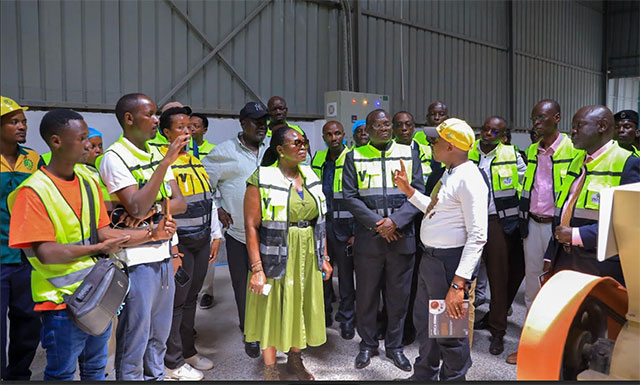
Ntungamo, Uganda | JULIUS BUSINGE | It is 11:50 am on October 1 at Africa Coffee Park in Rwashamire, Ntungamo District. The air hums with celebration. Uganda’s Minister of Energy and Mineral Development, Ruth Nankabirwa, sways to music as the launch of Inspire Africa’s first batch of finished coffee products reaches its crescendo.
Moments earlier, Chief Justice Alfonse Owiny-Dollo had waved off a small truck carrying four flagship products—Drip Coffee, Coffee Capsules, Ground Coffee, and Roast Coffee—destined for local and international markets.
For Nelson Tugume, the founder and chief executive of Inspire Africa, it was the culmination of a decade-long ambition to move Uganda from a raw-bean exporter to a player in the global value-added coffee market.
Uganda has long been a coffee powerhouse. It produces over 4 million 60-kilogram bags annually, making it Africa’s largest robusta producer and among the world’s top ten exporters. Yet, the majority of beans leave the country unprocessed.
The economic cost is substantial in terms of foreign exchange earnings, jobs, and technological capacity that could underpin industrialisation are lost. By investing in advanced spray-drying and freeze-drying technology, Africa Coffee Park aims to change this narrative, turning raw beans into premium products suitable for international consumers.
Tugume sees the venture as more than a business. “We shall give you the best products on the market… The dream is not for Nelson; it is for Uganda,” he told a cheering crowd.
His words resonate beyond the celebration. The project reflects a broader industrial challenge across Africa: translating abundant raw materials into domestically processed goods that generate wealth, employment, and technological know-how.
Shs 126 million government investment
The government has been a committed partner. It has invested over Shs126 billion into the facility, signaling its intent to derisk capital-intensive industrial ventures.
Nankabirwa pledged additional support, including a dedicated transformer at the nearby Mirama Hills Power Substation and preferential electricity tariffs.
“We have to derisk this project and power its growth,” she said, framing industrialisation as a collaborative public-private effort.
The launch coincided with International Coffee Day, attracting high-profile dignitaries, including military delegations from Rwanda and Uganda.
The event’s theme, “From Bean to Brilliance,” highlighted coffee’s symbolic and economic significance. Uganda’s coffee sector is no longer just a source of export revenue; it is central to the country’s industrial ambitions.
Tugume showcased the Park’s processing lines and hinted at future diversification, including coffee-based energy drinks and beauty products, signaling a move toward innovation-driven growth.
Spanning 150 acres, Africa Coffee Park is claimed to be the largest coffee industrial complex in Eastern Africa. Beyond processing, the Park will host convention centres, exhibition spaces, a coffee academy, agro-tourism facilities, hotels, sports amenities, and even an airstrip.
The facility is projected to produce 15,000 metric tonnes of finished coffee annually, with export plans targeting Somalia, China, Turkey, the United Kingdom, and the United States. For Uganda, this represents a potential doubling of export earnings from value-added products, a shift with far-reaching economic implications.
Uganda’s experience is instructive in a regional context. Rwanda and Ethiopia have long invested in coffee processing, branding, and export diversification. Ethiopia, for example, has developed a strong presence in packaged coffee markets worldwide, leveraging its cultural heritage and perceived premium quality.
Uganda, with its robusta-dominated production, has historically lagged behind in branding and value addition. Africa Coffee Park seeks to close that gap, positioning Uganda not just as a producer of beans, but as a manufacturer of globally competitive coffee products.
The initiative also underscores the role of homegrown entrepreneurship. Tugume’s journey has not been without hurdles. Early skepticism ranged from doubts about technical feasibility to critiques of public funding.
“If government had supported a person of a different colour, people would have no problem,” he remarked, highlighting the social and cultural dimensions of industrial support in Uganda. Yet government backing, coupled with a clear vision, has allowed Inspire Africa to overcome these barriers.
Multiplier effect
Economic analysts note that projects like Africa Coffee Park could have multiplier effects. Value addition generates jobs across the supply chain—from farmers supplying high-quality beans, to technicians operating sophisticated drying equipment, to marketers promoting premium brands abroad.
It also encourages technological diffusion, as workers gain skills in food processing, quality control, packaging, and logistics. In a country where youth unemployment remains high, such ventures have the potential to transform livelihoods.
Chief Justice Owiny-Dollo praised Tugume’s vision as emblematic of what domestic entrepreneurship can achieve, while Minister for the Presidency Milly Babalanda likened the project to a crawling child poised to walk independently, urging Ugandans to nurture it.
The first international shipment to Somalia was set to be flagged off on October 7 during the Uganda–Somalia Business Summit, a symbolic step integrating Uganda further into regional and global value chains.
For Tugume, the launch is just the beginning. “The dream is not mine alone,” he told the crowd. “It is for Uganda.”
In an economy often defined by raw exports, Africa Coffee Park represents a bold pivot; a statement that Uganda is ready to trade not just beans, but ambition, innovation, and industrial vision on the world stage.