 The Independent Uganda: You get the Truth we Pay the Price


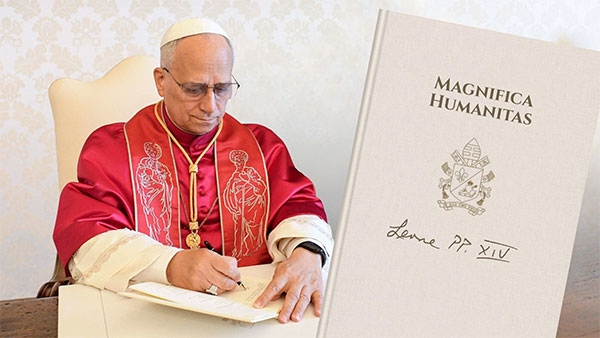
Will AI make civilization less human and hollow out the value of work?
COMMENT | KENEDY MUSEKURA | On May 25, 2026, Pope Leo XIV released Magnifica Humanitas (Latin for ‘Magnificent Humanity’), his first encyclical letter and most extensive papal document ever dedicated to Artificial Intelligence (AI). This extensive document has been making headlines in the international papers of repute and continues to be discussed extensively in similar forums.
The letter is structured in five chapters and a conclusion which, among others, is concerned with preserving the human person in the age of AI. The document warns that the technology risks making civilisation “less human”, reducing the dignity of human beings and hollowing out the value of work.
For this comment, I wish to highlight what caught my attention, mostly in chapters three and four of the document. The Pontiff, under chapter three, among others, cautions humanity on AI by calling for prudence, rigorous evaluation and even, at times, a slower pace in adopting AI. However, he quickly adds that “this doesn’t mean opposing; rather, it is an exercise of responsible care for the human family.” This need is more urgent given the frequent imbalance between the speed of technological growth and the slower development of awareness, norms, safeguards and institutions capable of governing its effects.
The Holy Father reminds me of the fears and alarm that were raised in that big story that featured as a cover story in The Economist magazine of April 18 2026 titled: “The Mythos moment: Can the five men be trusted with AI?’’ Herein the USA is depicted suddenly waking up to the AI masters after learning that some AI models had made very significant progress to the extent of possessing a threat to America’s own security.
The turning point being the recent Anthropic announcement of Claude Mythos on April 7 2026. A model that is being touted as being so good, so powerful and with potential of finding software vulnerabilities that are in wrong hands, hence fears that it would threaten critical infrastructure, from banks to hospitals, etc.
Anthropic’s boss Dario Amodei confessed that Mythos was too dangerous for general release. Instead, he reserved it for use by around 50 big firms in computing, software and finance so that they can boost their own defenses. America’s treasury secretary, Scott Bessent, was so unnerved that he summoned the biggest banks for urgent talks. It was the first time the Trump administration had acted.
Only weeks ago, the Pentagon stepped in after Mr. Amodei refused to allow Anthropic’s model to be used in fully autonomous weapons or mass domestic surveillance. The Trump administration was alarmed because of the power a single firm wielded over a technology so central to national security. The US government is now considering starting to vet AI models before they are deployed to the public.
On the education front, Pope Leo writes in one of the paragraphs, “In recent years, psychological and psychiatric literature has documented with the growing insistence of how early unsupervised exposure to digital devices and social media can negatively impact sleep, attention span, control of emotions and relationships especially during the most vulnerable stages of life at times with tragic consequences…”
Here, the Holy Father’s letter reinforces the views in that highly influential 2024 book by social psychologist Jonathan Haidt titled “The Anxious Generation: How the Great Rewiring of Childhood is Causing an Epidemic of Mental Illness”, which, among others highlighted the sharp, global rise in adolescent mental health issues due to addiction to some social media sites by teens (like anxiety, depression and self-harm) that began around 2010.
Some Western countries, basing their perspectives on those highlighted in the Pope’s letter and Haidt’s book, have taken a step to legislate by lifting up the age by which teens open up their social media accounts on platforms like Facebook, Instagram and TikTok from 13 to 16 years, a case in point being Australia which did so in December last year. Others, including Britain and Spain and some states in the USA, have mulled over a similar idea.
On the segment of work, the Pontiff cautioned inter alia thus: more than ever, in the age of AI and robotics, it is no longer possible to rely solely on the “invisible hand” of the market. Politics has the task of orienting economies and technologies to the common good, promoting dignified work, social inclusion and an equitable distribution of the benefits of innovation….”
Last but not least, the Pope’s letter offers timely guidance and raises genuine concerns that warrant attention from countries like Uganda, East Africa, continental AI stakeholders, and humanity at large. His letter challenges us to embrace innovation while safeguarding human dignity, justice, truth and solidarity, which, in my view, is a balanced take on AI from the Pontiff.
****
 Musekura Kenedy is a Lawyer, Tech and Digital Policy Analyst
musekurakenedy@gmail.com 0784393922



Let’s get this clear: AI is the foundation for the nastiest form of control on the human population now in the works. It must be absorbed with extreme caution.
really?
really?