The Independent Uganda: You get the Truth we Pay the Price


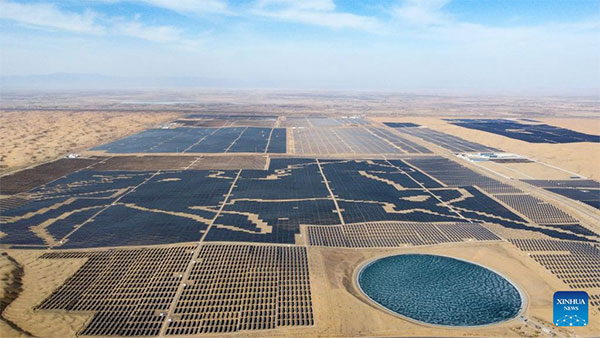
BEIJING | Xinhua | Across the deserts in northwest China, where the sun blazes and the winds never relent, those forces that people once had to endure are now powering a new source of wealth.
“We used to hide from them,” said Qi Pengxiao, now in his 80s. He arrived in the Qaidam Basin in Qinghai Province as an oil worker in 1957, when the resources beneath the ground were the only treasures that mattered. “Now they’ve become our precious assets: new energy.”
Today, under that same sun, row upon row of solar panels stretch across the desert like a blue ocean, while towering turbines turn in a slow, steady rhythm in the wind. The barren land has emerged as a new energy heartland of renewables.
Driving this shift is a revolution spanning over a decade championed by Chinese President Xi Jinping, who aims to build a new energy system that is clean, low-carbon, secure and efficient to power the world’s second-largest economy.
Xi, also general secretary of the Communist Party of China (CPC) Central Committee and chairman of the Central Military Commission, has long given priority to energy security, an issue he considered overarching and strategic to the nation’s economic and social development.
“Whoever commands energy may well command the development potential and the vital source of wealth creation,” Xi told a meeting on fiscal and economic affairs back in 2014.
In the face of changes in energy demand and supply, as well as new developments in the international energy landscape, China must ensure national energy security through a revolution in energy production and consumption, he said.
Central to his thinking is a question of balance. How to advance the transition from fossil fuels to new energy without undermining the energy security on which China’s development depends, while steadily improving self-sufficiency and long-term supply resilience? The country’s climate goals — to peak carbon emissions before 2030 and achieve carbon neutrality by 2060 — only sharpen the stakes.
The solution is taking shape in the vast fields of solar panels, an expanding power grid, and a growing fleet of electric vehicles. China now relies on an increasingly diverse energy mix. While crude oil output remains steady at around 200 million tonnes a year, its wind and solar energy installations for the first time surpassed those of thermal power in 2025.
This restructuring has not come at the expense of energy security. Despite growing demand in recent years, over 90 percent of China’s increase in energy consumption has been met domestically, and one-third of its electricity consumption is powered by green energy.
During an inspection trip last month to Xiong’an New Area, a much-anticipated “city of the future” in north China’s Hebei Province, Xi said China’s efforts to develop wind and solar power had proven “forward-looking in hindsight.”
At the same time, he noted, coal-fired power remains the bedrock of the nation’s energy system, providing a crucial foundation to ensure energy security.
Such a coordinated approach has led to significant gains in energy efficiency. From 2013 to 2023, China fueled 6.1 percent average annual economic growth with just 3.3 percent energy consumption increase, making it one of the world’s fastest-improving nations in energy intensity.
China is also strengthening its energy infrastructure. Today, it takes only an instant — about five milliseconds, to be exact — for electricity generated in the northwestern Qinghai Province to travel over 1,500 kilometers and reach the power-intensive central China via ultra-high-voltage lines. A single second’s pulse of electricity is enough to support a household in Henan Province — one of the country’s most populous regions and an economic powerhouse — for an entire year.
In Henan alone, the ultra-high-voltage corridor is estimated to help slash the region’s annual coal consumption by over 15 million tonnes, cutting carbon dioxide emissions by more than 25 million tonnes.
The sweeping transformation is underpinned by a wave of technological breakthroughs that Xi has called for, not only to advance the energy transition but also to foster new engines of economic growth.
“We should develop energy technology and its related industries into a new growth driver to boost industrial upgrading, facilitating the development of new quality productive forces,” he has told senior CPC officials.
China has emerged as a global frontrunner in new energy technology and equipment manufacturing. From 2021 to 2025, the nation held over 40 percent of the world’s new energy patents, while its photovoltaic conversion efficiency and offshore wind turbine unit capacity repeatedly set new world records.
Just a day earlier, on April 21, Chinese clean-tech giant Contemporary Amperex Technology Co., Ltd. (CATL) unveiled its third-generation Shenxing fast-charging battery, capable of charging from 10 percent to 98 percent in six minutes and 27 seconds, narrowing the gap between electric vehicle charging and conventional refueling.
In the recently adopted outline of the 15th Five-Year Plan (2026-2030) for national economic and social development, China has set a bold target of doubling its non-fossil fuel supply by 2035.
Emerging technologies such as green hydrogen, concentrated solar power and geothermal energy have also been folded into the blueprint, alongside next-generation energy storage solutions.
Over the next five years, China’s power grid investment is expected to exceed 5 trillion yuan (about 728.5 billion U.S. dollars), while efforts will continue to upgrade coal-fired power units for energy conservation and carbon reduction, and to promote technologies such as carbon capture, utilization and storage.
China’s push to build a new energy system carries significance well beyond its borders, as the rapid expansion of artificial intelligence data centers strains power grids worldwide and adds fresh pressure alongside growing climate concerns.
According to a February report from the International Energy Agency, global electricity demand is expected to grow at an average annual rate of 3.6 percent over the 2026-2030 period.
China’s technological and manufacturing edge is helping bridge this gap. The country has ranked first globally in new energy vehicle production and sales for 11 consecutive years, and it produces 80 percent of the world’s solar cells and 70 percent of both wind turbines and lithium batteries.
According to Xi, China’s new energy industry has made real progress in open competition and represents advanced production capacity, which not only increases global supply and alleviates the pressure of global inflation but also contributes significantly to global climate response and green transition.
“Low-carbon energy development concerns the future of humanity,” he has said, pledging that China stands ready to work with the international community to boost energy cooperation, safeguard energy security, address climate change, and protect the ecological environment to promote sustainable development and benefit people around the world.