The Independent Uganda: You get the Truth we Pay the Price


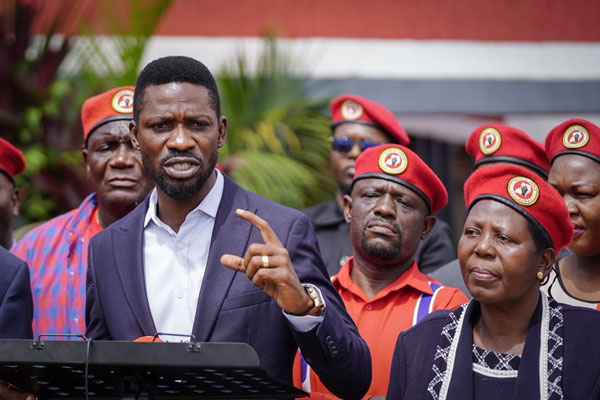
COMMENT | NNANDA KIZITO SSERUWAGI | In the previous article, Bobi Wine (Mr Kyagulanyi Robert)’s manifesto was critiqued for structurally constituting grievances against the Museveni government as opposed to focusing on the articulation of an inspiring, affirmative vision for Uganda’s future. It was established that his manifesto reads more like a human rights report than a policy document.
Kyagulanyi’s manifesto, Priority Two, is titled “End corruption and wasteful government expenditure.” When you read it, it flows with the same shortfalls we highlighted in Priority One. Over 80% of it is, for the most part, a catalogue of criticisms and complaints against Museveni personally and the fiscal discipline of his government’s public administration system. While it is true that Uganda faces serious challenges with its large and increasing number of public servants, which consequently leads to a high public wage bill at the expense of funding for basic services, Kyagulanyi still fails to articulate concrete policy solutions to this challenge. His complaint-to-policy ratio on the fiscal mismanagement of Uganda is highly asymmetrical.
Kyagulanyi’s cluelessness about how to reform Uganda’s public administration (which his manifesto captures as “corruption and wasteful government expenditure”) is very pronounced in how he cannot provide solutions. After documenting complaints and grievances from pages 9-13, he finally attempts to make what would be policy proposals on pages 14 and 15, but these proposals are simply brief, superficial bullet points. What is clear from this is Bobi’s lack of bandwidth to deal with the problems he complains about. If he were clear-headed about reforming and transforming the country post-Museveni, he would be as lengthy and articulate about what to do better as he is with complaints.
Kyagulanyi compensates for his inability to articulate a solid policy alternative to Museveni by living and conditioning his supporters to live in a populist fantasy. This explains why his manifesto is largely constituted of emotionally charged platitudes and oversimplified narratives. It lacks the thought and depth of Museveni’s solvent, bulky manifesto. However, we should not just despise Bobi’s retreat to empty platitudes and oversimplified narratives because they are the gasoline that runs populist movements.
Although his manifesto is incapable of dealing with the complexities of managing Uganda’s challenges, it is successful in creating an illusory world that further distracts his unsuspecting supporters from thinking through the flaws in his promises, while making them feel empowered and emboldened to support him regardless of whether he represents a more enlightened position for the future of this country or not.
What Bobi achieves with his manifesto, which extensively documents government excesses, is the entrenchment and radicalisation of NUP’s existing base. However, for the average Ugandan who certainly may be struggling with challenges of underfunded public services, poor infrastructure, etc., it does not serve them to read ten thousand words that confirm their dilemma. What would serve them is a detailed, credible roadmap that shows how Kyagulanyi’s government would govern differently. Unfortunately, this is the one responsibility Kyagulanyi’s manifesto abandons. Instead of allocating at least 20% of his manifesto to identifying and explaining the problems he wants to deal with and 80% to articulating detailed solutions, Bobi does the opposite.
Kyagulanyi’s grievances manifesto weaves a populist fantasy that thrives on selling quick fixes to deep problems. That is why scapegoating Museveni is his forte. His manifesto’s messaging is designed to make his supporters internalise stories that make Museveni the beginning and end of all Uganda’s problems. The people supporting Bobi are not supporting him because he carries any policy alternatives with practical outcomes, but because he has a constant anti-Museveni narrative. That narrative succeeded in creating the illusion among his supporters that Museveni is Uganda’s problem and getting rid of him is the solution. It is such a simplistic story with empty platitudes, but unfortunately, it is easy to sell and quick to buy.
But let us, for a moment, assess Kyagulanyi’s populist policy proposals if they were to be carried through with a sincerity as extreme as the hypocrisy with which they are told. For instance, his first “promise for a new Uganda” under Section 2.1 is to “slash the cabinet to a maximum of 20 ministers, reduce the number of MPs and their bloated costs, scrap redundant political appointments, etc.” Whereas this proposal is emotionally appealing, it exposes either Kyagulanyi’s political naïveté or his deliberate oversimplification of reality for political expediency. For Bobi to reduce parliament from 556 members to, let’s say, about 200, he would have to pass a constitutional amendment. To achieve this, he would have to convince sitting MPs to vote themselves out of their jobs. Even with a parliamentary majority (which NUP doesn’t have), this remains politically unlikely. The NUP manifesto provides no strategy for overcoming this obstacle whatsoever.
The manifesto also has no measure of the optimal size of public administrators that is required to meet Uganda’s governance needs. It does not think through proportional representation or regional balancing to curb ethnic tensions. All the numbers it suggests as an alternative to the current numbers of public administrators in various sectors are simply politically appealing, random, round numbers.
****
 The writer is a Ugandan thinking about Uganda.