The Independent Uganda: You get the Truth we Pay the Price


Kampala, Uganda | PATRICIA AKANKWATSA | Uganda’s growing climate crisis is forcing policymakers, financiers, development agencies and agribusinesses to rethink how the country will feed itself in an era of erratic rainfall, prolonged droughts and rising temperatures.
At the centre of that conversation is solar-powered irrigation systems (SPIS), a technology increasingly being promoted as the bridge between climate adaptation, agricultural productivity and rural economic transformation.
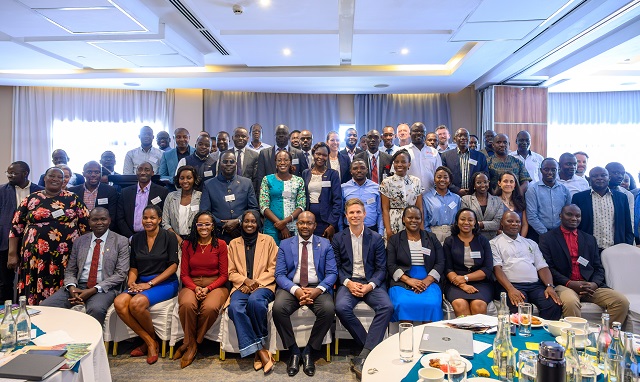
That debate dominated discussions at a national investment forum and wrap-up meeting for the Accelerating Climate Technology Transition (ACT) project held at the Golden Tulip Hotel in Kampala on May 06, where government officials, development partners, financial institutions, private sector players and farmer organisations examined how to move solar irrigation from pilot projects to large-scale national investment.
The ACT initiative is funded by Denmark through Danida and implemented with support from multiple international partners including the United Nations Environment Programme (UNEP), the Food and Agriculture Organization (FAO), the United Nations Capital Development Fund (UNCDF), and other public and private sector actors working on climate-smart agriculture and clean energy transitions.
The meeting also served as a platform to launch a new report examining Uganda’s solar-powered irrigation investment landscape and how the technology could help the country achieve commitments under Uganda’s Nationally Determined Contributions (NDC 3.0), national adaptation plans and broader development priorities.
Uganda’s agriculture sector employs more than 70% of the population directly or indirectly, yet it remains overwhelmingly rain-fed and therefore highly vulnerable to climate variability.
Officials at the forum warned that the old agricultural model built around predictable rainfall seasons is steadily collapsing.
Bob Natifu, Commissioner in the Climate Change Department at the Ministry of Water and Environment, said Uganda’s average temperatures have already risen by about 1.3 degrees Celsius, intensifying pressure on farming systems.
“Climate adaptation means reducing dependence on rainfall and building resilience in food systems through reliable energy and irrigation solutions,” Natifu said.
He noted that although about 80% of Uganda’s land is suitable for agriculture, only around 35% is currently cultivated, while irrigation coverage remains extremely low.
The implications are increasingly visible across rural Uganda where failed harvests, drying water sources and shifting planting seasons are becoming more common.
For policymakers, the challenge is no longer whether climate change is happening, but whether Uganda’s agricultural systems can adapt quickly enough.
Solar irrigation emerges as adaptation tool
The forum positioned SPIS not merely as an irrigation technology but as a wider economic and climate resilience strategy.
By replacing diesel-powered pumps with solar systems, officials and investors argue that farmers can reduce production costs, expand dry-season farming, increase yields and shield themselves from volatile fuel prices.
Adam Sparre Spliid, Denmark’s Deputy Ambassador and Head of Cooperation in Uganda, said solar irrigation is about “transforming the future of Ugandan farmers and businesses through strategic climate resilience investments.”
Spliid said Denmark, working with Team Europe and other partners, has been supporting initiatives aimed at connecting farmers to climate technologies through innovative financing and business partnerships.
Among the partners and initiatives, he referenced were FAO, UNCDF, Mercy Corps, SONA Power, Julem Power, the African Green Grant initiative and agribusiness actors working in northern Uganda and refugee-hosting communities.
He said solar irrigation systems are already demonstrating social and economic impact beyond crop production.
“Replacing expensive and polluting diesel pumps with pay-as-you-go solar models is enabling women and youth entrepreneurs to move from subsistence farming to surplus production,” Spliid said.
“In displacement-affected areas, reliable harvests are providing the foundation for new beginnings and economic stability.”
The Danish envoy said the broader objective is to create a functioning climate technology ecosystem where investors, technology suppliers, agribusinesses and farmers are linked through blended finance and risk-sharing mechanisms.
The financing problem
But while enthusiasm around solar irrigation is growing, financing remains the sector’s biggest bottleneck.
Many smallholder farmers cannot afford the upfront cost of irrigation systems, while banks still consider rural agriculture high-risk lending territory.
That financing gap featured prominently during the forum discussions.
Officials from the Ministry of Finance, Planning and Economic Development warned that unless financing structures are redesigned, solar irrigation could remain inaccessible to the very farmers who need it most.
James Muhwezi from the ministry’s Climate Finance Unit said Uganda urgently needs financing models that move beyond awareness campaigns into actual investment.
“We need to move from good intentions to concrete banking investments,” Muhwezi said.
He noted that Uganda requires an estimated US$28.1 billion to fully implement its current climate commitments, yet available financing currently covers only a fraction of that need.
Muhwezi argued that solar-powered irrigation systems represent one of the most direct and scalable tools for achieving Uganda’s climate and agricultural transformation goals under the Fourth National Development Plan (NDP IV).
According to data presented at the forum, irrigation currently covers only a tiny portion of Uganda’s agricultural land despite evidence showing significant productivity gains compared to rain-fed farming.
Officials said SPIS could generate major income increases for smallholder farmers while simultaneously reducing carbon emissions.
The dairy sector alone, participants heard, represents more than US$128 million in potential investment opportunities linked to irrigation, cold storage and renewable energy integration.
Yet despite the potential, private sector investors remain cautious.
Several barriers continue to slow uptake: high equipment costs, weak rural financing systems, fragmented supply chains, poor after-sales support, and limited farmer awareness.
Martin Ameu, Assistant FAO Representative in Uganda, said demand for solar irrigation technology is growing rapidly at community level, but affordability continues to undermine expansion.
“The community-level demand is there,” Ameu said. “Farmers are ready, but financial barriers remain significant.”
He argued that the challenge now is translating years of pilot projects and technical studies into scalable investment models.
“The opportunity is real,” Ameu said. “What is needed now is moving from analysis to investment and from fragmented efforts to coordinated partnerships.”
Participants also highlighted the need for clearer policy incentives, quality assurance systems and stronger regulation to protect farmers from poor-quality technologies entering the market.
Officials argued that the technology sits at the intersection of food security, energy access, climate resilience and rural industrialisation.
Natifu noted that nearly half of Uganda’s population still lacks reliable electricity access, particularly in rural areas where agriculture dominates livelihoods.
Solar irrigation therefore offers dual benefits: improving agricultural production while simultaneously expanding access to clean decentralized energy.
“This is not just about water management,” he said. “It is about integrating renewable energy into agriculture in a way that transforms productivity and creates sustainable rural economies.”
He added that Uganda’s enormous solar energy potential makes the technology particularly attractive compared to large-scale hydropower projects, which require massive capital investments.
Uganda’s solar energy potential, officials said, is estimated at roughly 24,000 megawatts — significantly higher than currently exploited renewable energy sources.
Search for blended finance
As discussions turned toward implementation, participants repeatedly returned to the need for blended financing mechanisms involving governments, donors, development finance institutions and private investors.
The ACT project itself was presented as an example of how international climate finance partnerships can help de-risk emerging agricultural technologies.
UNEP, FAO, UNCDF, Danida and other implementing partners were praised for helping create investment dialogue between policymakers and the private sector.
Spliid said innovative financing tools such as guarantees, insurance schemes and carbon finance mechanisms could help commercial banks become more comfortable lending to rural farmers.
“If we mitigate investor risk properly, we can create a financial ecosystem where smallholder farmers in remote districts access solar technologies as easily as businesses in urban areas,” he said.
Muhwezi also pointed to growing opportunities in carbon trading and climate finance instruments that could subsidize solar irrigation costs if Uganda develops credible regulatory frameworks.