The Independent Uganda: You get the Truth we Pay the Price


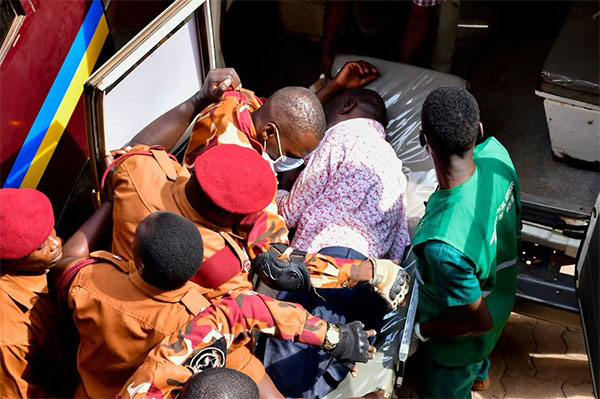
Saleh Reveals How Besigye Was Transferred To JCRC For Better Treatment
Namunkekera, Uganda | URN | Retired General Caleb Akandwanaho aka Salim Saleh, has revealed that he intervened to secure medical attention for detained opposition leader Dr Kizza Besigye after finding him in what he described as an almost-dead condition at Luzira Prison.
Saleh said he re-established contact with Besigye following an August 25 social media post by Chief of Defence Forces (CDF) General Muhoozi Kainerugaba, who reportedly tasked him with handling the matter involving the former Forum for Democratic Change (FDC) president.
Addressing chairpersons of parliamentary committees from the 12th Parliament, led by Government Chief Whip Jane Ruth Aceng, at Namunkekera in Kapeeka, Saleh said Muhoozi’s intervention presented an opportunity to reconnect with Besigye after years of estrangement over political differences.
“On the 25th of August, I got a tweet from CDF, that Kizza’s problem is my problem; I’m the one going to sort it out,” Saleh said.
He said the message initially surprised him because he had lost contact with Besigye amid their political disagreements.
“When I got that tweet, I said, you guys, are you serious? He said, yes, I’m serious. Okay. What followed was very, very extraordinary for me,” Saleh said.
Saleh said he subsequently visited Besigye and was shocked by the condition in which he found him at Luzira, prompting him to arrange his transfer to the Joint Clinical Research Centre (JCRC).
“By the time I went to the hospital, I found my friend almost dead in prison. So, my first action was to take him from the prison and take him to a proper medical centre,” he said.
Saleh defended the choice of JCRC, saying it was a facility he helped establish and one he would personally use if he required intensive medical attention.
“It’s the same bed I would be in myself if I were under intensive conditions. Yeah, at the Joint Clinical Research Centre, which was established by us. I’m a founder member there,” he said.
His revelation comes amid growing public attention to Besigye’s health following his collapse during a High Court session in July 2026.
He was initially taken to Mulago National Referral Hospital before being transferred to JCRC for further medical care.
Saleh’s intervention has also drawn attention because of reports that he has been leading efforts to engage Besigye and other political actors in discussions intended to address longstanding political differences.
However, Saleh avoided describing his engagement with Besigye as peace negotiations, saying he regarded it primarily as an opportunity to restore contact with an old colleague.
“Don’t ask me whether we are in peace talks or not. For me, the moment I got that tweet, I said, aha, now God has helped me to reconnect with an old colleague,” he said.
Gen Salim Saleh “I recently reconnected with Dr. Kizza Besigye after learning about his illness & visited him.
Now that the CDF @mkainerugaba, has asked me to handle his matter, I welcome the opportunity. In the next three to six months, we shall have a successful outcome.” https://t.co/KAcwMrm1Os— UBC UGANDA (@ubctvuganda) October 30, 2026
He disclosed that he had been in contact with Besigye and that their discussions were focused on examining the origins of their political separation and finding common ground on Uganda’s future.
“We are carefully examining what needs to be done for you people of 45, 35, 45, 50, 55, so that you don’t inherit our generational quarrels,” Saleh said.
He traced the divisions to disagreements that emerged within the political establishment following the National Resistance Movement’s (NRM) assumption of power in 1986.
According to Saleh, the early political arrangement brought together people from different political backgrounds, including members of the Democratic Party (DP), but that unity gradually weakened as disagreements emerged.
“If I show you the first list of the whole Cabinet, the NRM people were not there. It was DP,” he told the legislators.
He said the departure of DP members from the political arrangement contributed to the loss of what he described as political harmony.
Saleh also pointed to the late 1990s as a turning point in his relationship with Besigye, when the two developed different assessments of the country’s major challenges.
He said Besigye viewed politics as Uganda’s principal challenge, while he was more concerned about poverty.
“Dr Besigye wrote that paper of his, a political paper. But for me, I wrote a very subversive document also around that time. But mine was for fighting poverty. I was saying that poverty is going to be our main challenge. But Dr Besigye was saying that politics is going to be our big challenge. So, we separated at that moment,” Saleh said.
Besigye’s document, titled An Insider’s View of How the NRM Lost Its Broad Base, was published in 1999 and criticised the direction of the NRM government. He subsequently became one of President Yoweri Museveni’s leading political challengers, contesting the presidency in 2001, 2006, 2011 and 2016.
Saleh said he hoped the renewed engagement would enable the two to overcome their differences and agree on a common vision for the country.
“I hope we shall convince each other in the next, maybe six months, or maybe three months, to have a combined outlook of the Uganda we want to look at, you guys want to have tomorrow,” he said.
He urged the legislators to study Uganda’s political history and understand the compromises made by previous generations instead of allowing old disagreements to define their own political relationships.
He recommended that the MPs listen to former United Nations Under-Secretary-General Professor Olara Otunnu’s arguments on consociational democracy, which advocates political accommodation and power-sharing among competing groups.
Saleh said Otunnu’s experience in negotiating compromises with political actors and armed groups offered lessons for Uganda’s current political divisions.
“Those compromises he has made with political actors, with the military insurgencies, I think you need to study what we are proposing now,” he said.
Besigye was arrested in Nairobi, Kenya, in November 2024 and later charged with treason alongside his aide Hajj Obeid Lutale and UPDF Captain Denis Oola.
The prosecution alleges that they participated in a plan to overthrow the government by force of arms. The accused have denied the allegations.
The case was initially brought before the General Court Martial but was transferred to the civilian judicial system following a January 2025 Supreme Court ruling that civilians should not be tried by military courts. Besigye and Lutale were subsequently charged before the Nakawa Chief Magistrates Court before the case was committed to the High Court for trial.
Besigye’s wife, Winnie Byanyima, has previously rejected suggestions that his release should be negotiated politically, maintaining that his health and constitutional rights should not be subjects of political bargaining.
His political associates have also maintained that his case should be resolved through the judicial process.
Saleh’s remarks do not establish that Besigye has agreed to participate in political negotiations or that an arrangement has been reached concerning his release. The treason proceedings remain before the High Court.
Meanwhile, Saleh thanked Aceng and the visiting committee chairpersons for visiting Namunkekera, which he said was being transformed from a former war zone into a centre for innovation and economic activity.
******
RELATED STORY