The Independent Uganda: You get the Truth we Pay the Price


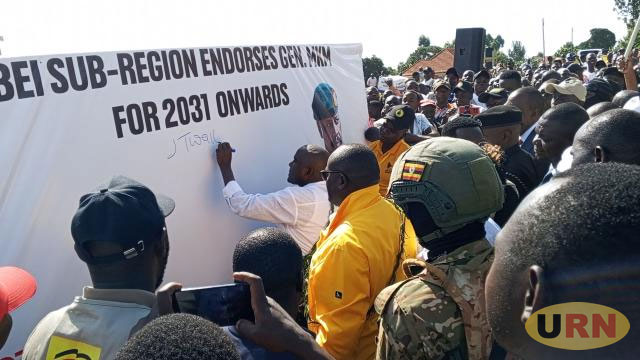
COMMENT | MORRISON RWAKAKAMBA | When I set out the specific constitutional and statutory boundaries governing the Patriotic League of Uganda (PLU) and General Muhoozi Kainerugaba’s chairmanship in my recent submissions online, I did not argue that a serving military officer has an open right to run a political party. I laid out the specific constitutional and statutory tests that distinguish a pressure group or civic organization from a political party under the Act, and noted the court ruling on expressed desire of a civic group to support a serving officer’s future ambitions.
I argued that the real question is whether we apply the law as written—including its own definitions of political organization versus civic organization’s/pressure groups. Subsequently, I suggested a grey area exists in the current law, and lawmakers can look into it. The response on X (formerly Twitter) did not engage the law. Instead, critics defaulted to a familiar tactic: the straw man method.
The straw man method is a rhetorical fallacy where an arguer deliberately avoids an opponent’s real position, swapping it for an oversimplified and twisted caricature that is easier to destroy. It functions like the snappy one-liners Americans call “zingers”—verbal drive-bys designed to substitute intellectual engagement with instant dismissal. For example, when a concerned citizen asks whether a proposed civic program by government is fiscally sustainable, a zinger sneers: “So you want our children to go hungry?“ In six words, nuance is murdered for an applause line.
In formal public discourse, this tactic operates across three distinct steps:
a). Extraction: The critic strips away all qualifying statutory clauses, legal exceptions, and contextual boundaries from the original argument.
b). Exaggeration: They refashion the remaining fragment into an unreasonable, bite-sized extreme.
c). Execution: They forcefully dismantle their self-manufactured absurdity, claiming victory over a point that was never made.
This practice has long crippled political dialogue in Uganda. When regional leaders advocate for federalism, central authorities routinely collapse complex fiscal devolution into the classic zinger: “You just want to resurrect tribal kingdoms.” During national debates on the Land Amendment Bills, statutory proposals to streamline overlapping tenure rights were caricature-framed: “They are coming to confiscate your ancestral land.“ When citizens raised questions about equity in emergency relief distribution during COVID-19 lockdowns, constructive inquiry was instantly reduced to: “You are claiming the state wants to starve whole region on purpose.”
The exact same dynamic unfolded following Executive Order RNB No. 13 of 2026 issued by the Uganda Law Society regarding the PLU. Rather than debating the statutory provisions I highlighted—Article 208(2) on military neutrality, Section 16 of the Political Parties and Organisations Act (PPOA), and Section 97 of the UPDF Act—prominent and fringe online critics bypassed the law entirely. One widely shared response claimed I was advocating for total military control, dismissing the argument as “regime sycophancy” and “intellectual prostitution.“ Another online comment collapsed the legal distinction between civic pressure groups and political parties into a zinger: “You are attempting to sanitize illegal military politics with long English.“
Of course critics also raise understandable anxieties about selective enforcement, asking why one group appears to mobilize freely while opposition entities face strict restrictions. This hits at a valid civic concern that should be discussed and resolved, yet it confuses two distinct questions: whether a statutory distinction exists in law and whether that law is being applied evenly across the board. The proper constitutional remedy for selective enforcement is not to ignore existing legal definitions but to demand that statutory standards be applied uniformly to everyone.
Moving the debate out of the current legal regime and into purely emotional territory serves a clear purpose: by focusing entirely on character assassination, profanity, and bad-faith distortion, the critic avoids addressing the actual legal distinctions drawn by our statutes.
While passionate debate is expected when military roles and national leadership intersect, personal attacks do not resolve constitutional questions. To build genuine common ground, Uganda requires a shared, inclusive framework where disagreements are mediated rationally.
Achieving this requires three concrete steps:
First, legislative refinement is urgent. Parliament must systematically resolve statutory ambiguities between civic pressure groups and political organizations within the Political Parties and Organizations Act (cap.178), establishing plain language that leaves no room for selective interpretation.
Second, public commentators and institutional leaders must commit to a higher standard of debate, actively rejecting social media zingers, profanity, and ad hominem attacks as substitutes for reasoned argument. Extremism and fundamentalist tendencies on all sides of the divide must be dissuaded.
All political actors must honor institutional fidelity by meeting opposing arguments on the precise terms established by the Constitution. Common ground can only emerge when accurate engagement with the law and democratic norms becomes the baseline of civic participation.
Finally, efforts at establishing a framework for a genuine and inclusive national dialogue must continue. This genuine national dialogue may provide the golden parachute and last resort firewall against Uganda’s instability in the raging anxiety of succession politics the country is currently immersed in.
*****
 Morrison Rwakakamba | Coffee farmer, Nyeibingo Village, Rukungiri.