The Independent Uganda: You get the Truth we Pay the Price


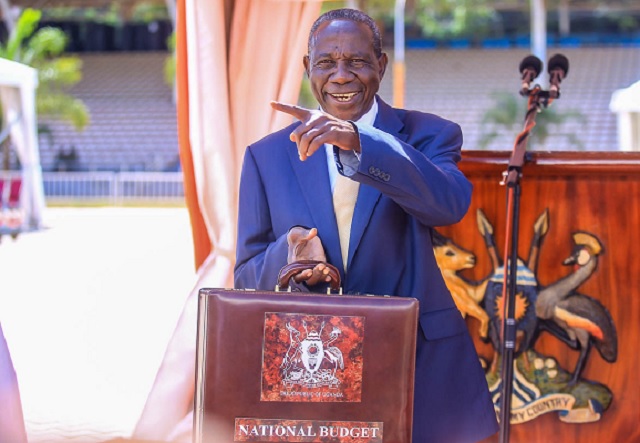
Kampala, Uganda | URN | As Matia Kasaija exits the cabinet after a decade as Finance Minister, he leaves behind a legacy shaped not only by economic policies and budget speeches but also by the colourful remarks that made him one of the country’s most recognisable public figures.
He stands out as one of the most loved members of the Cabinet over the last decade, particularly among journalists and parliamentarians who eagerly awaited his often unscripted and colourful reactions to current events.
Innocent, inadvertent, and intentional are some of the words used to describe Kasaija’s public statements. Others say he simply spoke from the heart, a trait that endeared him to many and occasionally landed him in controversy.
At 82, the veteran politician retires from Cabinet after navigating Uganda’s economy through major challenges, including the COVID-19 pandemic, global inflation, and the fallout from the Russia-Ukraine war. Yet for many Ugandans, journalists and legislators, he will be remembered as much for his humour and candour as for his stewardship of the country’s finances.
Indeed, Kasaija became one of the most quoted ministers of his generation. His usually unscripted responses to situations and questions often sounded more comical than factual, and at media conferences, journalists frequently looked forward to the surprise reaction that would spice up their stories.
Perhaps the most famous of his remarks, which later became a social media sensation, came in 2018 when he described Uganda’s economic growth as being in take-off mode. “…the economy is now swiiiii,” he said, gesturing with his hand to mimic an aircraft taking off.
Three years later, after an economic slowdown largely attributed to the COVID-19 pandemic, the Russia-Ukraine war, and global inflationary pressures, Kasaija returned to transport analogies to explain the economy’s performance.
“When I go to Parliament, they usually say, ‘Kasaija, you said the economy was moving like this… what happened?’ …In movement, you expect accidents; we had an accident. But that does not mean the train stopped; the train is still moving.”
Then came the famous “Colleagues, money will come” assurance to MPs who were questioning the government’s ability to meet its financial obligations amid apparent cash shortages. The statement went viral and later inspired a sequel.
While presenting the 2025/26 budget, Kasaija jokingly announced, “Colleagues, money has come,” before breaking into his trademark croaky laughter.
Yet beyond the humour, Kasaija’s principal responsibility was finding money to finance government programmes, much of it from external lenders and development partners. It was not always a task he enjoyed. At one point, he openly expressed frustration at having to seek financing from institutions such as the World Bank, saying he sometimes felt reduced to the status of a beggar.
A few days later, however, he offered a more philosophical reflection, arguing that government resources would never be enough and urging fellow ministers and MPs to appreciate the challenges of raising funds.
Kasaija was also known for yielding ground and apologising when confronted with evidence that contradicted his position.
During a 2022 parliamentary probe into a controversial supplementary expenditure that led to the payment of more than 10 billion Shillings to purported land claimants, some of whom were alleged to be non-existent, Kasaija initially defended the process.
However, he later acknowledged that the request should have originated from the Uganda Land Commission rather than the Ministries of Lands and Finance.
“I think it was in error for sure, I cannot deny that. My ministry should not have entertained this. They should have said; Hey, Land Commission, please put in your request,” he stated. On another occasion, while appearing on a radio programme, Kasaija blamed corruption among some technocrats for frustrating his efforts.
“I have not failed at my job, but the people I work with are very corrupt, though not all. The public keeps blaming me, but nobody can work with technical officers who are selfish, and you are appreciated,” he said.
One issue that repeatedly featured in Kasaija’s speeches was youth unemployment. Throughout his tenure, he urged government and investors to create more opportunities for young people.
“I am appealing to you, members and investors, please let us invest in the youth of this country. When you go around the country, unemployment among the youth is worrying, and it can become a problem for this country. You know an idle mind is the devil’s workshop.”
As Finance Minister, Kasaija will be judged partly on the performance of government wealth-creation initiatives such as Operation Wealth Creation, Emyooga, and the Parish Development Model. His tenure also coincided with major global and domestic economic shocks, including the COVID-19 pandemic and the Russia-Ukraine war, which affected growth prospects across the world.
Under his stewardship, the government established intervention programmes including the Small Business Recovery Fund, the Micro and Small Enterprise Recovery Fund, and the Institutional Strategic Recapitalisation Fund, among others. He leaves office with Uganda’s nominal GDP estimated at 66 billion dollars, compared to approximately 32.4 billion dollars when he assumed office as Finance Minister.
Economic growth currently stands at about 6.5 per cent annually. Kasaija had hoped to oversee the country’s transition into an oil-producing economy, but commercial production is now expected to commence in the next financial year after he departs from the ministry.
One of the major blemishes on his record was the Karamoja iron sheets scandal, in which he was among senior officials accused of receiving iron sheets intended for vulnerable communities in Karamoja. True to character, Kasaija admitted receiving the iron sheets but insisted that he had never requested them.
“So, crucify me knowing that there’s an innocent man in this issue. I’m innocent. I never asked for iron sheets. The iron sheets found themselves in my compound.” He later returned the iron sheets.
Former Kira Municipality MP Ibrahim Ssemujju Nganda argues that Kasaija’s otherwise solid record was weakened during his final years in office by his inability to effectively manage some critical economic issues, partly due to advancing age.
“In any case, he had delegated most of his duties to his technocrats and State Minister Henry Musasizi,” Ssemujju says.
Former Tororo County MP Geoffrey Ekkanya takes a different view, arguing that Kasaija still had the energy and capacity to serve. “He is rich and one of the clean NRM historicals,” Ekkanya says.
Whether remembered for the budgets he read, the funds he mobilised, the programmes he supervised, or the colourful remarks that became part of Uganda’s political folklore, Matia Kasaija leaves public office as one of the most distinctive and memorable figures to have occupied the country’s finance docket.