The Independent Uganda: You get the Truth we Pay the Price


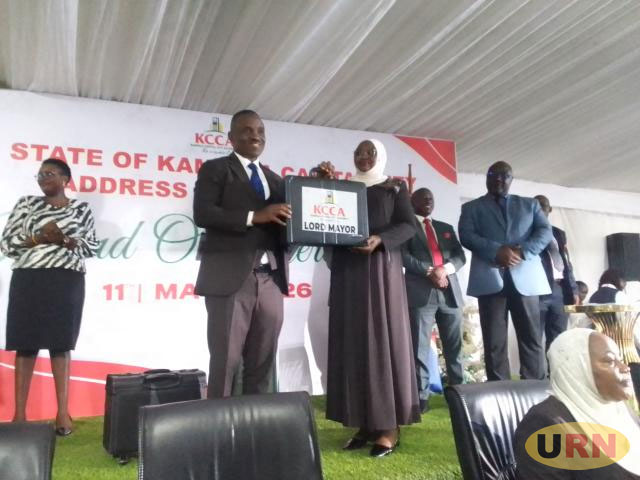
Kampala, Uganda | URN | Outgoing Kampala Lord Mayor Erias Lukwago has officially marked the end of his 15-year tenure, describing his leadership journey as one defined by resilience, political struggles, and service to ordinary Ugandans. Speaking during a handover ceremony at City Hall on Monday, Lukwago reflected on his long political career, which began in 2006 when he was elected Member of Parliament for Kampala Central at the age of 36.
As Kampala’s pioneer Lord Mayor under the Kampala Capital City Authority arrangement, Lukwago compared his leadership experience to “riding an unruly horse”, citing years of political turbulence, institutional conflicts, and governance challenges. He said his administration was guided by principles of integrity, accountability, compassion, and commitment to the people of Kampala.
Lukwago outlined six pillars that, according to him, defined his leadership. These included strengthening corporate governance and the rule of law, promoting sustainable urban planning, accountability and transparency, equity and justice, prudent budgeting, and positioning Kampala as an investment destination.The outgoing Lord Mayor also revisited the political battles that shaped much of his tenure, particularly after the enactment of the Kampala Capital City Authority Act, which changed the governance structure of the city. He described the arrangement as conflict-ridden and said it created overlapping centres of power involving elected leaders, ministers, presidential representatives, and technocrats.
According to Lukwago, the law significantly weakened the authority of elected city leaders by transferring key powers to the central government. “The law emasculated the executive authority of the Lord Mayor,” Lukwago said. He added that throughout his tenure, critics repeatedly referred to him as a ceremonial leader despite later demanding accountability for city operations.
“But now, as the term comes to an end, they ask me to account for what I have done. What an irony,” he said. Lukwago also criticised the current leadership structure at KCCA, describing it as excessively large, costly, and inefficient. He argued that the hybrid governance model introduced under the KCCA arrangement created unnecessary administrative layers and operational contradictions that continue to burden taxpayers.
“Even after reducing the number of councillors by nearly 50 percent in the recently concluded elections, more still needs to be done to rationalize the leadership structure,” he noted. The outgoing Lord Mayor further accused Yoweri Museveni of directly influencing Kampala’s governance through presidential directives affecting sectors such as transport, markets, procurement, land allocation, and urban planning.
On corruption, Lukwago said the vice remains deeply rooted across government institutions despite some improvement in KCCA’s public image compared to the former Kampala City Council. He cited the controversial Shs43 billion Usafi Market transaction during the 2013/2014 financial year as one of the examples of alleged financial mismanagement that attracted public criticism.
Lukwago also highlighted some of the achievements registered during his tenure, including efforts to protect public land belonging to schools such as Nakivubo Blue Primary School, Nakasero Primary School, Kasubi Primary School, and Bat Valley Primary School. He said the authority secured land titles for 10 public primary schools to protect them from encroachment and illegal land grabbing.
He also credited his administration for helping to recover and protect public facilities, including St. Balikuddembe Market, Nakasero Market, and the City Abattoir, which he said had previously been fraudulently leased to private individuals and companies. Looking ahead, Lukwago proposed tougher academic qualifications for KCCA leaders, suggesting that councillors and division mayors should possess qualifications equivalent to those required of Members of Parliament because of the complex planning and oversight responsibilities attached to city leadership.
During the ceremony, Lukwago formally handed over instruments of power, including ceremonial chains of office and two official vehicles, to KCCA Executive Director Sharifah Buzeki. One of the vehicles handed over was reportedly mechanically defective at the time of the transition.