 The Independent Uganda: You get the Truth we Pay the Price


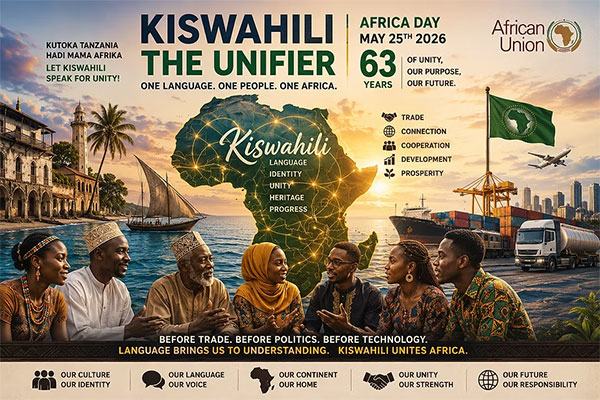
From heritage and tourism to digital innovation and youth enterprise, Kiswahili can position Tanzania at the center of Africa’s rising cultural economy.
COMMENT | TOSHI BWANA | In an era increasingly defined by economic competition, technological disruption and cultural influence, the most successful nations are no longer merely those endowed with abundant natural resources, but those capable of transforming their cultural heritage into strategic capital for sustainable development. Tanzania stands uniquely positioned in this global landscape through Kiswahili, a language that has evolved beyond communication into a powerful instrument of national unity, African identity and international influence.
Today, Kiswahili represents a unique linguistic legacy. It is a key economic asset with the huge potential to accelerate Tanzania’s socio-economic transformation, deepen cultural diplomacy, expand employment opportunities for youth, empower women and rapidly strengthen the country’s growing tourism sector.
According to UNESCO estimates, Kiswahili is spoken by about 200 million people globally, making it one of the most influential African languages in the modern world. It has already attained official language status within the African Union (AU), the East African Community (EAC) and the Southern African Development Community (SADC). This recognition places Dr Samia Suluhu Hassan and the United Republic of Tanzania in an exceptional position to transform this linguistic heritage into a globally competitive economic and diplomatic resource.
UNESCO’s formal recognition of Kiswahili as one of its official working languages marked a historic milestone for Tanzania and Africa as a whole. The decision elevated the status of the language within international education systems, academic scholarship, translation services, publishing industries, media networks and digital technologies. Increasingly, international organizations, multinational technology companies and digital communication platforms are seeking Kiswahili experts to expand their engagement with East and Central African markets.
Within the rapidly evolving global knowledge economy, Kiswahili could emerge as a key driver of the creative industries. Tanzania now possesses a rare opportunity to position itself as the global hub of Kiswahili cultural content through music, cinema, literature, Swahili cultural festivals, podcasts, digital storytelling and creative media production. The remarkable expansion of Bongo Flava, Swahili cinema and performance arts has already generated employment for thousands of young Tanzanians in audio production, videography, scriptwriting, digital marketing, photography, event management and online content creation. Ladies and gentlemen, we can do much more!
Beyond the creative economy, the Swahili civilisation journey provides Tanzania with a powerful comparative advantage in cultural tourism. Historic destinations such as Stone Town and Pemba in Zanzibar, Kilwa Kisiwani, Bagamoyo and Mafia Island embody centuries of Swahili civilization that once connected Africa, the Middle East and Asia through maritime trade and cultural exchange. These heritage sites represent major cultural economy opportunities capable of generating significant foreign exchange earnings, attracting international visitors and stimulating community-based enterprises led by youth and women. For this to be harnessed, Tanzania must invest heavily in positioning and branding.
Kilwa Kisiwani, a UNESCO World Heritage Site, stands as compelling evidence of the sophisticated commercial networks established by Swahili civilization as early as the 13th century. Strategic investment in the preservation and modernization of such heritage destinations will substantially increase Tanzania’s unique international tourism profile while simultaneously creating employment opportunities across hospitality, transportation, conservation and cultural entrepreneurship sectors. In this context, Swahili culture should not merely be viewed as a historical memory but as a living economic resource central to Tanzania’s future development and youth employment trajectory.
Women, in particular, remain at the heart of preserving and advancing Swahili cultural heritage. Across Tanzania’s coastal communities, women continue to drive economic activities linked to traditional crafts, fashion design, culinary arts, storytelling, seaweed farming and community tourism enterprises. Their growing participation demonstrates how culture can become an effective mechanism for economic empowerment, poverty reduction and inclusive development when supported through targeted investment, access to patient capital and finance and effective and creative institutional partnerships.
Equally significant is the role Kiswahili can and should play in addressing youth unemployment, one of the most pressing socio-economic challenges facing Africa today. The rise of artificial intelligence, digital communication systems, online education and multilingual technologies has sharply increased demand for Kiswahili translators, digital content creators, language trainers and cultural consultants. Tanzania has a strategic opportunity to establish itself as the global center for Kiswahili learning, research and digital innovation.
This emerging ecosystem could generate thousands of new jobs across tourism, education, fashion, gastronomy, publishing, technology and international media industries. More importantly, it would position Tanzania as the principal custodian and exporter of Swahili cultural capital to the world.
Kiswahili also remains one of Tanzania’s most powerful instruments of cultural diplomacy. For decades, Tanzania has cultivated an international reputation as a nation of peace, unity and principled leadership within Africa. Kiswahili has played a central role in fostering regional cohesion and facilitating communication across East Africa. Through the language, Tanzania has developed considerable “soft power” rooted in values of dignity, solidarity, mutual respect and social harmony.
Globally, nations that strategically commercialize and promote their cultural identity often achieve significant economic and geopolitical influence. South Korea has successfully leveraged K-pop and film to expand its global presence; India has done the same through Bollywood. Nigeria’s Nollywood is an 8bn USD creative economy. The United Republic of Tanzania through a public, private and community partnership (PPCP) led by the Media Council of Tanzania (MCT), Umoja Conservation Trust (UCT), The National Arts and Culture Council (BASATA), The National Council of Sports (BMT), The Tanzania Kiswahili Council (BAKITA) National Environment Management Council (NEMC) and Glow Consulting Services, now has a fantastic opportunity to position Kiswahili culture as Africa’s next major cultural export. Through music, literature, cinema, fashion, poetry, arts and cultural galleries, a national cultural troupe, gastronomy and international cultural festivals. This unique and strategic PPCP will significantly increase tourism revenues, attract foreign investment and elevate Tanzania’s international cultural and sustainability visibility.
However, realizing this vision will require deliberate, urgent, national strategies and sustained investment. Key government institutions, private sector stakeholders and academic institutions must collaborate to strengthen and reposition swahili conservation, Kiswahili education, language technology, cultural preservation and tourism infrastructure. Government alone will not be able to succeed. Young people, starting with journalists, writers, and enivronmentalists must be equipped with digital and creative skills (including conservation education) that will enable them to transform Tanzania’s cultural heritage into sustainable economic dividend within an increasingly competitive global marketplace.
Looking ahead, Kiswahili possesses huge potential to become one of Africa’s defining pillars of the knowledge economy, cultural conservation, and creative economy. As the world increasingly seeks authentic cultural narratives and diverse linguistic identities, Tanzania is uniquely positioned to lead through a language, culture and civilization that already unite millions across the continent.
Indeed, Kiswahili is not just a historical inheritance; it is a unique conservation pillar and economic asset for the current and future generations. It is a harvest of the union capable of transforming the United Republic of Tanzania into a continental center of cultural diplomacy, cultural conservation, creative enterprise, women’s empowerment, youth employment and sustainable development in the twenty-first century.
*******
Toshi Bwana is the Founding Trustee, Umoja Conservation Trust (UCT).



Swahili really does connect cultures in such an interesting way. Did you find any specific examples of that advantage in tourism or trade?