The Independent Uganda: You get the Truth we Pay the Price


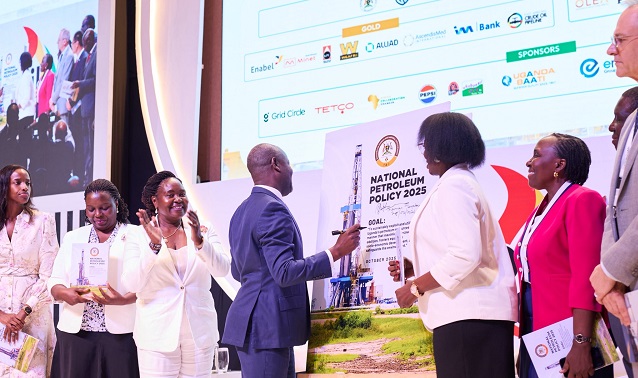
Kampala, Uganda | URN | The Ministry of Energy has launched the National Petroleum Policy 2025, aimed at regulating the oil and gas sector as the country prepares for oil production.
Speaking at the 11th Oil and Gas Convention in Kampala on Tuesday, Minister of Energy and Mineral Development, Dr. Ruth Nankabirwa, said Uganda is no longer debating the viability of its oil reserves but rather focusing on the timing, efficiency, and long-term management of production.
“For more than two decades, Uganda has undertaken a disciplined journey, from exploration to appraisal, from uncertainty to clarity. Today, the question is no longer if we will produce oil, but when and how well we will manage it,” she said.
At the centre of the transition is the forthcoming National Petroleum Policy 2025, which replaces the 2008 framework and reflects the realities of a sector moving into production.
According to the Ministry’s Permanent Secretary, Engineer Irene Batebe, the new policy is structured around nine pillars, including expanding exploration, strengthening downstream supply, promoting value addition, enforcing environmental standards, and improving transparency.
Crucially, the policy introduces more flexible licensing regimes, combining competitive bidding with direct applications, to attract investment and accelerate resource development.
Uganda’s petroleum governance framework is underpinned by key legislation, including the Petroleum (Exploration, Development and Production) Act, 2013, and the Petroleum Supply (Amendment) Act, 2023, which strengthen regulatory oversight, national participation, and supply security.
Presiding over the convention, Deputy Speaker Thomas Tayebwa framed the oil sector as a “strategic inflection point” in Uganda’s development trajectory, linking it directly to Parliament’s constitutional mandate of oversight, appropriation, and accountability.
“As Parliament, we must ensure petroleum revenues are managed prudently, transparency is upheld, and environmental safeguards are enforced,” Tayebwa said. “This is how oil becomes a blessing, not a curse.”
Under Article 90 and related provisions of the Constitution of Uganda, Parliament exercises oversight over public expenditure and national resources, placing it at the centre of monitoring oil revenues expected to significantly expand fiscal space.
Uganda targets tenfold economic growth, from approximately $50 billion to $500 billion by 2040, aligned to the Uganda Vision 2040 and successive National Development Plans.
On the ground, progress across major oil infrastructure projects underscores the shift from planning to execution.
The Tilenga project, operated by TotalEnergies, and the Kingfisher project and CNOOC are advancing steadily, with drilling, processing facilities, and associated infrastructure nearing completion.
The East African Crude Oil Pipeline, a 1,443km export route linking Uganda to Tanzania’s coast, has surpassed 70 percent completion, positioning it as a critical regional asset for trade and integration.
Government data presented at the convention indicates that Tilenga has completed drilling of over 145 wells, Kingfisher is approximately 70 percent complete, and Kabalega International Airport, a logistics hub, is over 90 percent complete.
These developments mark what officials described as “real momentum” towards First Oil, expected to unlock decades of production.
Industry players emphasised that the sector is transitioning from a capital expenditure (CAPEX)-driven construction phase to an operations (OPEX)-driven economy expected to last 20 to 30 years.
Philippe Groueix, Country Chair of TotalEnergies Uganda, highlighted investments in skills development and renewable energy as part of a broader “multi-energy strategy.”
“We are moving from building infrastructure to operating it. This is where real value will be created, through technology transfer, long-term contracts, and the growth of Ugandan enterprises,” he said.
He noted that Ugandan workers have undergone international training programmes, while renewable investments, including a 15MW solar plant and stakes in hydropower, signal efforts to balance fossil fuel development with energy transition goals.
Government officials stressed that oil is being positioned as a catalyst for broader industrialisation, rather than an end in itself.
Through local content policies and joint venture requirements, Ugandan firms have already secured contracts worth over $300 million, with more expected as the sector matures.
The planned $4 billion refinery, alongside petrochemical, fertiliser, and LPG industries, is expected to anchor value addition and reduce reliance on imports.
These efforts align with Uganda’s ATMS strategy, Agro-industrialisation, Tourism, Mineral-based industrialisation, and Science and Technology, which positions oil as a cross-cutting enabler.
Even as Uganda pushes toward First Oil, officials reiterated commitments to climate goals, including carbon neutrality by 2050.
The government argues that oil revenues will finance renewable energy investments and infrastructure, reflecting a dual strategy of exploiting hydrocarbons while preparing for a global energy transition.
With infrastructure nearing completion, policies aligned, and investment flows underway, Uganda stands at what leaders describe as a defining economic moment.
“The foundation has been laid. The policies are in place. What is required now is disciplined execution,” Tayebwa said.