The Independent Uganda: You get the Truth we Pay the Price


COMMENT | NANTEZA SARAH KYOBE | I had never been to Lira, only passing through it on my way to other districts for assignments. I had only previously heard about Lira from a friend who runs a business there, who said it is a booming business district, especially in the city. This time around, my assignment took me to Lira District to assess how government projects are impacting people’s lives there.
This gave me a chance to better understand Lira district in terms of business and how people are utilizing government projects to improve themselves.
On our way to the Lira district on April 2, as is the norm when we head north, we stopped at Kafu River Market to enjoy fresh, roasted cassava before continuing our journey. The next sight was the famous Karuma Bridge, with breathtaking scenery, followed by a free view of the baboons after crossing the bridge.
At Corner Kamdini, we turned onto Lira Road and travelled 68 km on a smooth, paved road. We arrived around 7:00 pm, when most businesses were closing, and it was raining.
On Wednesday, on a bright sunny day, we started off with a meeting with the district leaders, led by the District Resident Commissioner, Lilly Eyal.
We received a briefing from the district leaders about the programs that have improved residents’ lives in Lira District starting with the Lira Chief Administration Officer (CAO), Ismail Ochenge who gave us a brief overview of various projects, including the Parish Development Model (PDM), Emyooga, roads, irrigation schemes, and extension services, which are changing people’s lives.
“In PDM, the government has injected 22 billion Uganda shillings into the local economy of Lira District, and over 90% of that money has been sent to the communities,” we were told. Regarding Emyooga, the CAO noted it is partially successful despite challenges that began at the project’s outset; however, it has improved since then.
Extension services in the district have also gotten better due to significant government funding. Before receiving the funding, farmers had to manage without support; now, with the funds, they can access extension services.
“Although these services are not yet fully developed, the situation is better than it was eight years ago; now all sub-counties have at least two extension workers,” we were told.
With the briefings over, we headed to the field.
Adding Value: From Bananas to Wine and Flour
Olobo is not just selling raw bunches of bananas; he is transforming them into products that last longer and sell for higher prices. | #UMCfieldVisit pic.twitter.com/jDMijRmf3h— Uganda Media Centre (@UgandaMediaCent) April 7, 2026
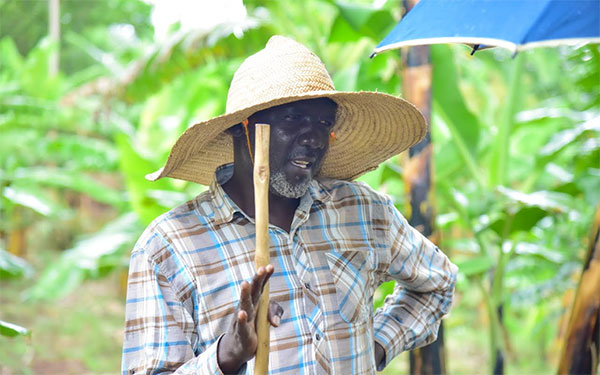
In the field, we met many beneficiaries of government projects whose lives have got better. The most remarkable person to me was Patrick Olobo , who decided to leave teaching for farming after hearing the president’s message in 2013. “Turn your home into an economic unit, and make sure if you work hard through that, you can get a better income,” he said.
It was not only the message but also the calculation that the president made. The calculations the president made led Olobo to eventually decide to shift a bit from teaching to farming. As I speak, Patrick now owns Mwalimu Smart Farm in Ayac Village, Amac Town Council, Ayac Parish (Cell), in Lira District. The farm engages in a wide range of integrated farming activities.
He now owns 5.7 acres of banana plantation and a coffee farm that he started two and a half years ago, and he has been involved in piggery, with plans to expand into chicken production. He adds value to coffee by processing it to produce manure that supports the growth of bananas and, eventually, coffee.
With the funds from selling bananas and coffee, Olobo told us he can comfortably pay the fees, buy a few pieces of land for future use, and start adding value to his products. He mentioned that they are now making banana wine locally and that it is very successful.
The first batch production was 300 litres, which is in high demand among both local people and others beyond.
He praises the government for supporting him by introducing a banana variety from NARO that has thrived in his village and is popularly called M27. “The NARO banana variety is very tasty, and above all, it is drought-resistant, disease-resistant, and not affected by a disease, which was a major challenge for the village,” he said.
Another form of government support Olobo commends is cost-sharing for irrigation equipment, in which he paid 40% and the government paid 60%. He was aware that the government subsidized the irrigation system for them by 60 percent. Irrigation has cut their biggest problem: drought during dry spells.
Another intervention he received from the government was the coffee seedlings he picked in 2023. “As I talk, this year I have started harvesting. I’m happy to report that so far, I have harvested 51 kilos, which is a good start for me. I sold a kilo for 7,000 Ugandan shillings. That was about 400,000 Ugandan shillings,” he said.
Olobo, however, challenged scientists to step in and help address the banana weevil, which is causing them to lose 20% of their bananas.
Having met Olobo and others in Lira, I can say that government programs are changing people’s lives. There is, however, a need to increase funding for PDM initiatives to achieve a greater impact than what we see now. The people we meet have the same request—to increase funding from UGX 1 million.
 Nanteza Sarah Kyobe works with Uganda Media Centre