The Independent Uganda: You get the Truth we Pay the Price


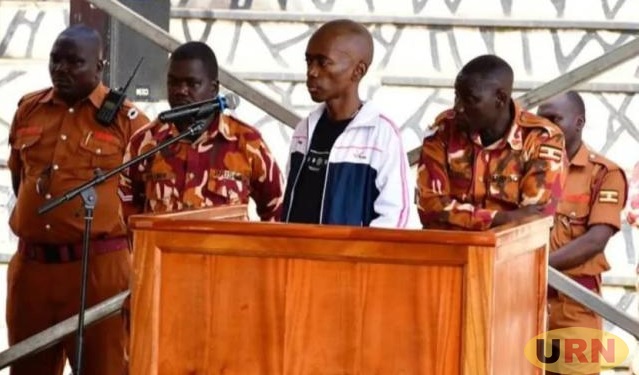
Kampala, Uganda | URN | Justice Alice Komuhangi Khaukha has sentenced Christopher Okello Onyum to death for the “meticulous” and “barbaric” murder of four toddlers at the Ggaba Early Childhood Development Centre.
The sentencing, delivered near the scene of the April 2, 2026, murders, marks one of the most severe punishments handed down by a Ugandan court in recent years.
Justice Komuhangi Khaukha ruled that the gravity of the crime placed it firmly within the “rarest of the rare” category, justifying the ultimate penalty.
Defense lawyer, Sarah Awelo, attempted to mitigate the sentence by highlighting Okello’s background. She noted he was a first-time offender from a “broken, dysfunctional family” and suffered from sickle cell anemia. She argued he could still be productive, citing his farming activities in Nwoya District.
The Judge, however, said that she did not believe that that should be a reason for someone to find other people’s children and then slaughter them mercilessly.
“I would find no reason why someone would rise or leave their home in the morning to come and slaughter children who are their safe space at school,” the judge stated. She said she was convinced that the killing of the four children was for ritual purposes. “Blood sacrifice for young children.”
The judge also agreed with the prosecution that this particular case or offenses fall in the rarest of the rare.
“Having said that, the convict must be given a sentence that will not only speak to him. But also, to those friends of his whose identities he refused to disclose. And any other person in this country who believes in sacrificing blood for wealth. Let them know that it is highly risky because they will be found. Like Mr. Okello was found. And they will not escape the long arm of the law.”
Before the sentence was passed, the judge asked the convict several times whether he had something to say. Okello, who was standing in the dock, attempted to remove his mask, held the microphone, and remained silent.
He appeared remorseless even when his lawyer tried to plead for a lesser sentence.
The Judge granted him another chance, but he did not even say sorry to the parents of the slain children.
“The accused person in mitigation. The Court asked him to say something in mitigation, but he chose to keep quiet,” the judge said.
Justice Komuhangi Khaukha noted that even when prompted by the court, Okello refused to apologize to the grieving families, some of whom collapsed in the courtroom.
The prosecution, led by Jonathan Muwaganya, painted a chilling picture of the events. He described the daycare as a “sanctuary” that was transformed into a scene of “unimaginable terror.” The victims, all under the age of three, were attacked with a knife in broad daylight.
The state argued that the killings were not a moment of madness but a “well-calculated massacre.” Muwaganya invoked Biblical justice, citing Exodus and the principle of “life for life,” arguing that those with no regard for human life forfeit the right to their own.
While the death penalty is no longer mandatory in Uganda, Justice Komuhangi Khaukha agreed with the prosecution that Okello’s actions necessitated it. The judge highlighted several aggravating factors, including the vulnerability of the victims, which she noted were defenseless infants.
The Judge also considered premeditation factors where the convict used “sophisticated technology” and meticulous planning to execute the murders. She added that the murders were committed in front of other children and caretakers, leaving a legacy of permanent trauma.
However, the defense’s attempt to use scripture (“Let the children come to me”) was met with boos and jeers from the gallery, forcing the court to call for calm. Justice Komuhangi Khaukha ultimately rejected the dysfunctional family background as a justification for such brutality.
The court heard a harrowing report from Peter Luwaga Mayanja, a KCCA probation officer. He detailed the “great shock” and broken lives of the parents, including Stella Apolot, who was too distraught to remain in court.
The prosecution also linked the case to a wider crisis, citing the 2025 Annual Police Crime Report, which indicates that the country has lost over 4,000 people every year since 2022 to homicides.
The State Attorney equated the loss to four entire villages wiped out every year by murder.
Muwaganya argued that when crime is not punished severely, society feels unsafe, quoting Ecclesiastes 8:11: “When a sentence for a crime is not quickly carried out, people’s hearts are filled with schemes to do wrong.”
Justice Komuhangi Khaukha noted that Okello’s actions were so aggravated that he likely would have killed more children had he not been apprehended.
Referencing the police surgeon’s testimony, she noted the killings appeared linked to human sacrifice- a practice the court sought to condemn in the strongest possible terms.
Christopher Okello Onyum killed four children of Ggaba Early Childhood Development Centre on April 2, 2026, around 11:00 am. The victims are Ryan Odeke, Keisha Agenorwoth Otim, Gideon Eteku, and Ignatius Sseruyange.
Available information indicates that the last civilian execution was carried out in 1999, when 28 death row inmates (including Musa Sebirumbi) were hanged at Luzira Maximum Security Prison.
Since the landmark Susan Kigula case in 2009, the death penalty is no longer mandatory for any crime. Judges have the discretion to award it only in the most aggravated circumstances (“the rarest of the rare”).
Before Okello, other high-profile death sentences included businessman Thomas Nkulungira (Tonku) in 2011 (for the murder of Brenda Karamuzi) and Jackie Mpambali in 2021 (for the murder of her husband). However, while sentences are still handed down, no civilian has been executed in over 25 years.