The Independent Uganda: You get the Truth we Pay the Price


The racket stretches from officers at the export declaration point at Entebbe Airport all the way to the highest echelons at URA
Kampala, Uganda | IAN KATUSIIME | Thaba Investments Limited, a major refiner and exporter of gold in Uganda, is under scrutiny for allegedly evading millions of dollars in taxes despite pocketing billions in profits in a well-orchestrated scheme that is denying the country substantial tax revenue.
Uganda Revenue Authority (URA) documents seen by The Independent indicate that Thaba Investments, formerly African Gold Refinery Limited, is under-declaring the amount of gold it refines and exports to markets such as the United Arab Emirates.
The documents show that for the period running from January 2022 to January 2026, Thaba declared a gross weight of gold exported as 586,759 kg and a net weight of 330,627 kg. The difference between the two figures is 256,132 kg.
Uganda imposes an export levy of USD 200 per kilogram on processed gold. This is stipulated in the Mining and Mineral (Export of Refined Gold) Regulations, introduced in 2024.
The 256,132 kg that is unaccounted for represents a loss of USD 51 million (Shs 192 billion) in tax revenue in a highly lucrative sector. Industry sources say there are six companies in Uganda refining and exporting gold: Thaba, Orofino, Aurnish, Simba, Karibu, and Faru.
However, the value of the undeclared gold by Thaba Investments is higher than the budgets of some government departments. Experts warn that such tax evasion undermines Uganda’s fiscal position, stripping the government of critical revenue from a sector that should be strengthening the national economy.
The documents also show that Thaba Investments has made a profit of USD 11 billion (Shs 40 trillion) since it took over from AGR in 2022, highlighting how lucrative Uganda’s gold trade has become in recent years. But the tax evasion has now brought the company back into the spotlight, drawing further scrutiny on its owners, URA, and the lax regulation of gold trade in Uganda.
Thaba investments could not be reached for comment by press time.
“Criminal networks are exploiting the system with the help of senior government officials,” a source who preferred anonymity told The Independent.
“The URA system appears to be compromised, with the knowledge and involvement of high-ranking officials. Access to the operational accounts of gold exporters is restricted to a small, carefully selected group of insiders.”
He added that the racket stretches from officers at the export declaration point at Entebbe Airport all the way to the highest echelons at URA.
Robert Kalumba, the Communications Manager for URA, told The Independent that the tax body is addressing the problem of under-declaration when asked about Thaba Investments’ undeclared gold dealings.
“It’s a vice that sabotages the economy. We are dealing with it as one of the biggest problems we have,” he said.
Sanctions trouble
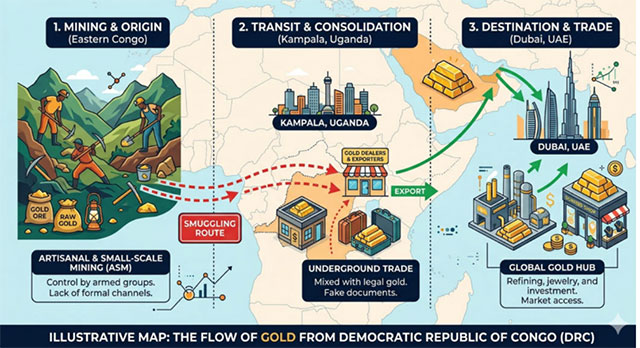
Sources say Thaba Investments was known as African Gold Refinery and then rebranded to its current name in 2022 after the latter was sanctioned by the U.S. Department of the Treasury for allegedly smuggling gold from the Democratic Republic of Congo (DRC) to Uganda. AGR director Alan Goetz, a Belgian businessman who has operated in East Africa for decades and maintains connections with influential figures in the region, was also sanctioned.
Goetz has also been implicated in gold smuggling from Venezuela—a country more than 10,000 km away from Uganda, where AGR was based.
Goetz is an international gold merchant who at one point ran 15 companies across four countries: Uganda, Belgium, Dubai, and Luxembourg, according to The Sentry, an investigative organisation tracking criminal networks.
In a 2018 report titled The Golden Laundromat, it was stated that Goetz refined illegally smuggled conflict gold from eastern Congo at AGR in Uganda and then exported it through a series of companies to the United States and Europe, potentially including Amazon, General Electric (GE), and Sony. According to the United Nations, an estimated USD 300–600 million is smuggled out of eastern DRC annually.
The U.S. Treasury’s Office of Foreign Assets Control (OFAC) sanctioned Goetz, AGR, and a network of companies involved in illicit gold movements valued at hundreds of millions of dollars per year from the DRC. The illicit trade provides revenue to armed groups, undermining the security and stability of the DRC.
In August 2022, the European Union also sanctioned the Belgian tycoon for importing illicit gold from the DRC.
By the time of the sanctions, AGR had exported 96,479 kg of gold. Sources say the rebrand was intended to give the company a new lease of life following the reputational damage caused by U.S. sanctions.
AGR began operations in Uganda in 2015. In February 2017, President Yoweri Museveni commissioned the AGR facility amid pomp and ceremony, an event hailed as a turning point for mineral trade in Uganda. At the launch, Museveni ordered a tax waiver for all gold processed by AGR.
Less than a year later, AGR ran into trouble with investigations by the Inspector General of Government (IGG) and the Financial Intelligence Authority (FIA) over alleged money laundering.
Fast forward, and the ghosts that haunted AGR appear to have returned at Thaba Investments. The discrepancy in its gold export declarations has raised red flags over the operations of the Entebbe-based refiner.
Biggest export commodity
On 11 March, Secretary to the Treasury Ramathan Ggoobi told Parliament that in 2025, Uganda earned USD 14 billion (Shs 53 trillion) in exports—the highest amount ever recorded for the country. Gold accounted for 40% of these earnings.
Ggoobi made the remarks while appearing before Parliament’s Public Accounts Committee, where he had been summoned to respond to queries raised in the Auditor General’s report for the Ministry of Finance for December 2025.
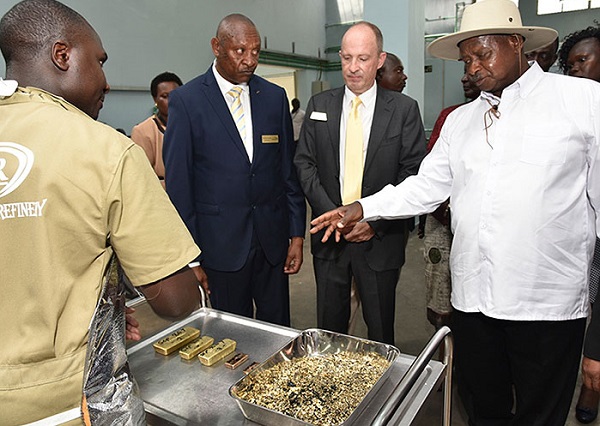
Gold is currently Uganda’s biggest export by value. In the financial year 2024/2025, Uganda exported gold worth USD 4.2 billion, according to Bank of Uganda data. Uganda acts as a major regional processing hub, importing raw gold from neighbouring nations, refining it, and exporting it.
The value of Uganda’s gold exports jumped by almost 70% from the previous financial year (2023/2024), when gold exports were worth USD 2.9 billion.
It is here that questions surrounding the origin of Thaba’s gold arise. Data show that more than half of Uganda’s exported gold comes from Thaba Investments. Much of the gold processed in Uganda and exported to the UAE is believed to originate from the DRC, a country rich in gold deposits, as well as other minerals such as cobalt and copper.
Some gold is reported to come from as far as the Central African Republic and neighbouring countries like South Sudan. This gold is often artisanal (small-scale mining), lightly regulated, and easy to smuggle across Uganda’s porous borders.
Rwanda has also emerged as a gold-exporting hub. Like Uganda, the source of its gold is widely believed to be the DRC, with which it has had longstanding disputes. Kigali has positioned itself as a clean, compliant hub, with Aldango Gold Refinery as the main player. However, Rwanda has faced scrutiny for rising gold exports despite having no major gold deposits.
Global trading links
Gold from Uganda and other countries is traded through the Dubai Multi Commodities Centre (DMCC), a government-established free zone and commodities trading hub in Dubai. Founded in 2002, DMCC facilitates global trade across a wide range of commodities.
DMCC is recognized as one of the world’s leading free zones and a key driver of Dubai’s non-oil economy. Here, gold can be traded, melted, and re-exported to luxury markets such as Switzerland and France.
Dubai has emerged as a global gold market for dealers like Thaba Investments due to its historically looser sourcing requirements, massive liquidity through institutions such as the Dubai International Financial Centre, and the emirate’s deep integration into global gold markets.
However, this model is beginning to face increased scrutiny due to the war in Iran and the growing concerns about the traceability of gold.