The Independent Uganda: You get the Truth we Pay the Price


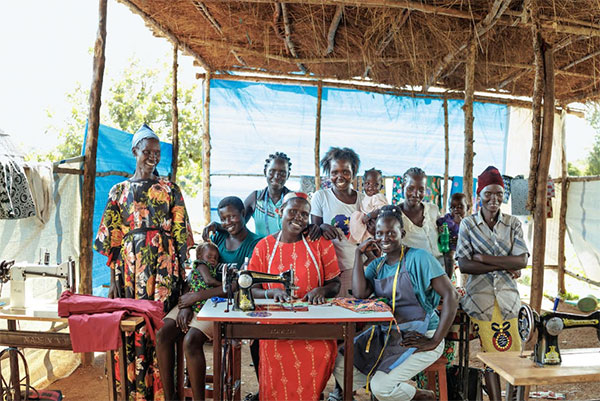
From Bidi Bidi in Uganda to Dollo Ado in Ethiopia, refugee families are proving that economic opportunity can be as important as humanitarian assistance
NEWS ANALYSIS | RONALD MUSOKE | When Viola fled South Sudan with her one-year-old daughter, survival was her only concern. The journey to Uganda’s Bidi Bidi Refugee Settlement in the north-west of the country was marked by hunger, exhaustion and uncertainty. Like thousands of refugees escaping conflict, she arrived with little more than the hope that life on the other side of the border would be safer.
“I had to carry my one-year-old daughter, and our hunger and fatigue made the journey even harder,” she recalls. “We arrived in Uganda with nothing.”
Hundreds of kilometres away in Ethiopia’s Dollo Ado refugee settlements, Nurina was facing a different struggle. A refugee from Somalia living with a disability, she often felt isolated and overlooked. “Because of my disability, I used to prefer to stay in one place,” she says. “I felt isolated. My neighbours used to underestimate me, and I wasn’t perceived as important.”
Today, both women tell a different story. Viola owns a hair salon in Bidi Bidi. Nurina earns an income, supports her children and has become a source of advice for neighbours seeking to improve their own livelihoods.
Their experiences are deeply personal, but they are also part of a much larger story unfolding across East Africa. Viola and Nurina are among more than 22,000 refugee and host-community households reached by the Delivering Resilient Enterprises and Market Systems (DREAMS) programme, a humanitarian initiative implemented by Village Enterprise and Mercy Corps. The programme’s impact was recently tested through two large randomized controlled trials involving 12,711 households in Uganda and Ethiopia, making it one of the most rigorous studies of refugee livelihoods undertaken in the region.
Dwindling humanitarian funding
The findings, released on June 10, arrive at a critical moment for the global humanitarian sector. As conflicts, economic instability and climate shocks continue to drive displacement, humanitarian funding is failing to keep pace with growing need. The United Nations estimates that millions of displaced people around the world now spend years, and often decades, away from home. Yet the aid system was never designed to support people indefinitely.
Against this backdrop, the new evidence offers a compelling message: that refugees can move beyond aid dependence when they are given the skills, capital and market opportunities needed to build sustainable livelihoods.
In Uganda, where more than 1.8 million refugees and asylum seekers live alongside host communities in 13 gazetted rural settlements, the results were particularly striking. Researchers from IDinsight, a global nonprofit that equips leaders with the data, evidence, and technology to improve lives at scale, found that households participating in the DREAMS programme increased their monthly consumption by 17% compared with non-participants.
Savings more than doubled, rising by 108%, while household assets grew by 20%. Participants also reported improvements in food security, financial inclusion, resilience to economic shocks and overall well-being. The gains were not limited to refugees. Host-community households also benefited, reflecting the programme’s deliberate focus on strengthening local economies rather than targeting refugees in isolation.
In neighbouring Ethiopia, where DREAMS was implemented in a refugee settlement called Dollo Ado, the pattern was remarkably similar. Participating households increased consumption by around 9 to 10 percent, savings by more than 90% and household assets by roughly one quarter. Income levels rose, food security improved and women reported greater economic empowerment.
For policymakers searching for durable solutions to displacement, the findings stand out not simply because the results were positive, but because they emerged in two very different refugee contexts.
“This evaluation adds meaningfully to a gap in rigorous evidence on what works for refugees,” says Alison Connor, the Chief Impact Officer at IDinsight. “We tested what happens when poverty graduation and market systems development are combined in refugee settings. Across Uganda and Ethiopia, participating households saw meaningful gains in consumption, income, savings and assets within months of programme completion.”
The programme itself is built on a deceptively simple idea. For decades, humanitarian responses have focused primarily on meeting immediate needs through food assistance, shelter and other emergency support. While such interventions remain essential, especially during crises, they often leave unanswered questions about how refugees can rebuild their economic lives once displacement becomes prolonged.
DREAMS attempts to bridge that gap. Village Enterprise provides what development practitiones call a “poverty graduation” approach. Participants receive business training, mentoring, access to savings groups and seed capital to launch small enterprises. Mercy Corps complements this support through market systems development, helping participants connect with suppliers, buyers and productive value chains such as poultry, sunflower, soybean, sesame, sheep and goat production. The objective is not simply to help people start businesses, but to ensure that functioning markets exist for those businesses to survive and grow.
From survival to stability
Researchers describe the approach as combining a “push” and a “pull”. The push comes through training, mentorship and financial support. The pull comes through stronger markets capable of absorbing and rewarding entrepreneurial activity.
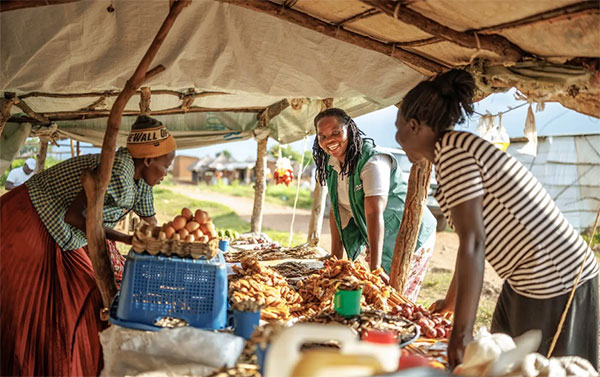
In Uganda’s West Nile region, where the programme was implemented in Rhino Camp and Bidi Bidi settlements, almost all participants joined business savings groups and launched enterprises. Many invested in poultry farming, sesame production and retail businesses, while others diversified into multiple income-generating activities. The evaluation found that these investments translated into tangible improvements in daily life.
Families reported purchasing more nutritious foods, including meat, milk and fish. Parents were better able to pay school fees, buy books and cover transport costs for their children. Many households invested in livestock, agricultural equipment, housing improvements and solar panels. For researchers, these assets are important because they signal more than temporary income gains. They represent longer-term resilience. In Uganda, participating households accumulated assets worth approximately 20% more than those in the control group. In Ethiopia, the difference reached 24%.
The growth in savings was equally significant. Refugee households often live one shock away from crisis. A failed harvest, an illness or an unexpected expense can quickly erase months of progress. By strengthening savings, the programme helped create a financial cushion that many participants previously lacked. The findings are especially relevant as humanitarian agencies confront severe funding constraints. According to the United Nations Office for the Coordination of Humanitarian Affairs (UNOCHA), global humanitarian appeals have faced widening funding gaps in recent years, forcing agencies to make increasingly difficult decisions about where resources should be directed.
Sazini Mojapelo, the Chief Executive Officer of Village Enterprise, believes the evidence points to an approach capable of delivering both humanitarian and development outcomes. “At a time when humanitarian budgets are shrinking, we need solutions that deliver real, lasting results for the millions of refugees worldwide,” she says. “DREAMS shows that with the right support, refugees and host communities living in extreme poverty can build businesses, grow their incomes and provide for their families.”
The bigger picture
Yet the findings also challenge persistent assumptions about refugees themselves. Public discussions about displacement often portray refugees primarily as beneficiaries of aid. The DREAMS evaluations paint a more nuanced picture. Participants demonstrated an ability to identify business opportunities, save regularly, invest profits and adapt to changing market conditions. Many built enterprises despite operating in environments marked by limited infrastructure, climate risks and uncertain economic conditions.
For Tjada McKenna, the Chief Executive Officer of Mercy Corps, that lesson may be one of the programme’s most important contributions. “Lasting change doesn’t come from aid alone; it comes from access to opportunity,” she says. “This evidence shows that when refugees are connected to functioning markets, supply chains and customers, they build, earn and contribute.” The evaluation also highlighted the importance of including host communities alongside refugees.
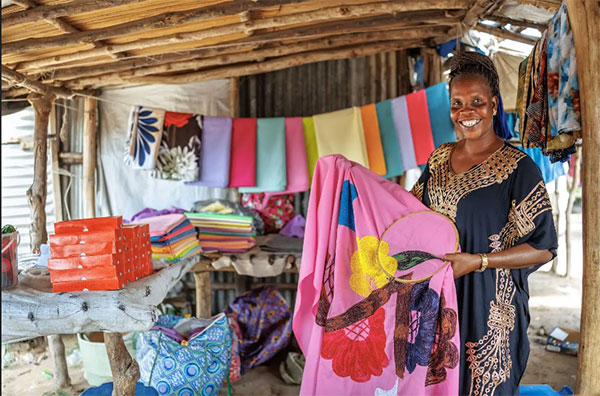
In many refugee-hosting regions, local residents face the same challenges as displaced populations; poverty, unemployment, climate shocks and limited access to capital. Programmes that support only refugees can sometimes create tensions or perceptions of inequality.
DREAMS deliberately avoided that trap. Both refugees and hosts participated in business groups, savings associations and value chains. While host households generally recorded larger gains in absolute terms, partly because they often had greater access to land and productive resources, both groups benefited significantly.
Lessons for governments
That finding carries important implications for governments across East Africa, where refugee-hosting areas frequently rank among the poorest regions of their respective countries. The message emerging from the research is that refugee inclusion need not come at the expense of local communities. Properly designed interventions can strengthen local economies for everyone.
The story, however, is not one of unqualified success. Researchers noted challenges related to market access, timing of agricultural inputs and land constraints. Some participants reported delays in receiving support, while others struggled to fully engage in certain value chains because of limited resources or environmental conditions.
And while women experienced measurable gains in economic empowerment, changes in deeper social norms proved more difficult to achieve. The programme’s long-term sustainability also remains under examination. A second round of surveys will assess whether the improvements observed during the first evaluation persist several years after implementation. Those answers will be crucial as donors and governments consider whether and how to scale the model
For now, however, the evidence provides a rare source of optimism in a sector often defined by overwhelming need and limited resources. The programme is projected to generate benefits worth more than twice its costs if the observed impacts are sustained over five years. That level of cost-effectiveness compares favourably with many comparable livelihood programmes across sub-Saharan Africa
For funders, that matters. For refugees, what matters is something simpler. Back in Bidi Bidi, Viola reflects on the distance she has travelled since arriving in Uganda with nothing.
“I didn’t know that I could change like this,” she says. “I think of the day I fled my home and how far I’ve come, and I’m amazed.” In Ethiopia, Nurina describes a similar transformation. “My neighbours used to underestimate me,” she says. “But now they see that I can earn a living, save money and provide for my children. They come to me for advice.”
Their journeys do not solve the global refugee crisis, but they do offer a glimpse of what becomes possible when humanitarian assistance is paired with economic opportunity. As East Africa and the wider world continue to search for sustainable responses to displacement, that lesson may prove as valuable as any statistic.