The Independent Uganda: You get the Truth we Pay the Price


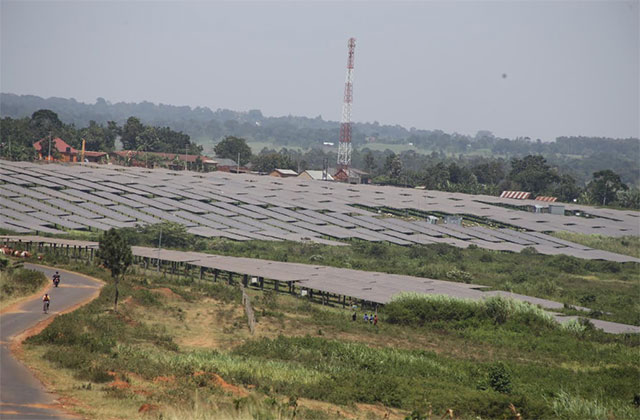
Across Africa, engineers and entrepreneurs are redesigning renewable energy to withstand weak infrastructure, limited financing, and unpredictable conditions
NEWS ANALYSIS | RONALD MUSOKE | In the northern reaches of Uganda, where the road from the provincial capital, Gulu, stretches toward the South Sudan border and the landscape opens into wide, lush plains and scattered homesteads, evening does not arrive quietly. It settles instead like a slow dimming of possibility.
In Lamwo District, near the porous borderlands where trade, migration, and uncertainty constantly cross paths, darkness used to mark the end of economic life. When the sun dropped, so did productivity, communication, and commerce.
That pattern has since begun to shift – not through a national electricity grid extension or a large infrastructure project, but through something smaller, more distributed, and increasingly central to Africa’s energy future – solar systems that behave less like products and more like living infrastructure. At the centre of one such transformation is a small roadside shop owned by a local entrepreneur whom we shall call Daudi Olum. Olum’s business has quietly become an energy hub for his community.
During the day, he sells basic household goods: soap, cassava and maize flour, sugar, salt, and a new addition, phone accessories. But as evening approaches, the front of his modest shop gets busier. A solar system mounted atop a wooden platform inside his shop powers a charging station where villagers line up with mobile phones: teachers, motorcycle taxi riders, traders, and teenagers who have walked several kilometres from nearby homes.
For many of them, this is the only reliable source of electricity in their daily lives. The shopkeeper is no longer just a trader. He is part of the energy infrastructure, and in that quiet shift, from consumer of energy to distributor of it, lies one of the most important transformations unfolding across Africa today.
A continent harnessing solar power
Across the continent, solar energy is expanding at a pace that would have seemed unlikely a decade ago. The Global Solar Council’s 2026–2029 outlook describes a continent entering a structural acceleration phase where solar is no longer a pilot technology or donor experiment but an increasingly dominant pillar of new electricity generation.
Growth is being driven by two parallel systems. On one side are utility-scale solar farms feeding national grids. On the other, and far more widespread, are decentralized systems: rooftop solar panels, mini-grids, and pay-as-you-go home kits powering households and small businesses far from transmission lines.
In Uganda, Kenya, DRC, Tanzania, Nigeria, Ghana, and beyond, this distributed model has become the real frontier of energy access. But as the sector expands, a more difficult question has emerged. Not whether solar can be deployed, but whether it can endure. This is because in many African markets, the challenge is no longer installation. It is sustainability under constraint: weak infrastructure, fragile financing ecosystems, difficult terrain, and regulatory systems that often lag behind technological change. The future of solar, in other words, is increasingly defined not by generation capacity, but by resilience.
When solar energy becomes livelihood
In Lamwo, resilience is not an abstract concept. It is the difference between a functioning business and a closed door. Daudi Olum’s solar charging station illustrates this reality with unusual clarity. His system is not large, just enough to power a few bulbs, a radio, and a set of charging ports. But its impact stretches across the surrounding community.
People arrive throughout the day, often carrying multiple phones. Some are charging devices for family members who live in deeper rural areas without any electricity access at all. Others are small traders who rely on mobile money systems to conduct business. A drained battery is not an inconvenience; it is lost income. In this context, the shop becomes more than a commercial space. It becomes a node in a distributed energy network that operates entirely outside the formal grid.
But it is also fragile. When components fail, replacement parts are not immediately available. When demand spikes, capacity is stretched. When weather disrupts supply chains, repair cycles slow. This is where the deeper innovation challenge emerges: not just providing solar power, but ensuring it continues working consistently in environments where maintenance is difficult and infrastructure is thin. Across Africa, a new generation of innovators is emerging precisely to solve this problem.
Solar power infrastructure for resilience
In Kampala, 470km south of the borderlands of Lamwo but deeply connected to its realities, engineer and entrepreneur David Tusubira has been working on a different part of the same problem. As co-founder of Innovex, Tusubira is part of a growing wave of engineers building the invisible infrastructure of Africa’s solar economy; the digital systems that make distributed energy manageable at scale.

In theory, solar systems are simple. Install panels, connect batteries, and deliver electricity, but in practice, distributed solar networks quickly become complex ecosystems spread across hundreds or thousands of locations, often in remote areas with limited connectivity. Without regular monitoring, these systems degrade silently.
A battery fails in one village, a payment cycle breaks in another, and in another far-flung area, a panel underperforms for weeks before anyone notices. By the time technicians arrive, revenue has already been lost and customer trust eroded.
Innovex’s “Remot” addresses this gap through remote monitoring and data-driven management tools that allow solar companies to see what is happening across their networks in real time. Faults can be detected early, and usage patterns can be tracked. Payment behavior in pay-as-you-go systems can be analyzed to reduce default risk, while field operations can be prioritized based on actual system performance rather than guesswork.
The platform combines small hardware units, called Davix devices, with cloud-based software. These devices are fitted to solar systems to collect information on power use, environmental conditions and the performance of connected equipment, helping operators spot problems early. The software then turns this information into practical insights for technicians, administrators and solar distributors through web and mobile apps. It also includes tools to manage customers, support pay-as-you-go payments through mobile money, and monitor the long-term health of each system.
In effect, Remot turns solar from a collection of isolated installations into a coordinated, responsive system. What makes this approach significant is not just the technology, but its context. It is built for environments where infrastructure cannot be assumed, where technicians travel long distances, where connectivity is inconsistent, and where financial margins depend on minimizing downtime. Increasingly, this digital layer is becoming as important as the physical hardware itself.
The system has been used across schools, solar maize mills and water pump installations in Uganda, Kenya, Tanzania and the Democratic Republic of Congo. Its applications show the importance of maintenance, data and long-term performance in energy access.
Over the past year, Innovex has expanded Remot’s role in off-grid energy management through a partnership with Ennos, manufacturing more than 1,000 solar water pump controllers fitted with Innovex remote monitoring units and connected to the Remot platform for pay-as-you-go distribution across Africa.
“Through a partnership with the Energy Saving Trust, Innovex has also developed predictive maintenance machine-learning algorithms for off-grid appliances, including solar water pumps, solar freezers and solar maize mills, strengthening Remot’s ability to support long-term system performance,” Tusubira told The Independent via email.
Fusion Wind Turbine in Ghana
In Ghana, another form of resilience is being engineered through the work of inventor Johannes Amo-Aye, the mind behind the Fusion Wind Turbine concept. Rather than treating renewable energy sources as separate or competing systems, Amo-Aye’s approach focuses on integration.
The Fusion Wind Turbine is designed to operate alongside solar installations, providing energy during periods when solar output is low, particularly at night or during cloudy conditions. In many rural Ghanaian communities, this hybrid model offers a more stable and predictable energy supply than solar alone.
Developed through MINAGIE Energy, the system uses a gearless vertical-axis wind turbine with a solar arch to generate power across different weather conditions. It is designed to be locally repairable, quieter than diesel generators and suitable for remote settings. Around 90% of the system’s components are designed and manufactured in Ghana. Rural health centres are one clear use case. Reliable electricity supports night-time treatment, vaccine refrigeration and the safe use of medical equipment. Early installations in Ghana have replaced diesel generators, reducing fuel costs while supporting lighting and refrigeration at remote health facilities.
Fusion Wind Turbine has delivered more than 6,000 hours of clean energy at Adeiso and Asitey Health Centres in Ghana’s Eastern Region, supporting vaccine preservation and helping safeguard more than 300 maternal deliveries each year.
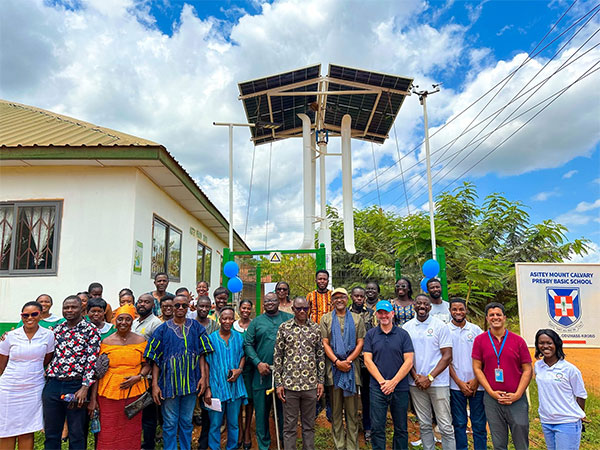
For small enterprises such as cold storage operators, welding shops, and agro-processing units, stability is not optional. A few hours of downtime can mean financial loss or spoiled goods. At Adeiso Health Centre alone, the system has eliminated diesel costs of around US$600 per month. MINAGIE Energy has also trained 12 technicians through its MTEDI programme, with plans to reach more than 200 young people as it scales and has secured a letter of intent to expand to Asitey Presby Primary School this year, where the system would power water infrastructure for 350 pupils and the adjacent clinic.
The innovation reflects a broader shift in thinking across Africa’s energy landscape: resilience often comes not from maximizing a single technology but from combining multiple imperfect systems into a more stable whole.
Nigeria’s Just Add Water
In Nigeria, Derick Nwasor, founder of the “Just Add Water” energy initiative, is working on a different constraint altogether; the dependency of energy systems on complex fuel and supply chains.
His innovation focuses on designing energy systems that minimize external input requirements, particularly in rural and peri-urban areas where logistics are unreliable and fuel costs are volatile. In many of these communities, small-scale agriculture and food processing dominate economic life. Energy interruptions directly affect productivity – grain cannot be milled, produce cannot be preserved, and goods cannot reach markets in time.
The “Just Add Water” concept is built around simplifying energy generation systems so that they rely less on imported fuels or fragile distribution networks and more on locally available inputs and low-maintenance operation.
For users, the impact is not theoretical. It is measured in preserved harvests, extended working hours, and reduced dependence on costly fuel transportation systems. It is an approach shaped by a simple constraint: in environments where supply chains are unreliable, energy systems must become self-contained.
Just Add Water has already been deployed in three hospitals in Lagos, generating clean electricity and producing medical-grade oxygen to support patient care. Its service model is designed to help facilities adopt the technology without taking on the full upfront cost and complexity of owning specialist infrastructure.
Just Add Water is now scaling its quantum and AI-optimized regenerative fuel cell system from 100kW towards 1MW deployments across Nigeria, supporting its ambition to provide cleaner, more reliable power and medical-grade oxygen for healthcare facilities.
E-Safiri: Where energy meets movement
In Kenya’s growing urban corridors, Carol Ofafa, the founder of E-Safiri, is addressing another dimension of resilience: mobility. Transport systems across the East African region are deeply tied to fuel costs, which fluctuate unpredictably and place constant pressure on both operators and passengers. For informal transport providers, fuel is often the largest daily expense.
The model allows users to swap batteries at local hubs, reducing charging time and avoiding dependence on home charging. This is useful in areas where motorcycles and bicycles play a central role in work and local transport, and where charging infrastructure and household access to electricity remain limited.
E-Safiri’s hubs are powered by solar energy and supported by smart batteries and a central dashboard that tracks energy use and battery status. Surplus power can support other local services such as phone charging, cooling, solar drying and street lighting. The hubs can therefore serve both transport users and nearby businesses or residents, including those without grid connections.
E-Safiri is building electric mobility solutions supported by distributed charging infrastructure powered increasingly by renewable energy sources. The impact is twofold. For operators, it stabilizes costs and reduces dependency on volatile fuel markets. For communities, it improves access to transport services that connect rural areas to markets, schools, and health centers.
Here, energy is not just about electricity access. It is about movement—about whether people and goods can move efficiently through economic spaces. In this sense, mobility becomes a continuation of the energy story rather than a separate sector.
Innovation shaped by constraint
Across Uganda, Ghana, Nigeria, and Kenya’s mobility corridors, a clear pattern has emerged. These innovations are not emerging in ideal environments. They are being shaped by constraint. Infrastructure is incomplete. Financing is uneven. Regulation is evolving. Geography adds friction at every stage. But rather than slowing innovation, these constraints are defining its direction.
Systems are being designed to be modular, so they can be repaired locally; remote-monitored, so failures are visible early; flexible in financing, so users can participate incrementally; and hybrid, so no single energy source carries the entire burden. This is not optimization in a stable system. It is adaptation in an unstable one.
The Africa Prize for Engineering Innovation
Many of these ideas do not emerge in isolation. They are supported, refined, and scaled through institutions like the Africa Prize for Engineering Innovation, run by the Royal Academy of Engineering.
The Prize has become one of the most important platforms for identifying early-stage engineering solutions across Africa. Its focus is deliberately practical: technologies designed not for laboratory conditions, but for real-world environments defined by constraint. Beyond recognition, the program provides mentorship, technical support, and access to networks that help innovators move from prototype to market deployment.
Over time, it has become a pipeline through which many of Africa’s most promising energy and infrastructure solutions gain visibility and traction. The next call for applications is expected in July, opening another opportunity for engineers, inventors, and entrepreneurs working at the intersection of infrastructure, climate resilience, and development challenges.