The Independent Uganda: You get the Truth we Pay the Price


How foreign capital is reshaping the ports, railways and logistics networks connecting East Africa to global markets and what that means for the region’s economic future
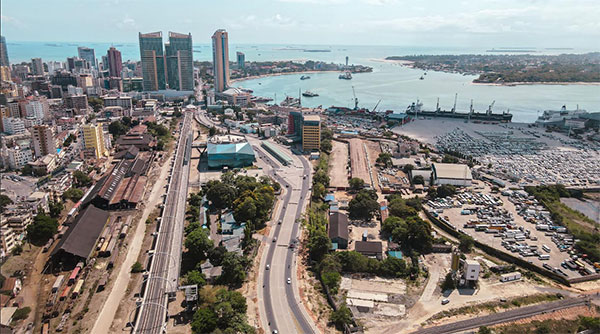
NEWS ANALYSIS | IAN KATUSIIME | At Tanzania’s Indian Ocean coast, the port of Dar es Salaam is emerging as a crucial gateway to the landlocked economies of East and Central Africa—and an increasingly important prize for foreign investors seeking a foothold in the region’s trade corridors.
The port, which has eleven berths and serves seven landlocked countries, generated $120 million in revenue between April and September 2025, according to official reports, as the government moves to expand its capacity to 30 million tonnes by 2030.
Its expansion comes as control of East Africa’s trade corridors assumes growing strategic importance. The region is attracting a new wave of foreign capital as governments seek billions of dollars to close an infrastructure gap.
China, which spent two decades building railways, roads, power plants and telecommunications networks, remains deeply embedded in the region.
But United Arab Emirates investors are increasingly moving into ports, logistics, energy and agriculture, creating a new contest over the corridors through which East Africa’s future trade will flow. Dubai-based DP World has become a major player in these networks.
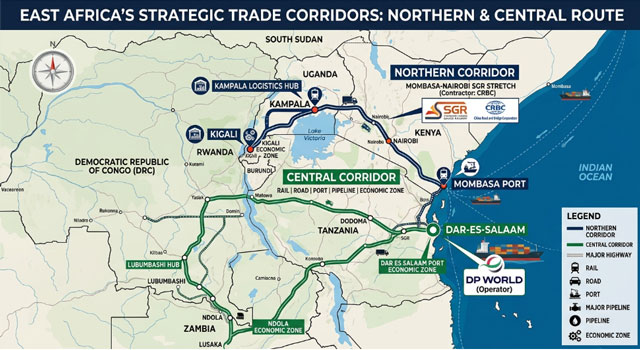
For Tanzania, Dar es Salaam is more than a port. It is the maritime link to a vast hinterland stretching into Zambia, the Democratic Republic of Congo, Malawi, Rwanda, Burundi and Uganda.
Geopolitical and trade analysts say that whoever can build, finance or operate the infrastructure around these corridors is gaining a stake in the movement of goods, minerals and energy across the region.
Dar-es Salaam is only one piece of the puzzle. Further north along the Indian Ocean coast, the Port of Mombasa is an even larger entrypoint, handling about 45 million tonnes of cargo annually and serving as a key node for trade into East and Central Africa.
The Kenya Ports Authority manages the port’s core infrastructure and cargo operations, but foreign investors are increasingly embedded in the wider ecosystem around it.
DP World has partnered with Kenya to develop logistics and industrial infrastructure, while digital systems are being deployed to streamline cargo handling and port operations.
Mombasa is also connected directly to Kenya’s Standard Gauge Railway, one of the region’s most consequential infrastructure projects, linking the port to Nairobi and the country’s interior, with the wider railway network intended to extend towards Uganda and the region’s landlocked economies.
The railway was constructed by China Road and Bridge Corporation (CRBC), a Chinese state-owned enterprise, and financed largely through loans from China’s Export-Import Bank.
The contrast is revealing. Along East Africa’s most important trade corridors, Chinese capital and construction expertise increasingly intersect with Emirati capital, port operators and logistics networks. That convergence is being driven in part by the sheer scale of infrastructure investment the region requires.
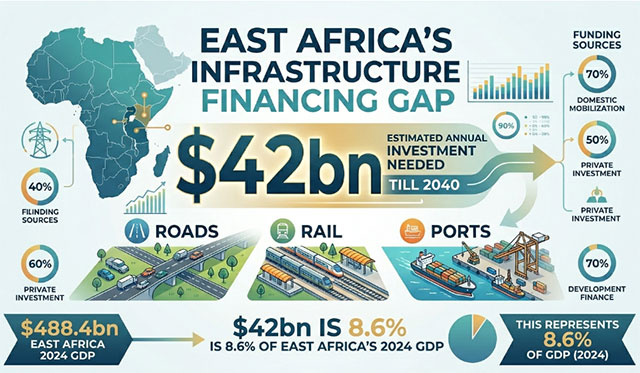
$42bn infrastructure gap
To close its infrastructure gap, East Africa needs about $42 billion in investment annually until 2040, according to the Organisation for Economic Co-operation and Development (OECD)—the largest infrastructure investment requirement of any African region. The figure is equivalent to about 8.6% of the region’s 2024 GDP, underscoring the scale of the financing challenge facing governments.
The need is particularly acute in a region where rapidly growing populations and urbanisation are putting pressure on transport networks, while several economies—including Uganda, Rwanda, Burundi, South Sudan and Ethiopia—remain landlocked and dependent on neighbouring countries for access to seaports.
Kenya and Tanzania, meanwhile, are seeking to expand and modernise their ports and the road and rail networks that connect them to the region’s interior.
Better roads and railways can have effects beyond simply moving people and cargo faster. By lowering transport costs and improving access to markets, experts say infrastructure can raise the competitiveness of agricultural producers, facilitate regional trade and help landlocked economies connect more efficiently to global markets.
The key challenge is that East Africa needs infrastructure faster than its governments can finance it.
.
China was the first major international player to build a sustained infrastructure footprint across East Africa. Over the past two decades, Chinese companies have been involved in power dams, highways, telecommunications, industrial parks and railways, giving Beijing an early grip in the physical networks that carry the region’s trade and electricity.
Kenya offers perhaps the clearest illustration. China Road and Bridge Corporation (CRBC), a subsidiary of state-owned China Communications Construction Company, built the Mombasa-Nairobi Standard Gauge Railway and later the Nairobi Expressway.
Chinese companies were also involved in the construction of the Thika Superhighway, an eight-lane road linking Nairobi with the industrial town of Thika. The progression from railway to expressway shows how deeply Chinese construction expertise became embedded in Kenya’s transport infrastructure.
In Uganda, China’s presence is even more pronounced. Chinese companies have built major transport and energy infrastructure, including the Entebbe Expressway, which links Kampala to Entebbe International Airport.
Sinohydro, a subsidiary of PowerChina, constructed the 600MW Karuma hydropower project, while Isimba, with an installed capacity of 183MW, was built by China International Water & Electric Corporation (CWE), a subsidiary of China Three Gorges Corporation.
Together, the projects demonstrate China’s role not only in moving people and goods but in supplying the electricity needed to power East Africa’s industrial ambitions.
The result is a first-mover advantage that extends beyond individual projects. Chinese companies have become embedded across the region’s roads, railways and power systems—-giving Beijing an infrastructure foothold on which a new generation of commercially oriented investments can build.
But it is not just concrete and still. China heavily financed and built Uganda’s National Data Transmission Backbone Infrastructure (NBI) project. The massive project has been constructed in sequential phases to establish the foundation of Uganda’s digital network infrastructure.
Huawei Technologies, the Chinese telecommunications behemoth, has been the primary contractor implementing the project since its inception—-laying thousands of fibre optic cables across the country. Most of these projects have been funded by Exim Bank of China.
China’s changing role
But China’s role is changing. After years in which Beijing financed some of Africa’s most ambitious infrastructure projects through state-backed loans, Chinese companies are increasingly pursuing commercially structured projects and partnerships.
One example is Kenya’s $1.5 billion Nairobi–Nakuru–Mau Summit–Malaba highway, a project that will extend the country’s transport network towards the Ugandan border and the wider East Africa.
The project is being developed by Chinese companies, including CRBC and Shandong Hi-Speed, under a public-private partnership (PPP) that combines debt and equity financing, with the investors expected to recover their costs through a 28-year toll concession.
Infrastructure financing experts say the project marks a shift in the way Chinese capital is approaching African infrastructure. Rather than relying solely on state-backed lending to finance large public projects, Chinese companies are increasingly taking equity positions and seeking commercial returns from infrastructure they help build and operate.
For Kenya, the highway promises to improve a crucial trade route from the port of Mombasa towards Uganda and the Democratic Republic of Congo; for China, it offers a long-term commercial stake in one of East Africa’s most important transport corridors.
The shift is not unique to Kenya. Research published in the Journal of Current Chinese Affairs identifies a broader move in China’s African infrastructure strategy from loan-financed projects towards PPPs, as Beijing seeks new ways to manage financial risk while maintaining its commercial presence on the continent.
Few companies exemplify China’s deep infrastructure footprint in Kenya better than CRBC. From the SGR to Nairobi Expressway and to the expansion of the Nairobi-Nakuru-Mau Summit road under a PPP. Its progression from a contractor on a state-backed railway to a participant in commercially structured road projects mirrors the broader evolution of Chinese infrastructure finance in Africa.
Uganda embodies the transition in two different ways. The Entebbe Expressway represents the earlier Chinese-backed model: a major piece of infrastructure financed through Chinese lending and repaid by the Ugandan government, with tolling introduced later.
The planned Jinja Expressway points toward a different model, with the project expected to be developed under a PPP and private-sector participation playing a larger role.
UAE capital
If China’s influence was built largely through roads, railways and power plants, UAE capital is pursuing a different route into East Africa: the gateway.
Ports and logistics networks are becoming the new front line of Emirati investment, with Dubai-based DP World emerging as one of the most prominent players.
At Dar es Salaam, DP World has a 30-year concession to operate and modernise the multi-purpose port and has committed more than $500 million to upgrade its infrastructure and information technology systems. The company describes the port as a node linking Tanzania and its landlocked neighbours to global markets.
Tanzania’s Transport Minister Prof. Makame Mbarawa said the government’s partnership with DP World would help create employment and strengthen transportation, distribution and supply chains.
A year later, Indian conglomerate Adani Ports and Abu Dhabi-based AD Ports Group added another layer, with their consortium acquiring a 95 percent stake in Tanzania International Container Terminal Services, which operates berths 8 to 11.
The UAE presence extends beyond Tanzania. In Somaliland, whose bid for international recognition remains unresolved, DP World operates the Berbera container terminal and is developing a wider logistics ecosystem around it, including an economic zone and a trade corridor linking the port to landlocked Ethiopia.
The historic port city on Somaliland’s Red Sea coast offers perhaps a prime example of the UAE model. Rather than treating the terminal as a standalone investment, DP World has sought to connect the port with its inland region, positioning Berbera as an access point for the wider Horn of Africa trade.
The strategy is also linking Berbera directly to the Gulf. In 2025, DP World launched a shipping service connecting Berbera with Dubai’s Jebel Ali port, integrating the East African outlet into one of the world’s major maritime and logistics hubs.
The result is more than a port upgrade. It is an attempt to build an entire trade ecosystem around a critical junction—from the terminal and economic zone to the road network connecting it inwards and the shipping routes linking it to the Gulf.
In Berbera, UAE capital is not simply financing infrastructure; it is helping shape the network through which regional trade will flow.
But does foreign investment actually integrate East Africa, or does it primarily connect the region to the investors’ own global networks?
‘Connectivity is never neutral’
Sitati Wasilwa, a Kenyan economist and EMEA manager and lead analyst at APAC Assistance, argues that the distinction is important. He says foreign powers typically pursue their own strategic and commercial interests first, meaning that regional integration can sometimes emerge as a by-product of infrastructure designed to connect East Africa to external markets.
“Connectivity is never neutral,” Wasilwa says. He argues that China’s infrastructure investments, for example, have helped create regional links along the Northern Corridor from Mombasa through Nairobi and Kampala towards Kigali, Bujumbura and eastern DRC but that these networks also serve Beijing’s broader trade and geopolitical interests under the Belt and Road Initiative.
A similar dynamic, he says, can be seen in Emirati investments in ports and logistics, which increase East Africa’s connectivity while simultaneously giving UAE operators greater access to African markets and global trade routes.
The result, Wasilwa argues, is a paradox: East Africa is becoming more connected to the world without necessarily becoming more integrated with itself. Foreign investment is strengthening the region’s links to external markets, but the pace of intra-regional integration remains slower.
“No external power invests in another region simply to connect it; it invests to secure access, markets and influence,” Wasilwa says.
Dar es Salaam offers a useful test of that argument. If East Africa’s infrastructure is increasingly being woven into external networks, few places illustrate the convergence better than Tanzania’s commercial capital.
Dar has grown rapidly into an industrial and commercial hub, bringing together Gulf port operators, Chinese construction and infrastructure companies, Indian investors and African state interests.
Its importance extends deep into the hinterland: rail and road corridors connect the Indian Ocean gateway to Zambia and the DRC placing Dar at the centre of one of East Africa’s most important trade routes.
The new scramble, however, is not neatly divided between Chinese and Emirati spheres. Their interests increasingly overlap, with Indian and other international capital adding another layer to a regional infrastructure landscape in which different investors can compete in one project and collaborate in another.
The Tanzania-Zambia Railway (TAZARA) adds another layer to the corridor. The railway provides an artery for moving minerals and other cargo from Zambia and the DRC to the Indian Ocean, linking the resource-rich interior to global markets.
As China, UAE, India and European countries compete for access to critical minerals, control over the infrastructure that moves those resources to the coast could become an important source of economic leverage.
For landlocked countries such as Uganda, Rwanda and Burundi, the competition over ports and trade corridors is not somebody else’s problem. Uganda, for example, relies heavily on the Northern Corridor through Mombasa and is increasingly looking to the Central Corridor through Dar es Salaam to diversify access to international markets.
The two routes are therefore economic lifelines for a country whose imports and exports must cross a neighbouring state before reaching the sea.
Uganda’s oil industry has created another strategic corridor. The East African Crude Oil Pipeline (EACOP) will carry crude from Uganda’s oil fields in the Albertine region to the Tanzanian port of Tanga, giving the landlocked country a direct route to global markets through the Indian Ocean.
Sources at TotalEnergies say Uganda is expected to produce its first oil in September, placing even greater importance on the reliability of the Tanzanian corridor.
The oil project also shows how multiple foreign interests can converge around a single African corridor. China’s CNOOC is Uganda’s upstream partner alongside TotalEnergies, while the pipeline itself involves a complex network of international contractors, financiers and suppliers.
Uganda’s access to the coast has become as geopolitically important as what lies beneath the ground. President Yoweri Museveni has warned that competition over access to the Indian Ocean could eventually become a source of conflict, arguing that East African countries could one day go to war over access to the sea. “I am entitled to that Ocean. In future, we are going to have wars,” he said in November 2025.
Regional dilemma
The benefits of East Africa’s expanding corridors are clear: improved infrastructure, lower logistics costs, new jobs, greater trade and connectivity, and the potential to accelerate industrialisation.
But the risks are equally significant. Governments must contend with debt, opaque contracting, long-term concessions and the possibility that critical infrastructure could give foreign investors and governments greater geopolitical leverage.
There is also a deeper question over who these corridors are ultimately designed to serve. Critics argue that some infrastructure projects are oriented more towards moving commodities and resources from the hinterland to global markets than towards fostering deeper regional integration and industrialisation.
Yet the distinction is not always clear-cut: the same railway, road or port that enables the export of minerals can also lower transport costs for farmers, connect manufacturers to markets and strengthen trade between neighbouring countries.
For East Africa, the challenge is therefore not whether to welcome foreign capital, but how to ensure that the corridors it finances serve more than the interests of those who build and operate them.
The question is no longer simply who is building East Africa’s infrastructure, but whose interests are strengthened when those corridors are opened.