The Independent Uganda: You get the Truth we Pay the Price



Libreville, Gabon | THE INDEPENDENT | Edgar Mujuni, a Ugandan space systems engineer and emerging leader in Africa’s space sector, is one of eight set to get the 2026 Young African Space Professionals award next month.
The awards are set for April 20th in Libreville, Gabon, at the NewSpace Africa Conference. This is Africa’s leading business and policy event for space and satellite innovation, technology, and advancement that gathers decision-makers, industry leaders, policymakers, investors, and innovators in Africa and abroad.
The 2026 edition in Libreville, builds on the momentum of previous years to catalyse new partnerships, accelerate space-driven innovation, and position Africa as a force in the global space economy.
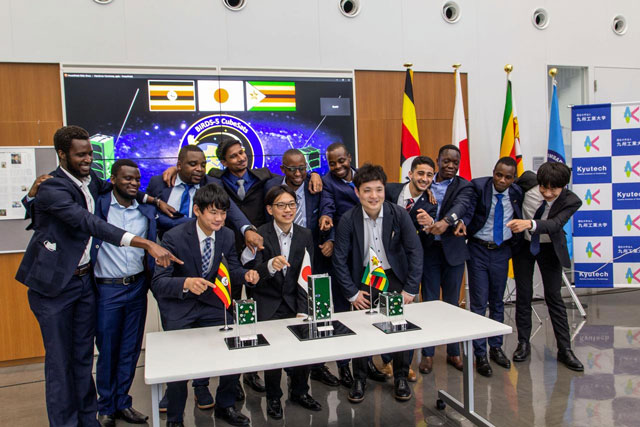
Mujuni will be recognised for his pivotal role in the development of Uganda’s first satellite, PearlAfricaSat-1, launched in December 2022 under the BIRDS-5 international program. He holds a first-class degree in telecommunications engineering from Kyambogo University, Uganda, and a master’s degree in space systems engineering from the Kyushu Institute of Technology (Kyutech), Japan, where he is currently pursuing a PhD in space systems engineering at the Wireless Systems Laboratory.
Mujuni thanked the African Space Agency (AfSA) and Space in Africa for this recognition. “This acknowledgement is not only a personal honor, but also a strong validation of the progress being made in advancing Indigenous space technology development across the African continent,” he told The Independent
He added that “The President of Uganda has consistently emphasized the strategic risk of Africa’s limited participation in the space sector, often describing this reluctance as unsustainable in the face of global technological advancement. As the global space economy continues to expand at an unprecedented pace, it is imperative that Uganda, East Africa, and Africa at large position themselves not merely as consumers of space-based services but as producers of space technologies—driving sustainable development, economic growth, and strategic security.”
“For Africa to meaningfully enter the global space economy and establish strategic autonomy, we must go beyond theory. We must design, build, launch, and operate satellites—demonstrating indigenous capability, validating our technologies, and directly engaging with and studying the space environment.”
He said Uganda is already taking decisive steps. Within just one year of establishment, AfriSpace Labs has been recognized among the top four emerging upstream space technology startups in Africa by the African Space Agency and Space in Africa.
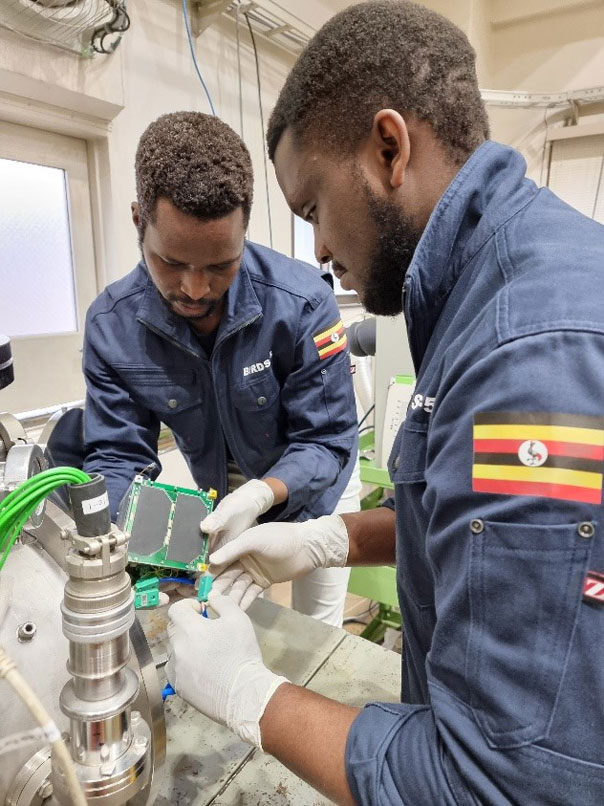
Mujuni is also a special presidential assistant on space engineering. “As part of the State House Science Team, I sincerely acknowledge the mentorship and leadership of Eng. Sheba Kyobutungi, whose guidance and strategic direction have been instrumental in shaping these achievements, and President Yoweri Kaguta Museveni, who has always encouraged science and initiated the establishment of the State House Science Unit.”
What is it about Mujuni?
Mujuni has strong expertise in satellite communications, onboard computer systems, small-satellite missions, and ground-station systems, with contributions to more than 5 nanosatellite projects.
He serves as Uganda’s Point of Contact for UNISEC-Global, advancing practical space engineering and institutional capacity development across Africa.
He is the Founder and CTO of AfriSpace Labs, an indigenous African upstream space startup that enables institutions to design, build, and operate CubeSat systems through high-level, hands-on training, technology transfer, and systems engineering programs.
Driven by a bold vision for Africa’s space future, Mujuni is committed to leveraging satellite technologies to address critical challenges across the continent, including agriculture and food security, climate monitoring, disaster risk reduction, water resource management, and environmental protection. He strongly advocates for international cooperation as a key enabler for accelerating Africa’s space capabilities and unlocking the full potential of space-based solutions for sustainable development.
The 2026 edition of the award received a total of 168 unique submissions from applicants from 35 countries in both early-stage career and academic programmes. The selection of the 2026 awardees involved a highly competitive evaluation by a panel of distinguished judges drawn from across private and public institutions, with extensive experience in the African space industry.
Each submission was assessed based on five core criteria: strategic relevance to Africa’s space priorities and continental goals; tangible impact and scalability; demonstrated leadership and influence; innovation through novel approaches or solutions; and professional integrity and credibility.
The final selection was guided by four additional principles to ensure a balanced and representative cohort. Awardees were chosen through a merit-based assessment using the evaluation criteria above, alongside consideration of regional representation across Northern, Western, Eastern, and Southern Africa; gender balance, ensuring equitable recognition of both women and men advancing the sector; and career stage diversity, achieving a balance between students and young professionals.
With the African space economy projected to grow to USD 22.64 billion by 2026, the continent is witnessing an unprecedented expansion in satellite infrastructure, earth observation capabilities, commercial space ventures, and national space programmes, driven by increasing investments, expanding satellite infrastructure, and a rising generation of scientists, engineers, policymakers, and entrepreneurs shaping the continent’s future in space. As Africa deepens its participation in the global space economy, the need to recognise, support, and amplify the contributions of emerging talent has become both strategic to the long-term development of the continent’s space ecosystem and essential to long-term development.
To this end, the Young African Space Professionals Award, jointly led by Space in Africa and the African Space Agency, was created to spotlight the next generation of students and young professionals whose work is already influencing and making measurable contributions to the trajectory of the continent’s space ecosystem.
From advancing Earth observation applications and satellite communications to contributing to space governance and policy, research, innovation and capacity development, and socio-economic impact, these individuals represent the intellectual and operational backbone of Africa’s space ambitions. Aligned with the African Union Commission’s mandate on gender equality, diversity, and geographic equity, the programme recognises talent across the African Union Member States, ensuring that excellence is celebrated wherever it exists on the continent.