The Independent Uganda: You get the Truth we Pay the Price


SPECIAL REPORT | Uganda insists it has contained its Bundibugyo virus disease outbreak, but cases in Kenya and Nigeria, conflicting accounts of the patients’ movements and questions about the source of infection have put its public-health assurances under renewed scrutiny, reports Ronald Musoke.
In May, this year, as Uganda confronted the latest outbreak of Ebola, the country’s Permanent Secretary at the Ministry of Health, Dr Diana Atwine, made a categorical declaration during a meeting with donors and diplomats in Kampala. “We have never exported Ebola,” she said. “For the nine epidemics we have had, not even one (case of Ebola has been exported). That is our commitment,” Dr. Atwine said on May 22.
But, five months later, Uganda’s public-health record is facing an uncomfortable test. A woman who was recently diagnosed with Bundibugyo virus disease in Nigeria is said to have travelled from Uganda, while a man who died of the same disease in Kenya is believed to have also passed through the country enroute to his homeland.
Epidemiologists in Bunia, Kampala, Abuja and Nairobi are now examining whether the two cases might be connected. In Kampala, the government maintains that Uganda’s outbreak was brought under control, and it unilaterally declared the epidemic over on July 28, about a dozen days inside the World Health Organization’s official countdown.
It says no further confirmed cases have been recorded in the country since then. Yet the Nigerian case has exposed an unresolved question at the heart of the regional response: where was the woman infected, and can investigators reconcile the competing accounts of her movements?
Uganda’s declaration and the international investigation are not necessarily contradictory. A country can successfully end local transmission and remain vulnerable to imported infections. But when cases diagnosed elsewhere prompt scrutiny of travel through its territory, the government’s assurances must be accompanied by clear evidence about what happened. The challenge for Uganda is to defend its public-health record without prejudging an investigation that has yet to establish the source of the Nigerian patient’s infection.
The scale of the outbreak
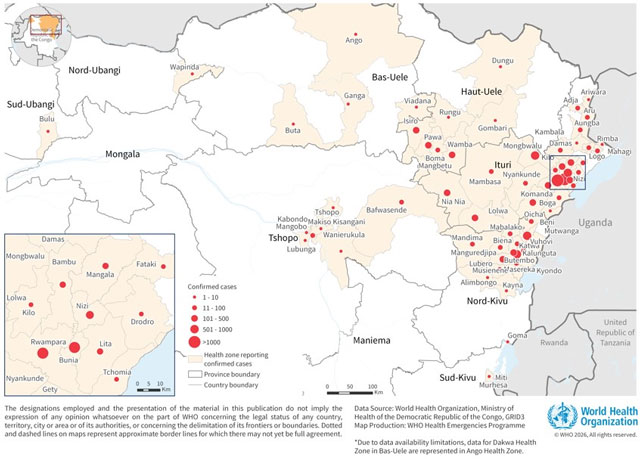
The cross-border cases have emerged against the backdrop of a serious outbreak in the Democratic Republic of Congo (DRC). The World Health Organization (WHO) reported that, as of Oct. 20, DRC had recorded 9,704 confirmed cases of Bundibugyo virus disease and 4,687 deaths.
The outbreak had spread across 66 health zones in eight provinces, with Ituri Provice, which neighbours Uganda, remaining the epicentre. WHO said sustained, high-level transmission continues and that deaths in communities highlight persistent difficulties in detecting cases early and getting patients timely care.
For decades, Uganda had acted as a buffer for Kenya but that shield was breached on Oct.6 when the country reported its first imported case. The patient, a man who had reportedly travelled from the DRC through Uganda, arrived in Nairobi by air on Oct. 3. He had reportedly been ill for about a month and had received treatment at several hospitals in DRC. He tested positive for Bundibugyo virus and died on Oct. 5.
By Oct. 20, Kenya had reported nine confirmed cases, including one death, with eight subsequent cases linked to the initial patient. The Kenyan Ministry of Health said there was no evidence of transmission outside the cluster at that time.
Nigeria confirmed one imported case on Oct. 20. The patient, a woman who had travelled from Uganda, developed symptoms on Oct. 7, sought medical care in Abuja on Oct. 11 and tested positive on Oct. 20. She was isolated and has been receiving treatment, while 44 contacts have been identified for monitoring.
By Oct. 23, the US Centers for Disease Control and Prevention reported a wider cumulative total of 9,847 confirmed cases and 4,761 confirmed deaths across the countries affected by the outbreak, including historical cases in Uganda. Its breakdown listed 9,816 confirmed cases and 4,757 deaths in the DRC; nine cases and two deaths in Kenya, one case and no deaths in Nigeria, and 20 cases and two deaths in Uganda.
For public-health authorities in Uganda, Kenya and Nigeria, the task is to determine where each infection originated, identify contacts and prevent further spread. For Uganda, in particular, the additional challenge is to explain the evidence behind its position while investigations involving people who travelled through the country remain incomplete.
Uganda stands by its declaration
Uganda confirmed its Bundibugyo virus disease outbreak on May 15, 2026, following a cross-border introduction involving Congolese nationals who sought treatment in Ugandan hospitals. The Ministry of Health says it interrupted local transmission and declared the outbreak over on July 28.
At the time of the declaration, Uganda had recorded 20 confirmed cases and two deaths. Eighteen patients recovered, according to the Ministry of Health’s record. The ministry said the cases were epidemiologically linked and that contact tracing and surveillance had found no evidence of continuing community transmission.
On Oct. 25, Health Minister Dr Chris Baryomunsi reiterated the government’s position while announcing additional preparedness measures. “The end of local transmission does not mean the risk has ended,” Dr Baryomunsi said in a statement delivered at the Uganda Media Centre in Kampala. He pointed to the continuing outbreak in the DRC and the close links between communities through travel, trade and family ties.
It is a significant caveat because being declared free of an active outbreak does not mean that a country cannot experience another introduction of the virus. Nor does a patient’s travel through a country establish that the patient was infected there.
Dr Baryomunsi’s statement also noted that all 60 contacts identified and monitored in the country in connection with the Kenyan traveller had completed 21 days of follow-up without developing symptoms. They included people working at points of entry and exit, hotel staff and transport operators. The minister said they had been discharged from monitoring.
Dr Baryomunsi also announced enhanced screening at Entebbe International Airport and land border crossings, renewed passenger locator forms and additional infection-prevention measures. It introduced restrictions affecting travel across the Uganda–DRC border and set out quarantine and enforcement measures for specified travellers.
These actions show that Uganda recognises the continuing risk. They do not, however, resolve the separate investigation into the Nigerian patient. The question is not whether Uganda can maintain that its outbreak ended in July; it is whether the government and its partners can establish where the woman was exposed and provide a consistent, evidence-based account of her movements.
A disputed itinerary
The most consequential uncertainty concerns the woman’s travel history. In the first statement issued on Oct. 20, Uganda’s Ministry of Health said preliminary information indicated that the woman had travelled to eastern DRC for business before transiting through Uganda. The government stressed that her presence in Uganda did not prove that infection had occurred there and said the location of exposure remained under investigation.
But that account was disputed two days later. Switzerland’s Federal Department of Foreign Affairs reportedly told Reuters that the woman and her husband had not travelled to the DRC. Swiss authorities identified her as a Swiss national of Ugandan origin married to a Swiss diplomat based in Abuja. The Swiss account, as reported at the time, said she was believed to have contracted the virus while travelling with her husband in Uganda.
Dr Wessam Mankoula, the Director of Emergency at Africa CDC’s Regional Coordination Centres, said at a virtual media briefing on Oct.22 that there was “no validated information” that the Nigerian patient had travelled to the DRC. He said investigators in Nigeria and Uganda were working to establish the source of infection.
The difference between the accounts is substantial. Whether the woman travelled to the DRC is not a peripheral detail: it affects the reconstruction of her movements and the assessment of where she may have been exposed. But the public record at that stage did not establish which account was correct. The authorities had not released a definitive itinerary or final findings that conclusively located the exposure.
Uganda’s Director General of Health Services, Dr Charles Olaro, said in an Oct. 23 statement that investigations were continuing in collaboration with Nigeria and international partners. The inquiry was to examine genomic sequence findings, verify travel information and reconstruct the woman’s interactions and activities in Uganda and on her journey to Abuja. “Travel through Uganda does not establish that infection occurred here,” Dr. Olaro said. “The location of exposure remains under investigation.”
But the conflicting accounts also place a responsibility on the authorities to explain how the information developed. Did investigators initially receive an itinerary that was incomplete or inaccurate? Was the reported DRC journey subsequently disproved? What do the clinical timeline and genomic findings establish? And when will the authorities publish their conclusions?
Did the patients cross paths at Entebbe?
The Nigerian case has also raised the possibility of a connection with Kenya’s outbreak. Both patients reportedly departed Entebbe International Airport on Oct. 3. At the Oct. 22 Africa CDC briefing, Dr Mankoula said investigators were considering whether the two might have interacted at the airport. He presented this as a possibility being investigated, not as an established explanation for transmission..
A shared departure date does not demonstrate that two travellers met, used the same equipment or transmitted the virus to one another. Establishing such a link would require evidence from the patients’ movements, possible contacts, timing and epidemiological and genomic investigations. The authorities must also consider other possible exposures. Without a complete reconstruction of each patient’s movements, an airport connection remains a hypothesis.
Africa CDC said it had convened Kenya, DRC and Uganda within nearly 24 hours of the relevant declaration to share information about the Kenyan patient’s movements and strengthen contact tracing. The agency also described plans for a continental incident-management team to improve coordination among countries and response partners.
The speed of that coordination reflects the practical reality of cross-border outbreaks. One country may hold the patient’s travel information, another the clinical records and another the laboratory findings. Without information sharing, investigators risk working from incomplete accounts.
The Kenyan and Nigerian cases therefore test more than Uganda’s surveillance. They also test whether regional authorities can rapidly assemble a reliable account of a patient’s journey and distinguish a confirmed transmission link from a plausible but unproven scenario.
“We have never exported Ebola”
Dr Atwine’s May promise now carries added weight because of the questions raised by the two international cases. Her statement then expressed confidence in Uganda’s record and its public-health responsibilities. But it was made before the current developments.
The fact that people who travelled through Uganda were subsequently diagnosed elsewhere does not prove that Uganda exported the virus. Neither case, on the evidence publicly established at the time, demonstrates where infection occurred. Still, the investigations make it impossible to settle the question merely by invoking the country’s past record.
The test is whether the current evidence supports the government’s position. The Uganda Media Centre Executive Director and government spokesperson Alan Kasujja responded to public discussion of the Nigerian case on Oct.23 with a simple tweet that was notably restrained.
“Wherever she travelled to; whatever her citizenship, wherever she was born, we wish the Ebola patient in Nigeria a quick recovery,” Kasujja said. The statement avoided assigning blame to the patient or making her nationality the focus. But it did not answer the central epidemiological question: where was she exposed?
The importance of early detection
Nigeria’s account of how the case was identified offers another important part of the story. On Oct. 25, Nigeria CDC Director General Dr Jide Idris said in a statement The Independent has seen that healthcare workers recognised clinical features that raised concern, triggering an alert through the agency’s event-based surveillance system.
Authorities then began investigations and laboratory testing, isolated the patient and initiated contact tracing. “This is one national response, with everyone working towards the same objective: to prevent further transmission and protect Nigerians,” Idris said.
Dr Idris said contacts were being identified and monitored for 21 days from their last possible exposure. These included healthcare workers, patients, caregivers, household members and people connected to the patient’s travel.
The case illustrates why surveillance cannot rely exclusively on airport screening. The woman developed symptoms four days after arriving in Nigeria and sought medical care several days later. Her illness was initially treated as malaria before Ebola was suspected. Early symptoms of Bundibugyo virus disease can resemble other illnesses, making clinical vigilance and careful assessment of exposure history important.
Dr Idris also warned against misinformation and urged Nigerians to cooperate with contact tracing. His statement emphasised that the number of contacts could change as investigations progressed and that the response would be adjusted as new evidence emerged.
That approach is relevant to the wider regional response. Outbreak investigations often begin with incomplete information. What matters is that authorities state clearly what they know, what remains uncertain and how they intend to resolve the uncertainty.
Uganda has since tightened border measures in response to the continuing outbreak in the DRC. Dr. Baryomunsi said the government would intensify screening, restrictions on movement across the Uganda–DRC border and additional requirements for people with a history of travel to the DRC.
The measures reflect the government’s concern about the risk of imported infection. But they also raise a policy question: how should authorities balance precautions against the need to maintain movement, trade and cooperation across borders?
Interestingly, the WHO’s Oct. 23 update advised against restrictions on travel to or trade with affected countries, emphasising surveillance, timely detection, preparedness and coordinated response. However, that recommendation does not, by itself, establish that every measure Uganda has introduced is inappropriate.
Uganda has said it is reinforcing these systems and supporting response efforts in the DRC, including treatment capacity and the deployment of health personnel. Those measures are relevant to assessing the government’s preparedness.
The evidence must decide
Uganda has a strong interest in demonstrating that it successfully contained its May outbreak. The country reported 20 confirmed cases and two deaths, declared the outbreak over in July and says it has recorded no subsequent confirmed cases. The government has also reported that all 60 contacts linked to the Kenyan traveller completed monitoring without developing symptoms.
Those facts matter. So does the scale of the outbreak in the DRC, where thousands of confirmed cases and deaths had been reported by Oct. 20. The regional threat is real, and the response requires countries to cooperate rather than assume that national boundaries will contain transmission.
But Uganda’s public-health record will not be settled by the declaration of July 28; or by Dr Atwine’s confidence in the country’s past performance, or by Kasujja’s measured response to the attention surrounding the Nigerian patient. Nor can the country be held responsible for transmission simply because a patient travelled through its territory.
The outstanding questions are specific: Did the Nigerian patient travel to the DRC? Where did she spend time in Uganda? What do genomic and epidemiological findings reveal? Is there evidence connecting her case with the Kenyan cluster? And can authorities explain the conflicting accounts of her itinerary?
The answers must come from the investigation. Uganda should publish a verified chronology of the Nigerian patient’s movements, explain the basis for the different travel accounts and release the findings of genomic analysis when available. Nigeria and its international partners should clearly distinguish confirmed conclusions from hypotheses that remain under examination. The Ugandan Ministry of Health should also clarify the inconsistencies in its published figures and dates.
The stakes extend beyond Uganda’s reputation. Reliable information is essential to contact tracing, public cooperation and the prevention of further transmission. Unresolved questions left unanswered can create space for speculation; premature conclusions can be just as damaging.
Uganda’s declaration that its outbreak is over may be entirely compatible with the facts. But the cases diagnosed in Kenya and Nigeria show why the declaration cannot, on its own, answer every question about cross-border exposure.
The real test is whether the countries involved can establish what happened and communicate the evidence clearly. For now, the paradox is not that Uganda must necessarily be hiding an outbreak because travellers who passed through the country were later diagnosed elsewhere. It is that Uganda can maintain that its local outbreak has ended while important questions about the origin of other cases remain unresolved.
The way to resolve that tension is not through accusation or reassurance alone. It is through transparent investigation, consistent public reporting and evidence that allows the public to distinguish what is known from what is still being established.