The Independent Uganda: You get the Truth we Pay the Price


Kampala, Uganda | THE INDEPENDENT | More candidates attained a C grade and above in the 2025 Uganda Certificate of Education (UCE) examinations than in 2024, signalling improved application of knowledge and skills to real-life situations.
Arts and humanities subjects registered the strongest performance, while science subjects recorded a notable decline in failure rates. Despite the overall improvement, examiners reported that many learners continue to struggle with interpreting scenario-based questions.
While releasing the results today, Uganda National Examinations Board (UNEB) Executive Director Dan N. Odongo described the outcome as broadly successful. UNEB reported that 428,628 candidates, representing 99.69 per cent of those who sat, qualified for the UCE certificate.
Odongo clarified that candidates who met the required competency levels will have “Result One” indicated on their transcripts and certificates. He emphasised that this designation does not correspond to the former “Grade One” under the previous grading system.
Analysis of the results further shows a sharp reduction in the proportion of candidates who did not qualify for the UCE certificate, falling from 1.9 per cent in 2024 to just 0.31 per cent in 2025.
According to Odongo, humanities and arts subjects led the gains, with particularly strong performances recorded in Christian Religious Education (CRE), geography, and English. He added that science subjects also demonstrated progress, as fewer candidates failed to attain at least a D grade, the minimum competency level required to apply acquired knowledge and skills.
However, Odongo noted that examiners highlighted persistent challenges in learners’ handling of scenario-based questions in Science subjects. These difficulties point to weaknesses in applying theoretical knowledge to practical contexts.
He explained that a cross-cutting concern across subjects remains candidates’ limited ability to connect scenarios and questions with creative thinking and real-life problem solving, competencies that lie at the heart of the current curriculum.
UNEB underscored the need for teachers to place greater emphasis on nurturing these skills, given that the Competence-Based Curriculum prioritises critical thinking and application over rote memorisation.
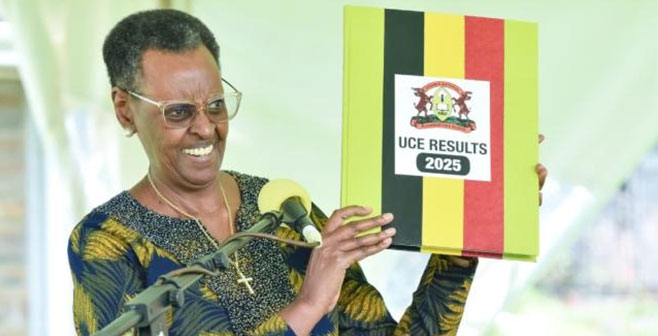
Commenting on the results, Education Minister Janet Kataha Museveni described the 2025 UCE outcomes as encouraging, noting that higher percentages of learners reached the defined competency levels compared to the 2024 cohort.
The minister attributed the improvement largely to evolving classroom practices, where teachers increasingly serve as facilitators of learning rather than sole sources of knowledge. She added that sustained implementation of the competence-based curriculum, coupled with growing teacher familiarity with its requirements, will be critical in consolidating and enhancing learner performance in future examinations.
A total of 432,163 candidates from 3,975 examination centres registered for the 2025 UCE examinations, up from 359,417 in 2024, an increase of 72,746 candidates, representing 20.2 per cent growth.
Of those registered, 204,292 (47.3 per cent) were male, while 227,871 (52.7 per cent) were female. Candidates under the Universal Secondary Education (USE) programme numbered 154,642 (35.8 per cent), while 277,521 (64.2 per cent) were non-USE beneficiaries.
In total, 429,949 candidates (99.5 per cent) sat the examinations in 2025, compared to 357,120 in 2024. Only 2,214 candidates (0.5 per cent) were absent. The absenteeism rate continued its downward trend, maintaining the improvement recorded in the previous year.
****
URN