The Independent Uganda: You get the Truth we Pay the Price


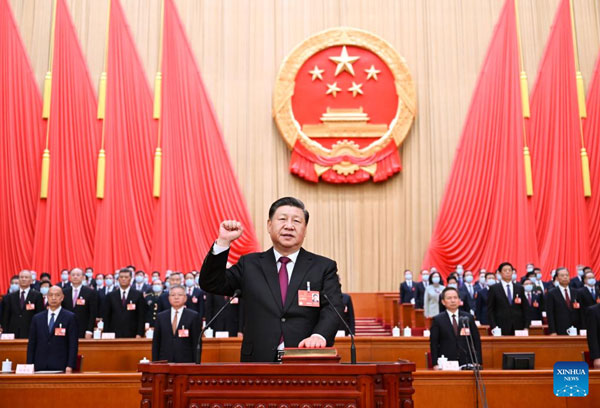
COMMENT | NNANDA KIZITO SSERUWAGI | Chinese President Xi Jinping, is one of the most consequential world leaders of our time. Both his leadership style and ideological persuasion are unique. He features distinctively, even when compared to former Chinese leaders in recent memory. His worldview – the ideological and thought system he has shaped to deeply respond to the challenges of this era – has been formally established as a systematic and complete theoretical framework. Even within the Chinese Communist Party (CCP), one of the strongest political parties in the history of politics, his governance thought has gained significance and become systematised in the shortest period of any previous leader. His personal grasp over China’s political dispensation can only be compared to Mao Zedong and Deng Xiaoping’s strongman models. On the international stage, Xi is increasingly casting a broad shadow of influence over world affairs. Within the first five months of this year alone, he hosted almost all leaders of the most powerful countries in the world; many of them were courting him, rather than him courting them. His sense of historical mission and timely urgency has rarely been exhibited in a world leader.
In official Chinese government communication, Xi Jinping’s global vision is primarily described as “building a community with a shared future for mankind”. While at the Moscow State Institute of International Relations in 2013, Xi first propounded this vision to an international audience. He would later go on to elaborate, deepen and expand this idea while giving his work report to the 19th Communist Party of China (CPC) National Congress in October 2017.
In October 2017, this vision was enshrined in the Chinese Communist Party Constitution and later in the Constitution of the People’s Republic of China in March 2018. This elevated the idea from a passing slogan to a formal doctrine.
Xi wove this doctrine from his appreciation of two distinct philosophies. On one hand, he drew from the critique of the hegemonic capitalist world order provided by the Marxist-Leninist political philosophy. On the other hand, he was inspired by the philosophical idea of datong, which means “the great harmony” or “the great union”, based on classical Chinese political philosophy. Xi’s global vision challenges the existing Western-dominated international system, criticising it rightly as unjust and unsustainable in the long course of history. He is awake to the fact that the world is dynamic, constant in change, always progressing, regardless of whether other powers like it or not. His philosophy cultivates the emergence of a more pluralistic world order, where countries share equal sovereignty and follow the principle of non-interference in each other’s internal affairs to the letter. It also maintains the UN as the central authority in international affairs.
Xi Jinping’s global vision is operationalised through an architecture of four initiatives: the Belt and Road Initiative (BRI), the Global Civilisation Initiative (GCI), the Global Security Initiative (GSI) and the Global Development Initiative (GDI). Last year, in 2025, Xi also unveiled the Global Governance Initiative (GGI) to complement the first four initiatives.
The earliest initiative under his vision was the BRI, which he launched in 2013, with a goal to tether global trade networks to the Chinese economy through building physical and digital infrastructure to link the continents of Asia, Europe, Africa, and Latin America. He followed it with the GDI in 2021 with a key focus on Economic Growth & Green Transition. The priorities underlying this initiative include poverty alleviation, food security, and green technology cooperation.
In 2022, Xi launched the GSI, focusing keenly on National Sovereignty & Security. The prevailing principle under this initiative is the “indivisibility of security,” meaning that global security cannot be divided into military alliances (like NATO), since alliances usually draw countries which are not party to conflicts into war, resulting in senseless large-scale wars. The initiative also opposes such practices as unilateral sanctions.
With a goal to champion cultural relativism and governance, Xi unveiled the GCI in 2023. This initiative is informed by the understanding that there is no universal model for democracy and human rights. Different countries, based on sometimes diverse values, can have diverse political systems. A society does not have to mirror Western cultural values to be civilised.
Unveiled in September 2025, the GGI advocates for the principles of sovereign equality, international rule of law, multilateralism, a people-centred approach for universally beneficial outcomes, and pragmatism. Xi believes that if these principles are followed, we shall have just participation in global affairs by all countries, a fair global governance system, and solidarity and cooperation among all countries.
While America’s global hegemony expressed pride traditionally in such exclusive bodies like the G7, Xi Jinping’s vision behind the GGI seems to position China as primarily a champion of developing nations in the Global South. Whereas America and its allies are interested in maintaining the status quo, China is pushing for greater representation, extended voting power, and amplified voice for Global South nations within multilateral bodies like the United Nations. Xi’s vision centers multi-country collaboration to address global issues and achieve the modernisation of the underdeveloped countries of the world. He prefers consensus-driven, state-centric approaches to deal with the world.
For all criticisms levelled against Xi’s China, including claims of normalisation of authoritarian governance and the weakening of universal human rights protections, and creation of economic dependencies, I find his vision more persuasive and honest about how to pragmatically deal with a complex world.
***
 The writer is a Ugandan thinking about Uganda.